
Overview
The Histone Antibody Test is a blood test used to detect antibodies directed against histone proteins. Histones are structural proteins found inside the cell nucleus, where they help organize and package DNA so it can function normally within the cell.
In certain autoimmune conditions—most notably Systemic Lupus Erythematosus (SLE) and drug-induced lupus—the immune system may lose tolerance and begin producing antibodies against these histone proteins. When this happens, it signals immune-mediated tissue injury rather than infection.
This test therefore serves as an important laboratory tool in identifying autoimmune activity, particularly when lupus-like symptoms appear in a clinical setting.
Where Histone Proteins and Histone Antibodies Are Produced
Histone Proteins
Histone proteins are produced inside the nucleus of nearly every cell in the body. Their primary role is structural. By binding tightly to DNA, they help keep genetic material compact, organized, and protected, allowing normal cell function and division.
Histone Antibodies
Histone antibodies are produced by the immune system, mainly by B-lymphocytes, when immune regulation becomes disturbed. Instead of recognizing histones as normal cellular components, the immune system mistakenly treats them as foreign.
This abnormal immune response is most commonly seen in conditions such as SLE, drug-induced lupus, and some related autoimmune disorders.
Importance of the Histone Antibody Test
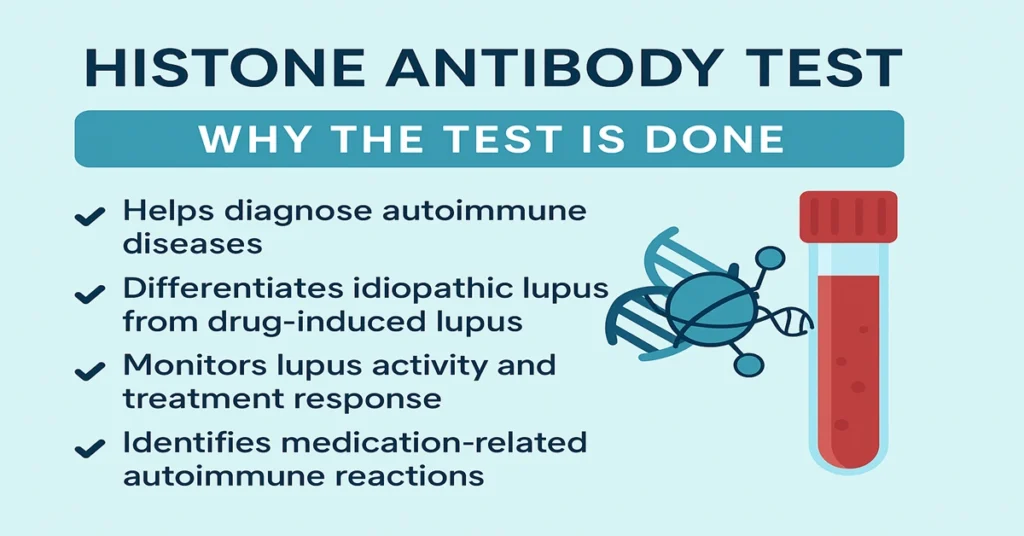
✔ 1. Helps Diagnose Autoimmune Diseases
The test supports the diagnosis of autoimmune conditions in which the immune system targets nuclear components, particularly histone proteins.
✔ 2. Differentiates SLE from Drug-Induced Lupus
This is one of the most clinically useful roles of the test.
In drug-induced lupus, histone antibodies are often strongly positive.
In idiopathic (naturally occurring) lupus, histone antibodies may also be present, but they usually appear alongside other autoantibodies.
✔ 3. Monitors Lupus Activity
In patients already diagnosed with lupus, changes in histone antibody levels may reflect shifts in immune activity. Falling levels are often seen when the disease becomes less active.
✔ 4. Helps Identify Medication-Related Autoimmune Reactions
Certain medications can trigger lupus-like immune responses. The histone antibody test helps clinicians recognize this pattern early and distinguish it from primary autoimmune disease.
Causes of Low or Negative Histone Antibody Levels
A low or negative result means that histone antibodies are absent or present only at very minimal levels. This usually suggests that the immune system is not reacting against histone proteins.
Such a result makes drug-induced lupus unlikely and lowers the probability of lupus related to histone-directed autoimmunity. In patients already diagnosed with lupus, low levels may be seen when the condition is stable or well controlled.
Symptoms When Results Are Negative
When histone antibodies are not detected, there are typically no symptoms related to histone-directed autoimmunity.
If symptoms are present, they are more likely due to another condition and require evaluation through other clinical findings and laboratory tests. Negative results are generally reassuring in this context.
Causes of High or Positive Histone Antibody Levels
A positive result indicates that the immune system is actively producing antibodies against histone proteins. This finding is most commonly associated with:
1. Drug-Induced Lupus (Most Common)
This form of lupus is linked to certain medications, including hydralazine, procainamide, isoniazid, minocycline, quinidine, and methyldopa. In these cases, histone antibodies are frequently prominent.
2. Systemic Lupus Erythematosus (SLE)
Histone antibodies may also be present in idiopathic lupus, although they are not as specific as in drug-induced cases.
3. Other Autoimmune Disorders
Occasionally, histone antibodies can be detected in conditions such as rheumatoid arthritis, scleroderma, or mixed connective tissue disease.
4. Rare Situations
Infrequently, chronic infections or certain malignancies may produce non-specific or false-positive results.
Symptoms Seen When Histone Antibody Levels Are High
Symptoms are not caused by the antibodies themselves but by the underlying autoimmune process. These may vary depending on the condition involved and commonly include joint discomfort, muscle aches, fatigue, skin rashes, low-grade fever, and sensitivity to sunlight.
In drug-induced lupus, symptoms often resemble lupus but tend to be milder and more limited in organ involvement compared with idiopathic SLE.
Reference Ranges
Typical laboratory reference values (which may vary slightly between labs) are:
Negative: less than 1.0 units, indicating no detectable histone antibodies
Equivocal: 1.0 to 1.5 units, considered borderline and sometimes repeated
Positive: greater than 1.5 units, indicating the presence of histone antibodies
These values are always interpreted alongside symptoms and other autoimmune markers.
Sample Type Used
The test is performed on a blood sample (serum) collected from a vein, usually in the arm. The serum is then analyzed for the presence of histone antibodies.
How the Histone Antibody Test Helps Doctors
This test helps clinicians confirm autoimmune activity, distinguish drug-induced lupus from primary lupus, avoid unnecessary investigations, and monitor immune trends over time. It supports clinical decision-making rather than acting as a standalone diagnostic test.
Test Preparation
No special preparation is usually required. Patients should inform their doctor about all current and recent medications, particularly drugs known to trigger lupus-like reactions. Medications should not be stopped unless advised by a healthcare professional. Known autoimmune diagnoses should also be shared for accurate interpretation.
When to Consult a Doctor
Medical advice is recommended if symptoms such as unexplained joint pain, persistent fatigue, recurring rashes, sun sensitivity, or fever without clear infection occur—especially if symptoms begin after starting a new medication. Sudden worsening of symptoms after exposure to high-risk drugs should prompt timely medical evaluation.
Important Word Explanations
- Histones – Proteins inside the cell nucleus that organize DNA
- Antibodies – Proteins produced by the immune system
- Autoimmune Disease – A condition in which the immune system attacks the body’s own tissues
- Drug-Induced Lupus – A lupus-like condition triggered by certain medications
- B-Lymphocytes – Immune cells responsible for antibody production
- Equivocal – A borderline test result
- Serum – The clear liquid portion of blood used for laboratory testing
~END~
Related Posts
None found