
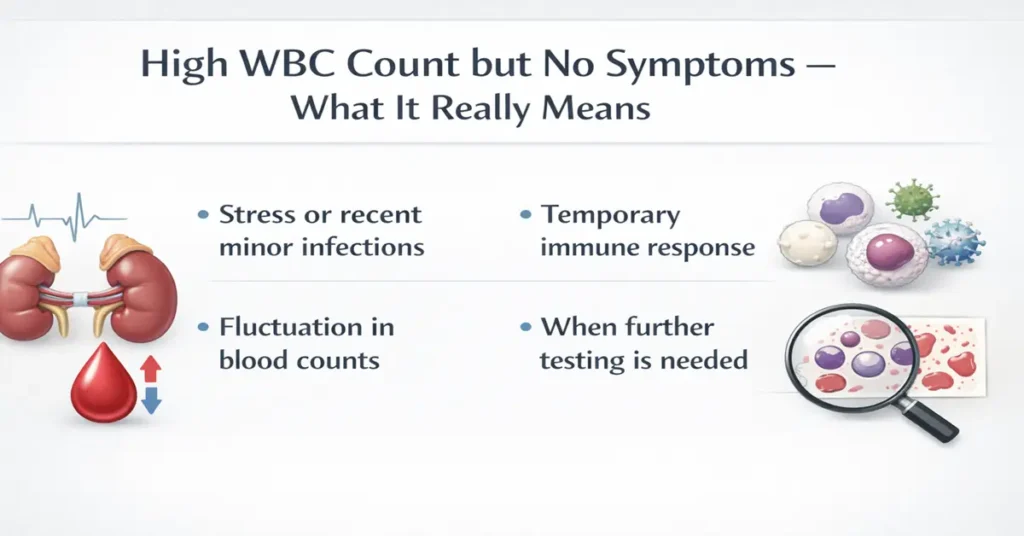
WBC Count High but No Symptoms
If you’ve received a blood report showing high WBC count but you feel completely fine, you are not alone. I see this situation almost every day in the lab and OPD. Patients walk in worried because the report looks “abnormal,” yet there is no fever, no weakness, no pain, and no illness they can point to. This article is written exactly for that confusion.
Let me explain this calmly, practically, and honestly—based on real lab experience, not textbook fear.
Why this report combination causes confusion
Most people expect blood test abnormalities to come with symptoms. So when a report shows elevated WBC count and the person feels normal, it creates doubt and anxiety. Patients often ask:
“Is something serious going on inside my body?”
“Why is my WBC high if I’m not sick?”
“Do I need medicines or more tests immediately?”
From lab experience, this combination is very common and often harmless, especially when found during routine testing.
What a senior lab technician notices first in such reports
When I see a high WBC count without symptoms, I don’t jump to conclusions. Clinically, doctors and lab professionals look at context, not just the number.
We usually ask:
- Was the test done during stress, travel, or lack of sleep?
- Was there recent fever, cough, cold, or infection—even if it has already settled?
- Was the sample taken early morning, after exercise, or during anxiety?
- Is this a first-time finding or a repeated one?
In many routine cases, the answer explains the report.
Real-world reasons why WBC can be high without symptoms
This is not a “causes list,” but practical lab-based explanations.
Body response without illness
Your immune system can become active even when you don’t feel sick. Mild immune responses don’t always produce symptoms. The body may already be handling something minor silently.
From lab experience, this is seen:
- After a recent minor infection that has already resolved
- During recovery phase
- After vaccination
- During allergic responses that are mild
The report catches the immune activity, but the body has already balanced things out.
Stress-related elevation is very common
Mental stress, anxiety, poor sleep, and physical exhaustion can temporarily increase WBC count. I’ve seen this clearly in:
- People tested before surgeries
- Patients anxious about reports
- Individuals tested after long travel or night shifts
Once stress settles, WBC often returns to baseline without treatment.
Temporary physiological variation
Blood values are not fixed numbers. They fluctuate.
In routine OPD testing, mild WBC elevation is often:
- A normal variation
- Temporary
- Not linked to disease
This is why doctors don’t react to a single report unless there is a pattern.
Why doctors usually don’t panic in this situation
Clinically, a high WBC count without symptoms is not treated as an emergency finding.
Doctors usually:
- Correlate with clinical condition
- Check differential count (types of WBCs)
- Compare with previous reports if available
- Decide whether follow-up is needed or not
In most routine cases, no immediate treatment is started.
When high WBC is usually harmless
From years of lab and OPD experience, this situation is usually harmless when:
- The patient feels well
- There is no fever or infection signs
- Other blood parameters are stable
- WBC elevation is mild or moderate
- It is a first-time finding
In such cases, doctors often advise observation or repeat testing later.
When attention is needed even without symptoms
Although uncommon, sometimes doctors do pay closer attention.
Extra attention is given when:
- WBC count is very high
- The value keeps rising on repeat tests
- There are abnormal changes in WBC types
- The elevation persists for weeks
- Other blood counts are also abnormal
Even then, this does not mean something serious—but it means further evaluation, not panic.
How repeat testing is usually handled
Repeat testing is one of the most practical tools in lab medicine.
From experience:
- Doctors often advise repeat CBC after 1–3 weeks
- Many times, WBC normalizes on its own
- No medicines are needed before repeating
- Testing is done when the patient is relaxed and well
Repeat testing helps differentiate between temporary variation and persistent change.
What patients should avoid doing after seeing this report
One common mistake I see is self-diagnosis.
Patients often:
- Google worst-case scenarios
- Start antibiotics on their own
- Panic unnecessarily
- Repeat tests daily without advice
This is not helpful and often creates more confusion than clarity.
What doctors actually focus on, not just the number
Clinically, doctors interpret reports by looking at:
- Overall clinical picture
- Differential WBC pattern
- Past medical history
- Recent infections or stress
- Physical examination
A lab report is only one piece of the puzzle, not the full story.
Why symptoms matter more than numbers
From real practice, symptoms guide decisions more than isolated lab values.
If there are:
- No complaints
- Normal daily activity
- No unexplained weight loss
- No persistent fever
Doctors are reassured, even if a value is slightly out of range.
Common reassurance I give patients in OPD
I often tell patients:
“A report shows what the body is doing today, not what it will do tomorrow.”
“One abnormal value without symptoms is not a diagnosis.”
“We observe trends, not single numbers.”
This reassurance is based on experience, not guesswork.
Test Preparation
For repeat testing or routine monitoring:
- Try to be well-rested before the test
- Avoid heavy exercise just before blood collection
- Inform the doctor about recent infections or stress
- Follow the same lab for repeat tests if possible
- Stay hydrated unless told otherwise
Proper preparation helps avoid misleading variations.
When to Consult a Doctor
Consult your doctor if:
- WBC remains high on repeated tests
- You develop fever, weakness, or unexplained symptoms
- There is a sudden change in health status
- Other blood parameters also become abnormal
- Your doctor advises further evaluation
If you feel well and your doctor is not concerned, trust the clinical judgment.
Important Word Explanations
WBC (White Blood Cells)
Cells that help the body fight infections and respond to immune activity.
CBC (Complete Blood Count)
A blood test that measures different components of blood, including WBCs.
Differential Count
Breakdown of different types of white blood cells.
Physiological Variation
Normal changes in body values that happen naturally.
Repeat Testing
Rechecking blood values after some time to observe trends.
People Also Ask
Can WBC be high due to stress alone?
Yes, stress can temporarily increase WBC count without illness.
Is high WBC without fever dangerous?
In most routine cases, no. Doctors look at symptoms and trends.
Should I take antibiotics for high WBC?
Not unless prescribed by a doctor after clinical evaluation.
How long does it take for WBC to normalize?
Often within a few weeks if the cause is temporary.
Is one high report enough to diagnose a problem?
No. Diagnosis is never based on a single report alone.
~END~