
Causes and Symptoms of High Alpha-1 Antitrypsin (A1AT) Levels
Alpha-1 Antitrypsin (A1AT) is an important protective protein in the human body. While low A1AT levels are widely discussed because of their clear link with genetic deficiency and lung disease, high A1AT levels are also clinically meaningful and deserve proper attention. In routine practice, elevated A1AT almost always reflects an underlying inflammatory or disease process rather than a condition that needs direct correction.
This article explains why A1AT levels become high, what symptoms may be seen, how doctors interpret these findings, and why treatment is usually focused on the underlying cause rather than the A1AT level itself.
Understanding High A1AT Levels
Alpha-1 Antitrypsin is produced mainly by the liver and released into the bloodstream. Its primary function is to protect lung tissue from damage caused by inflammatory enzymes released during infections or immune responses.
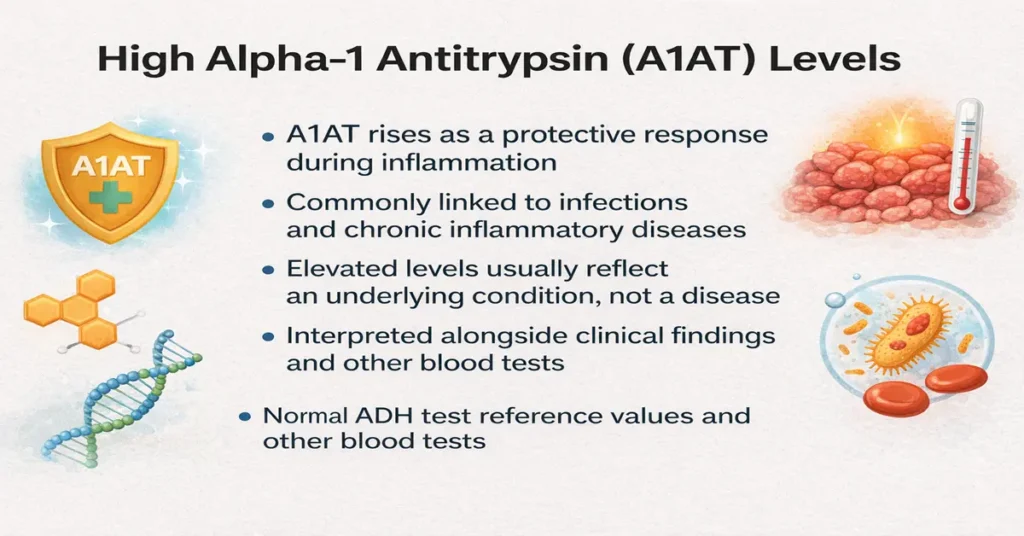
Clinically, A1AT behaves as an acute-phase reactant. This means that whenever the body is under stress—such as infection, inflammation, tissue injury, or systemic illness—the liver increases A1AT production as a protective response. Because of this, high A1AT levels are usually a signal that something inflammatory is happening somewhere in the body.
This is an important distinction. Unlike low A1AT levels, which often point toward a genetic deficiency, high A1AT levels usually do not represent a disease of the protein itself. They are best understood as a marker, not a diagnosis.
Major Causes of High A1AT Levels
In real-world lab practice, elevated A1AT levels are almost always secondary to another condition. Identifying that condition is far more important than focusing on the number alone.
Acute and chronic infections
Bacterial and viral infections commonly raise A1AT levels. Respiratory infections, pneumonia, urinary infections, and systemic infections can all cause temporary elevation as part of the body’s immune response.
Chronic inflammatory conditions
Autoimmune and inflammatory diseases such as rheumatoid arthritis, inflammatory bowel disease, and various vasculitic conditions can lead to persistently high A1AT levels due to ongoing immune activity.
Liver and biliary conditions
Because A1AT is synthesized in the liver, liver-related disorders can influence its levels. Hepatitis, fatty liver disease, and bile duct obstruction may be associated with increased A1AT production as a compensatory response.
Malignancy and tissue injury
Certain cancers, major trauma, surgery, burns, or extensive tissue damage can elevate A1AT as part of the body’s protective and inflammatory response.
Pregnancy and hormonal influence
During pregnancy, A1AT levels may rise due to hormonal changes and increased protein synthesis by the liver. This rise is considered physiological and usually not harmful.
Severe stress and systemic illness
Severe physical stress, prolonged illness, or systemic inflammatory states can temporarily increase A1AT levels without indicating a primary disorder of the protein.
Symptoms That Commonly Appear
High A1AT levels themselves do not cause symptoms. In practice, patients feel symptoms related to the underlying condition that triggered the elevation.
Depending on the cause, symptoms may include fatigue, fever, or general weakness during infections; joint pain and stiffness in inflammatory diseases; abdominal discomfort or jaundice in liver-related conditions; or unexplained weight loss and reduced appetite in chronic systemic illness.
Because these symptoms are non-specific, an elevated A1AT value alone never confirms a diagnosis. Clinically, this is where doctors pause and correlate lab findings with history, examination, and other tests.
Complications of Long-Term High A1AT Levels
Persistently high A1AT levels are not considered toxic or dangerous by themselves. The real concern lies in what the elevation represents.
If ignored, underlying inflammatory or liver diseases may progress silently. Chronic immune activation can lead to tissue damage, organ dysfunction, or delayed diagnosis of serious conditions. In rare situations, high A1AT levels during inflammation may temporarily mask an underlying genetic A1AT deficiency, which is why further testing may be needed in selected cases.
In routine practice, the complication is not the high protein level, but missing the disease driving it.
How High A1AT Levels Are Managed Safely
There is no medical indication to directly lower A1AT levels. A1AT is a protective protein, and attempting to reduce it artificially can be harmful.
The correct and safe approach is always to address the underlying cause. When infection resolves, inflammation settles, or the primary disease is treated, A1AT levels usually fall back into the normal range on their own.
There is no approved diet, supplement, or lifestyle method specifically meant to lower A1AT levels. Any treatment decisions are guided by the condition responsible for the elevation, not the A1AT value itself.
Additional Information
High A1AT levels can sometimes confuse interpretation if clinical context is ignored. For example, a patient with no lung disease may show high A1AT during a mild infection. On the other hand, a person with genetic A1AT deficiency may show normal or even high levels during inflammation, temporarily masking the deficiency.
Because of this, doctors may request additional tests such as A1AT phenotyping or genotyping when deficiency is suspected despite apparently normal or high levels.
Test Preparation
The A1AT test usually requires minimal preparation. Fasting is not required unless other blood tests are ordered together. Patients should inform the doctor or laboratory about recent infections, inflammatory conditions, pregnancy, or chronic illness, as these can influence interpretation.
If the test is being done to screen for genetic deficiency, doctors may prefer testing when there is no active infection or inflammation.
When to See a Doctor
Medical advice should be sought if A1AT levels remain persistently high without a clear explanation, if there are ongoing symptoms of inflammation or liver disease, or if there is a family history of A1AT deficiency. Consultation is also important when test results do not match clinical symptoms.
Sample Type
A1AT testing is performed on a blood (serum) sample collected from a peripheral vein. The protein is stable in serum, allowing reliable laboratory measurement.
Important Word Explanations
Alpha-1 Antitrypsin (A1AT): A protective protein made by the liver that prevents enzyme-related tissue damage, especially in the lungs
Acute-phase reactant: A substance whose blood level increases during inflammation or infection
Inflammation: The body’s immune response to injury, infection, or disease
Phenotyping: A laboratory test that identifies different forms of the A1AT protein
Genotyping: A genetic test used to detect mutations in the A1AT gene
People Also Ask
Is a high A1AT level serious?
Not by itself. It usually reflects inflammation or infection rather than a harmful condition of the protein.
Can high A1AT levels be temporary?
Yes. Levels often rise temporarily during infections, stress, or inflammation and return to normal afterward.
Does high A1AT always mean disease?
No. It often means the body is responding to stress or inflammation, not that there is a primary A1AT disorder.
When do doctors usually worry about high A1AT?
When levels stay high without explanation or when symptoms suggest underlying liver or inflammatory disease.
Is repeat testing common for high A1AT?
Yes. Repeat testing may be done after recovery from illness or to clarify unclear results.
Can high A1AT hide a genetic deficiency?
In rare cases, yes. During inflammation, levels may appear normal or high, so additional testing may be needed.
~END~