
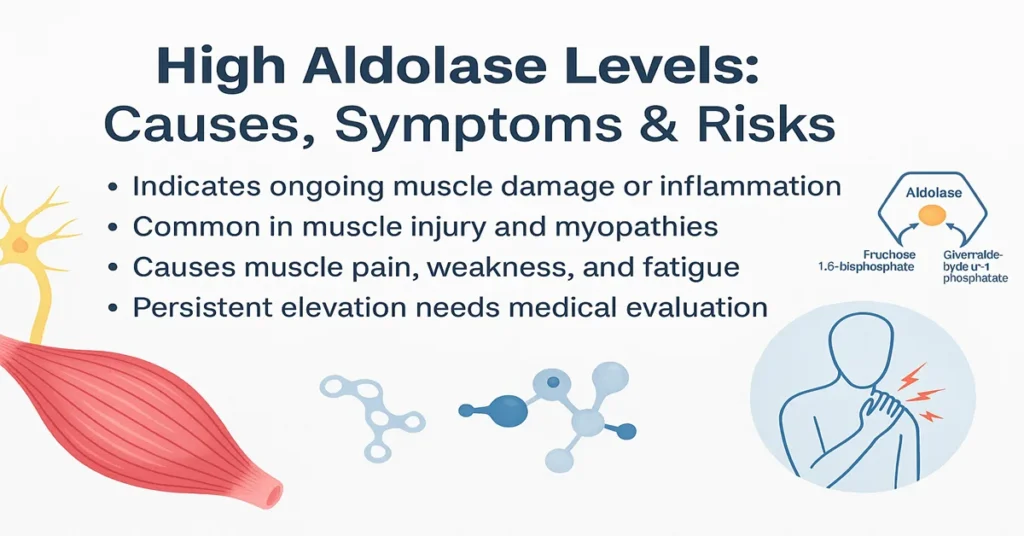
Causes and Symptoms of High Aldolase Levels
Understanding High Levels
Aldolase is a metabolic enzyme that plays an essential role in energy production, especially inside muscle cells. It is part of glycolysis, the process through which glucose is broken down to release energy needed for muscle movement and daily activity. Aldolase is found mainly in skeletal muscles, heart muscle, and to a lesser extent in the liver. In healthy individuals, only a small amount of this enzyme is detectable in the blood.
When aldolase levels are high, it usually means that muscle cells are being damaged or stressed. As muscle fibers break down or become inflamed, aldolase leaks into the bloodstream. Clinically, this result makes doctors pause and think about muscle involvement rather than a problem with the enzyme itself.
High aldolase is therefore considered a marker of muscle injury or muscle disease. It is not influenced much by food intake and is interpreted mainly in relation to muscle health, symptoms, and other laboratory findings.
Major Causes of High Levels
The most common cause of raised aldolase levels is muscle damage. This damage may be obvious, such as after an injury or accident, or subtle, such as after intense or unaccustomed physical activity. In routine lab practice, temporary elevation is often seen after heavy exercise, long-distance running, or weight training.
Inflammatory muscle diseases are an important cause of persistently high aldolase levels. Conditions like polymyositis and dermatomyositis involve immune-mediated inflammation of muscle tissue, leading to ongoing muscle fiber breakdown and enzyme release.
Inherited muscle disorders, including muscular dystrophies, can also cause elevated aldolase. In these conditions, muscle weakness progresses slowly, and enzyme levels may remain high even without recent injury.
Systemic illnesses may indirectly affect muscle tissue. Severe infections, prolonged inflammatory states, or autoimmune diseases can involve muscles and contribute to raised aldolase levels. Liver disease may cause mild changes, but muscle remains the primary source of elevation.
Certain medications are another consideration. Drugs that affect muscle metabolism, such as statins or long-term corticosteroids, can sometimes lead to muscle injury and increased aldolase levels. This is why medication history is always reviewed alongside test results.
Symptoms That Commonly Appear
High aldolase levels themselves do not cause symptoms. The symptoms come from the underlying muscle condition responsible for the elevation.
Many people experience muscle weakness, especially in large muscles such as the thighs, hips, shoulders, and upper arms. Tasks like climbing stairs, getting up from a chair, lifting objects, or raising the arms may become difficult.
Muscle pain, stiffness, or tenderness is also common, particularly after activity. Fatigue and reduced stamina are frequent complaints, and patients often describe feeling tired even with routine daily tasks.
In inflammatory muscle diseases, weakness usually develops gradually over weeks or months rather than suddenly. Some individuals notice problems with posture, holding the head upright, or maintaining balance.
If high aldolase is linked to a systemic illness, additional symptoms such as fever, weight loss, joint pain, or skin rashes may be present. Rarely, severe muscle breakdown may cause dark-colored urine and dehydration, which requires urgent medical attention.
Complications of Long-Term High Levels
Persistently high aldolase levels suggest ongoing muscle damage. Over time, this can lead to progressive muscle weakness and loss of muscle mass, affecting mobility and independence.
In advanced muscle disorders, muscles involved in breathing may weaken, leading to shortness of breath or reduced exercise tolerance. Swallowing muscles may also be affected, increasing the risk of choking or aspiration.
Severe and prolonged muscle breakdown can strain the kidneys due to the release of muscle proteins into the bloodstream. Although this is uncommon, it is a serious complication when it occurs.
Doctors often look at aldolase together with other muscle enzymes such as creatine kinase (CK). Patterns across these tests help assess disease severity and monitor progression.
How to Reduce Levels Safely
Aldolase levels should never be targeted directly. There are no safe home remedies or supplements that specifically lower aldolase. The correct and safe approach is to address the underlying cause of muscle injury.
If the elevation is related to physical overexertion, rest and gradual return to activity usually allow muscles to recover and enzyme levels to normalize. Clinically, this is one of the most common and least concerning scenarios.
When medications are suspected, doctors may adjust the dose or change the drug if appropriate. This decision is always individualized and based on risk–benefit assessment.
For inflammatory or autoimmune muscle diseases, treatment focuses on controlling inflammation under specialist supervision. As muscle damage settles, aldolase levels usually come down.
Trying to self-treat without understanding the cause can delay diagnosis and may worsen muscle injury, so medical guidance is essential.
Additional Information
High aldolase levels are rarely interpreted in isolation. Doctors usually order this test along with creatine kinase (CK), lactate dehydrogenase (LDH), liver enzymes, and sometimes inflammatory markers.
Mild elevations may be temporary, especially after exercise, while persistent or significantly high values often prompt further evaluation. In selected cases, imaging studies, electromyography, or muscle biopsy may be considered.
It is equally important to remember that normal aldolase levels do not completely rule out muscle disease. Clinical symptoms and examination remain central to diagnosis.
Test Preparation
No special preparation is usually required for an aldolase test. Patients are commonly advised to avoid strenuous exercise for 24 to 48 hours before sample collection to prevent false elevation.
Always inform the healthcare provider about recent injuries, exercise habits, medications, and existing medical conditions. Fasting is not required unless the test is combined with other investigations.
When to See a Doctor
You should consult a doctor if high aldolase levels are associated with persistent muscle weakness, muscle pain, stiffness, or unexplained fatigue.
Urgent medical attention is needed if there is severe muscle pain, sudden weakness, dark urine, or difficulty breathing or swallowing.
People with known muscle or autoimmune disorders should follow up regularly if aldolase levels remain elevated.
Sample Type
The aldolase test is performed using a blood sample, usually drawn from a vein in the arm and analyzed in a laboratory.
Important Word Explanations
Aldolase: An enzyme involved in breaking down glucose for energy, mainly found in muscle tissue.
Glycolysis: The process by which glucose is converted into energy.
Myopathy: A disease affecting muscle fibers that leads to weakness.
Creatine Kinase (CK): A muscle enzyme often tested alongside aldolase.
Autoimmune Disease: A condition in which the immune system attacks the body’s own tissues.
People Also Ask
Is a high aldolase level serious?
It can be, but not always. Mild elevations may occur after exercise, while persistent high levels usually need medical evaluation.
Can aldolase levels be temporarily high?
Yes. Recent strenuous activity, muscle strain, or injury can cause temporary increases.
Does high aldolase always mean muscle disease?
No. It signals muscle involvement but does not by itself confirm a specific disease.
When do doctors usually worry about aldolase levels?
When levels stay high over time and match symptoms like ongoing weakness or pain.
Is repeat testing common for high aldolase?
Yes. Repeat tests help determine whether the elevation is temporary or persistent.
Can aldolase return to normal on its own?
In many cases, yes, especially if the cause is temporary muscle strain or injury.
~END~