
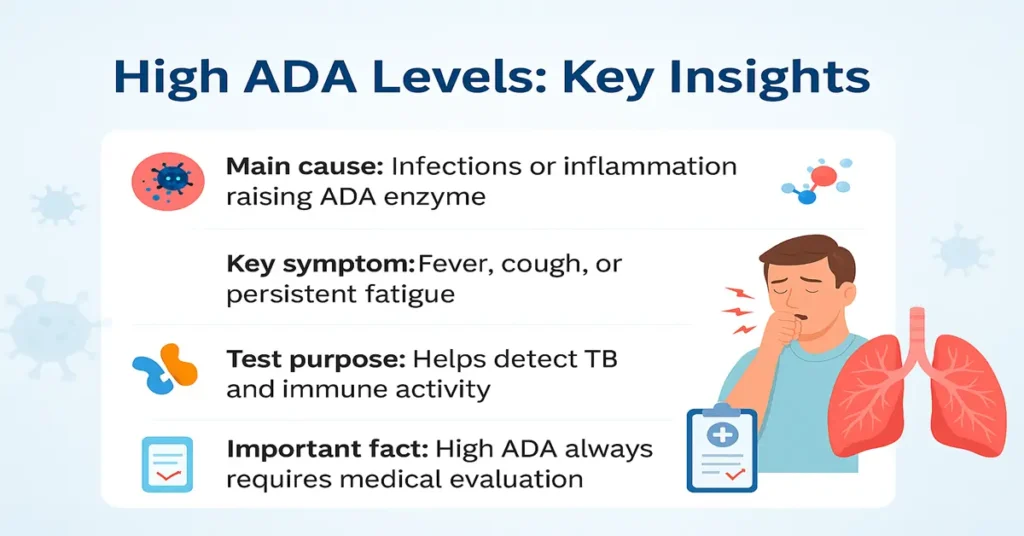
Causes and Symptoms of High ADA Level
Understanding High Levels
Adenosine Deaminase (ADA) is an enzyme present in many tissues, with particularly high activity in immune cells. Its role is closely tied to immune response and inflammation. When ADA levels rise above the expected range, it usually reflects increased immune activity rather than a disease by itself. In everyday clinical practice, high ADA is most commonly discussed in relation to tuberculosis, especially when measured in pleural fluid. That said, elevated ADA can also be seen in other infections, inflammatory conditions, and certain cancers.
Clinically, a raised ADA value is treated as a clue, not a conclusion. Doctors pause at this result and then correlate it with symptoms, imaging findings, and other laboratory tests. The meaning of high ADA always depends on where it is measured (blood or body fluid) and why the test was ordered in the first place.
Major Causes of High ADA Levels
Several conditions can lead to increased ADA activity. Each cause reflects immune system stimulation rather than direct enzyme overproduction.
Tuberculosis (Most Common Cause)
Tuberculosis is the most frequent and clinically important cause of high ADA, particularly in pleural fluid. TB strongly activates immune cells, leading to increased ADA release. In routine practice, a high pleural fluid ADA significantly raises suspicion of TB, especially when supported by symptoms and imaging.
Other Infections
Chronic or severe infections can also elevate ADA. These include bacterial infections, viral hepatitis, and long-standing respiratory infections. In such cases, ADA rises as part of the body’s immune defense.
Inflammatory and Autoimmune Disorders
Conditions like rheumatoid arthritis, systemic lupus, and sarcoidosis can cause persistent immune activation. ADA levels may increase moderately, reflecting ongoing inflammation rather than infection.
Certain Cancers
Some malignancies, particularly lymphomas and cancers involving the lymphatic or bone marrow systems, may show elevated ADA. This usually happens because of immune system involvement or secondary inflammation.
Liver Disorders
Chronic liver diseases such as hepatitis or cirrhosis may occasionally raise ADA levels. The elevation is usually mild and interpreted along with liver function tests.
Fluid Accumulation in Body Cavities
When ADA is measured in pleural, peritoneal, pericardial, or cerebrospinal fluid, infections, malignancy, or chronic inflammation in these spaces can lead to high values.
Symptoms That Commonly Appear
High ADA itself does not cause symptoms. The clinical picture depends entirely on the underlying condition responsible for immune activation.
Symptoms Often Seen in Tuberculosis
Patients may have a persistent cough, chest pain, fever, night sweats, weight loss, and fatigue. Breathlessness can occur if fluid accumulates around the lungs.
Symptoms Related to Infections
Fever, weakness, body aches, poor appetite, and localized pain are common. These symptoms reflect infection rather than the ADA rise itself.
Inflammatory Disease Symptoms
Joint pain, stiffness, swelling, skin rashes, and long-standing fatigue may be present when autoimmune or inflammatory disorders are involved.
Cancer-Related Symptoms
Unexplained weight loss, persistent fatigue, night sweats, and enlarged lymph nodes may appear if the elevation is linked to malignancy.
Because symptoms vary widely, ADA results are always interpreted in combination with clinical findings.
Complications of Long-Term High Levels
Persistently high ADA usually indicates an untreated or ongoing underlying condition. The risks come from the cause, not from ADA itself.
Delayed diagnosis can allow infections like tuberculosis to progress and spread. Chronic inflammation may gradually damage organs such as the lungs, joints, or liver. If malignancy is involved, delayed evaluation can lead to disease progression. Recurrent or unresolved symptoms can significantly affect quality of life.
Monitoring ADA trends helps doctors judge whether a condition is improving or worsening over time.
How to Reduce Levels Safely
There is no safe or effective home method to directly lower ADA levels. Because ADA reflects immune activity, the only appropriate way to reduce it is by treating the underlying cause.
Treating Infections
Appropriate antimicrobial therapy for TB or other infections gradually reduces immune activation and brings ADA down.
Managing Inflammatory Disorders
Autoimmune or inflammatory diseases are managed with medications that control immune overactivity. As inflammation settles, ADA levels often decline.
Cancer Management
When ADA elevation is linked to malignancy, cancer-specific treatment addresses the root cause.
Managing Liver Disease or Fluid Collections
Treating liver conditions or managing fluid accumulation helps normalize associated enzyme changes.
Any attempt to “lower” ADA without medical supervision is unsafe and ineffective.
Additional Information
ADA testing is especially valuable in TB-endemic regions, but even there, it is never used alone for diagnosis. High ADA supports a diagnosis only when imaging, microbiology, and clinical features point in the same direction.
The significance of ADA also depends on the sample type. Blood ADA and pleural fluid ADA have very different clinical meanings, which is why reports always specify the specimen and reference range.
Test Preparation
ADA testing generally requires no special preparation. Patients should inform their doctor about recent infections, TB exposure, ongoing medications (especially steroids or immunosuppressants), and current symptoms. Normal eating and drinking are usually allowed.
When to See a Doctor
Medical evaluation is advised if you experience persistent fever, chronic cough, chest discomfort, unexplained weight loss, recurrent infections, or swollen lymph nodes. A high ADA result should always be discussed with a doctor to determine the cause and next steps.
Sample Type
ADA can be measured in blood serum as well as in body fluids such as pleural, peritoneal, pericardial, or cerebrospinal fluid. The interpretation depends heavily on the sample type, with pleural fluid ADA being most commonly used in TB evaluation.
Important Word Explanations
Adenosine Deaminase (ADA): An enzyme involved in immune cell activity.
Pleural Fluid: Fluid present around the lungs.
Inflammation: The body’s response to infection or injury.
Lymphoma: A cancer arising from immune system cells.
Immune Activation: Increased activity of immune cells during disease.
People Also Ask
Is a high ADA level serious?
It depends on the cause. The value itself is not dangerous, but it may point to a condition that needs treatment.
Can ADA levels be temporarily high?
Yes. Acute infections or inflammation can cause temporary increases that return to normal once resolved.
Does high ADA always mean tuberculosis?
No. TB is a common cause, especially in pleural fluid, but other infections and inflammatory conditions can also raise ADA.
When do doctors usually worry about high ADA?
When it is significantly elevated and matches symptoms or imaging findings suggestive of serious disease.
Is repeat ADA testing common?
Yes. Doctors often repeat the test to monitor trends and response to treatment rather than relying on a single result.
Can blood ADA and pleural fluid ADA mean the same thing?
No. The clinical interpretation differs based on the sample type and the patient’s symptoms.
~END~
Great info.