
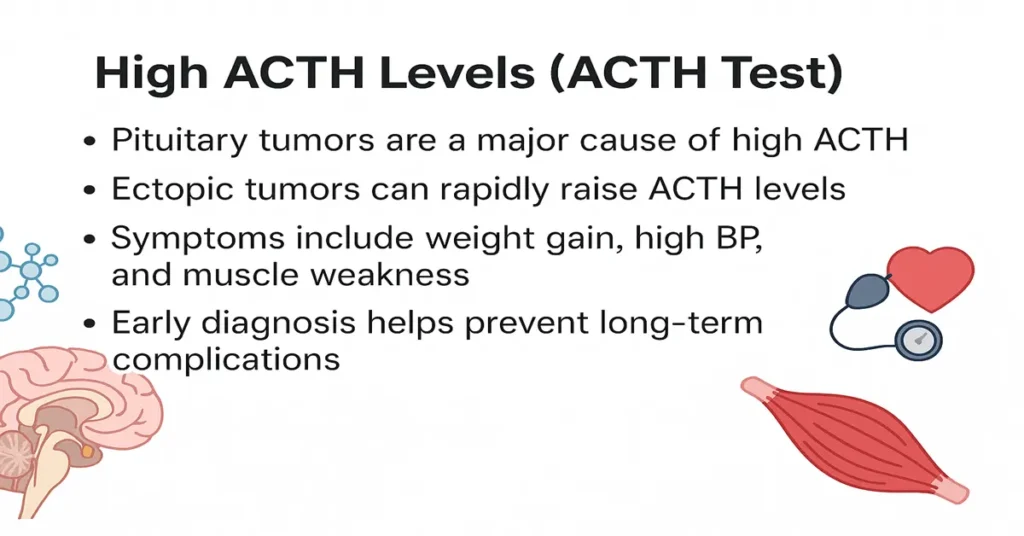
Causes and Symptoms of High ACTH Levels
Understanding High Levels
Adrenocorticotropic hormone (ACTH) is produced by the pituitary gland and plays a central role in controlling cortisol production by the adrenal glands. Cortisol is essential for regulating metabolism, blood pressure, stress response, and immune balance. When ACTH levels rise above normal, it usually signals that the body is trying to correct a hormonal imbalance or that hormone regulation has gone off track.
In clinical practice, high ACTH is not viewed as a condition by itself. It is a biochemical clue. Doctors see it as a signal that the pituitary–adrenal axis needs closer evaluation. In many cases, elevated ACTH leads to increased cortisol levels, but in some situations, cortisol remains low despite high ACTH. Understanding this distinction is important because it guides diagnosis and management.
Prolonged elevation of ACTH matters because long-term cortisol imbalance can slowly affect multiple organs. That is why identifying the cause early helps prevent complications rather than reacting once symptoms become severe.
Major Causes of High ACTH Levels
High ACTH levels can arise from different mechanisms, and the context in which the elevation occurs is crucial for interpretation.
Cushing’s disease (pituitary ACTH overproduction)
This is one of the most common causes seen in endocrinology practice. A benign pituitary tumor produces excess ACTH, which continuously stimulates the adrenal glands. Over time, this leads to excess cortisol production. Clinically, symptoms often develop gradually, making early diagnosis challenging.
Ectopic ACTH–producing tumors
In some cases, tumors outside the pituitary gland, often in the lungs or pancreas, produce ACTH independently. This condition is known as ectopic ACTH syndrome. ACTH levels in these cases are often very high, and symptoms tend to progress rapidly.
Chronic stress or severe illness
Physical or emotional stress can temporarily increase ACTH levels as part of the body’s normal stress response. In routine lab practice, this rise is usually mild and short-lived, but prolonged illness can sometimes sustain higher levels.
Addison’s disease (primary adrenal insufficiency)
Here, the adrenal glands fail to produce enough cortisol. The pituitary responds appropriately by increasing ACTH output. In this situation, ACTH is high, but cortisol remains low. This pattern is clinically important and changes how symptoms are interpreted.
Congenital adrenal hyperplasia (CAH)
Certain forms of CAH interfere with normal cortisol synthesis. As a result, ACTH levels rise in an attempt to stimulate cortisol production. This condition is usually identified early in life, but milder forms may present later.
Medication-related effects
Some medications can interfere with hormone feedback mechanisms. In these cases, ACTH elevation is usually interpreted cautiously and confirmed with repeat testing.
Symptoms That Commonly Appear
Symptoms associated with high ACTH are usually driven by cortisol imbalance rather than ACTH itself. The speed and severity of symptom onset depend on the underlying cause.
Weight gain is a common early feature, particularly around the abdomen, face, and upper back. Over time, facial rounding and fat redistribution may become noticeable.
Blood pressure often rises because cortisol affects salt balance and blood vessel tone. Patients may be diagnosed with hypertension that seems resistant to routine treatment.
Muscle weakness and fatigue can develop as cortisol breaks down muscle protein. People often notice difficulty climbing stairs or performing tasks that were previously easy.
Skin changes are also common. Thinning of the skin, easy bruising, slow wound healing, and stretch marks may appear. In conditions where ACTH levels are very high, increased skin pigmentation can also be seen.
Mood and cognitive changes frequently accompany hormonal imbalance. Irritability, anxiety, low mood, poor sleep, and difficulty concentrating are often reported and may be mistaken for primary mental health concerns.
Reproductive hormone disruption can occur as well. Women may experience irregular menstrual cycles, while men may notice reduced libido or energy.
Blood sugar levels may rise gradually, increasing the risk of glucose intolerance or diabetes over time.
Complications of Long-Term High Levels
If high ACTH levels persist, the long-term effects of cortisol imbalance become more pronounced. Cardiovascular risk increases due to sustained high blood pressure, altered lipid levels, and changes in blood sugar regulation.
Bone health is another major concern. Excess cortisol weakens bones by slowing bone formation and reducing calcium balance, increasing the risk of osteoporosis and fractures.
Immune suppression can occur, making infections more frequent or slower to resolve. Muscle wasting and reduced physical endurance may also worsen.
Mental and emotional health can be affected over time, with chronic anxiety, sleep disruption, and low mood becoming harder to manage. These complications highlight why persistent ACTH elevation should never be ignored.
How to Reduce Levels Safely
ACTH is a hormone regulated by complex feedback systems, and it cannot be safely reduced without medical supervision. Management always depends on identifying and treating the underlying cause.
In pituitary-related conditions, treatment may involve surgery, radiation, or medications aimed at restoring hormone balance. In ectopic ACTH production, addressing the tumor source is essential.
When high ACTH is a response to low cortisol, as seen in Addison’s disease or CAH, correcting cortisol deficiency usually brings ACTH levels down naturally.
Medication-related causes are handled through careful review and adjustment by a doctor. Patients should never alter hormone-related medications on their own.
Regular monitoring is a key part of care. Endocrinologists follow ACTH, cortisol levels, and symptoms over time to ensure stability and prevent complications.
Additional Information
ACTH levels fluctuate throughout the day, following a natural rhythm. Because of this, interpretation always considers the timing of the sample. Doctors often combine ACTH results with cortisol measurements, imaging studies, and sometimes stimulation or suppression tests to pinpoint the cause.
Lifestyle measures such as good sleep and stress management support general health but do not correct high ACTH on their own. Medical treatment remains the foundation of care.
Test Preparation
ACTH testing is usually done in the early morning when hormone levels are naturally highest. Patients may be advised to avoid strenuous exercise, emotional stress, and certain medications before testing. Because ACTH is unstable, proper sample handling is essential for accurate results.
When to See a Doctor
Medical evaluation is recommended for unexplained weight gain, persistent high blood pressure, muscle weakness, skin changes, or symptoms suggesting hormonal imbalance. People with known pituitary or adrenal conditions should maintain regular follow-up.
Urgent medical attention is needed if symptoms progress rapidly, or if there is sudden weakness, confusion, or severe blood pressure changes.
Sample Type
ACTH is measured from a blood sample drawn from a vein. The sample must be processed quickly and handled carefully to prevent hormone degradation.
Important Word Explanations
ACTH: A pituitary hormone that stimulates cortisol production by the adrenal glands.
Cortisol: A hormone involved in stress response, metabolism, and immune regulation.
Cushing’s disease: A pituitary condition causing excess ACTH release.
Ectopic ACTH syndrome: ACTH production by tumors outside the pituitary gland.
Adrenal insufficiency: Inadequate hormone production by the adrenal glands.
People Also Ask
Is a high ACTH level always serious?
Not always. It depends on the cause and whether cortisol levels are also affected.
Can ACTH levels rise temporarily?
Yes. Stress, illness, or medications can cause short-term elevation.
Does high ACTH always mean Cushing’s disease?
No. Several conditions can raise ACTH, and further testing is needed.
When do doctors worry most about high ACTH?
Concern increases when levels remain high and symptoms of cortisol imbalance appear.
Is repeat testing common for ACTH?
Yes. Repeat testing helps confirm results and track trends over time.
~END~