
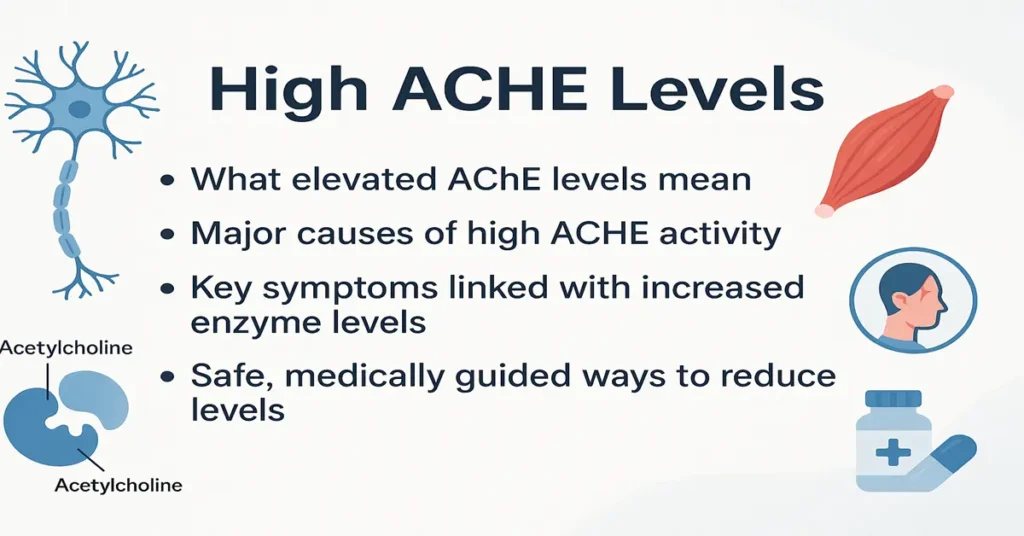
Causes and Symptoms of High AChE Levels
Understanding High Levels
Acetylcholinesterase (AChE) is an important enzyme that works at nerve endings and neuromuscular junctions. Its main job is to break down acetylcholine, the chemical messenger that carries signals between nerves and muscles. This breakdown is necessary so that muscles can relax after contraction and nerves can reset for the next signal.
When AChE levels are higher than usual, acetylcholine gets broken down more quickly than normal. Clinically, this does not usually cause sudden or dramatic symptoms. Instead, it subtly affects how efficiently nerve signals are passed to muscles. In routine lab practice, doctors often look at high AChE as a biochemical signal rather than a direct diagnosis. It tells us something about enzyme production, liver function, blood concentration, or inherited patterns, not necessarily a disease by itself.
High AChE levels are discussed less often than low levels because they are usually less urgent. However, persistent elevation still deserves proper interpretation, especially if the patient has symptoms related to muscle strength, fatigue, or medication sensitivity.
Major Causes of High AChE Levels
Genetic variation
Some people naturally have higher cholinesterase activity due to inherited enzyme patterns. This is commonly picked up during routine testing or pre-anesthesia screening. In real-world practice, these individuals often feel completely normal, but doctors take note because drug responses, especially to muscle relaxants, can differ.
Liver hyperactivity or regeneration
AChE is produced mainly in the liver. When the liver is recovering from injury, inflammation, or stress, enzyme production can temporarily increase. In OPD settings, this is often seen alongside improving liver function tests rather than worsening ones.
High metabolic activity
Conditions that increase overall metabolic activity may slightly raise enzyme levels. This is usually mild and not clinically significant on its own.
Certain medications
Some drugs can influence enzyme synthesis or alter how AChE is measured in blood tests. This is why clinicians always correlate lab values with medication history before drawing conclusions.
Dehydration or concentration changes
Reduced plasma volume can make enzyme levels appear higher than they truly are. This is a common and often overlooked reason for mildly elevated results, especially if the patient was unwell, fasting, or inadequately hydrated.
Rare medical disorders
In uncommon situations, bone marrow or red blood cell–related disorders can be associated with higher AChE activity. These cases are usually investigated further only when other abnormal findings are present.
Symptoms That Commonly Appear
High AChE levels themselves usually do not produce strong or obvious symptoms. Instead, any symptoms that appear are related to reduced availability of acetylcholine or the underlying condition causing the elevation.
In clinical practice, patients may report subtle issues such as mild muscle fatigue, reduced muscle strength during sustained activity, or slower reflex responses. Some people notice difficulty concentrating or a general sense of tiredness without a clear cause. Dry mouth or dry eyes may occur due to reduced secretory activity, and occasional muscle stiffness can be seen.
It is important to understand that these symptoms are often gradual and mild. Many patients with high AChE levels have no noticeable complaints at all.
Complications of Long-Term High Levels
Although high AChE is generally less concerning than low levels, persistent elevation can have functional implications over time.
Neuromuscular imbalance
With faster breakdown of acetylcholine, nerve signals may not remain strong enough for sustained muscle activity. This does not cause paralysis, but it can contribute to early muscle fatigue.
Medication sensitivity
In hospital settings, this is one of the most important considerations. Patients with high AChE may respond differently to certain anesthetic or neuromuscular drugs. This is why anesthesiologists pay close attention to cholinesterase values.
Increased fatigue
Ongoing disruption in nerve–muscle signaling can present as chronic tiredness or reduced physical endurance.
Misinterpretation of nerve function
Persistently high AChE levels can sometimes mask early neuromuscular issues, making clinical correlation essential.
How to Reduce Levels Safely
AChE plays a critical role in normal nerve and muscle function, so the goal is never to suppress it blindly. Management always focuses on the underlying reason for elevation.
Identifying the cause is the first and most important step. If the elevation is genetic, no treatment is required. When liver activity, medications, or temporary physiological factors are responsible, correcting those issues usually allows levels to normalize naturally.
Doctors may adjust medications if they are known to influence enzyme levels. This is done cautiously and never without medical supervision. If dehydration contributed to the result, proper fluid correction often brings the value back into range.
Scheduled monitoring is commonly advised in routine practice. Repeat testing helps determine whether the elevation is stable, improving, or progressing. Importantly, there are no safe home methods to lower AChE, and attempts to do so can lead to weakness, dizziness, or more serious neuromuscular problems.
Additional Information
In everyday laboratory and OPD practice, high AChE levels are rarely treated as an emergency. Most elevations are mild and linked to genetics, liver function changes, medications, or temporary physiological states. However, significantly elevated or progressively rising levels do prompt further evaluation.
AChE results should always be interpreted alongside symptoms, medical history, and other laboratory findings. Numbers alone do not tell the full story. Even small deviations can matter in certain clinical contexts, while in others they may have no practical impact at all.
Test Preparation
Inform your doctor about all medications and supplements you are taking.
Mention any recent liver-related illness, recovery, or ongoing monitoring.
Avoid dehydration before the test.
Follow blood collection instructions carefully.
Share any known family history of unusual enzyme activity.
When to See a Doctor
Consult a doctor if you experience persistent muscle weakness, unusual fatigue, difficulty performing routine physical tasks, or problems with concentration. Changes in muscle tone, reflexes, or unexplained dryness of mouth or eyes should also be discussed. Urgent review is advised if symptoms worsen or if AChE levels remain elevated on repeat testing.
Sample Type
AChE testing is usually performed on a blood sample. In some situations, enzyme activity may be measured separately in plasma or red blood cells for more detailed assessment.
Important Word Explanations
Acetylcholinesterase: An enzyme that breaks down acetylcholine at nerve endings.
Neuromuscular junction: The point where a nerve transmits a signal to a muscle.
Enzyme activity: How effectively an enzyme performs its biological role.
Cholinesterase variants: Genetic differences that affect enzyme levels or function.
Plasma volume: The fluid component of blood; changes can influence lab concentrations.
People Also Ask
Is a high AChE level serious?
Usually not. Most high values are mild and need correlation with symptoms and history.
Can high AChE levels be temporary?
Yes. Dehydration, recovery from illness, or medication effects can cause temporary elevation.
Does high AChE always mean a disease?
No. Many healthy individuals have higher levels due to genetic variation.
When do doctors usually worry about high AChE?
Concern increases if levels are very high, rising over time, or associated with symptoms.
Is repeat testing common?
Yes. Repeat testing is often done to confirm whether the level is stable or changing.
Can lab errors cause high readings?
Occasionally. That is why results are interpreted in context and sometimes repeated.
~END~