
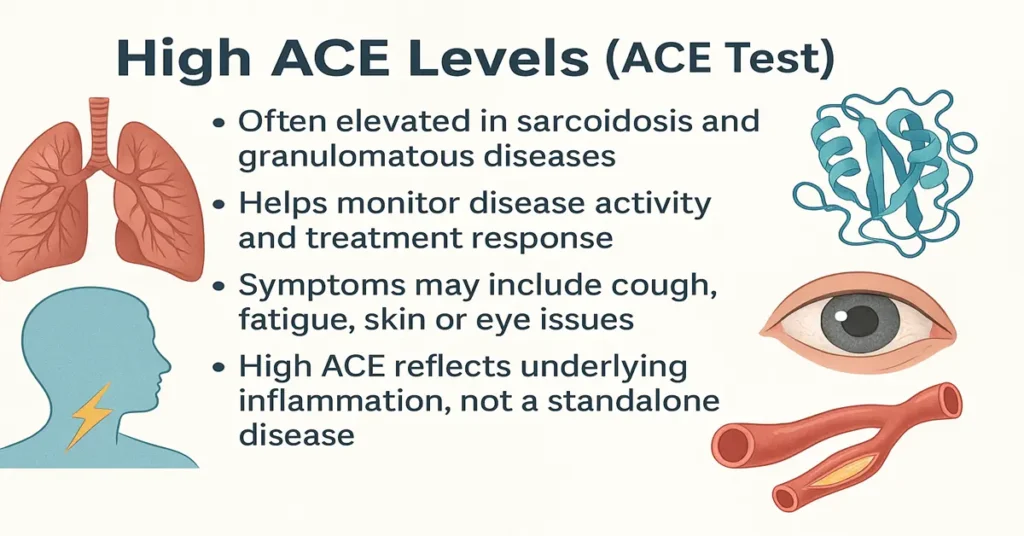
Causes and Symptoms of High ACE Levels
Understanding High Levels
Angiotensin-Converting Enzyme (ACE) is a protein found mainly in the lungs and in the cells lining blood vessels. Its everyday role is linked to blood pressure regulation, but in clinical practice, ACE becomes important for a different reason. When certain inflammatory or immune-related conditions are active—especially those that form granulomas—the body starts releasing more ACE into the bloodstream.
A high ACE value does not diagnose a disease on its own. Clinically, we treat it as a signal rather than a conclusion. It suggests that granulomatous or immune activity may be ongoing somewhere in the body. The condition most commonly associated with raised ACE is sarcoidosis, but many other situations can influence this enzyme. That is why doctors always correlate ACE results with symptoms, imaging findings, and other laboratory tests before drawing conclusions.
In routine lab practice, ACE is mainly used as a supportive and monitoring marker rather than a definitive diagnostic test.
Major Causes of High Levels
High ACE levels usually reflect increased activity of immune cells involved in granuloma formation. The underlying reason matters far more than the number itself.
Sarcoidosis
This is the most frequent and clinically relevant cause. In sarcoidosis, granulomas form in organs such as the lungs, lymph nodes, skin, eyes, and liver. These granulomas actively release ACE. In many patients, higher ACE levels parallel disease activity, although some patients with active sarcoidosis may still have normal values.
Tuberculosis and other granulomatous infections
Chronic infections like tuberculosis, certain fungal infections, and leprosy can also lead to granuloma formation and raised ACE. In these cases, ACE is supportive at best and never replaces microbiological or imaging-based diagnosis.
Autoimmune and inflammatory disorders
Some inflammatory conditions, including rheumatoid arthritis, inflammatory lung disease, and hyperthyroidism, may cause mild to moderate ACE elevation. These increases are usually less dramatic than those seen in sarcoidosis.
Liver disease
The liver helps clear ACE from circulation. When liver function is impaired, ACE may remain elevated because it is not broken down efficiently.
Genetic variation
Some individuals naturally have higher ACE levels due to inherited traits. In such cases, values tend to remain stable over time and are not associated with symptoms or organ involvement.
Age-related factors
Children and adolescents normally have higher ACE levels than adults. This is a common source of confusion if adult reference ranges are applied incorrectly.
Symptoms That Commonly Appear
ACE itself does not cause symptoms. The symptoms come from the underlying condition responsible for the elevation.
Respiratory symptoms
Because sarcoidosis frequently affects the lungs, patients may develop a persistent dry cough, breathlessness, chest tightness, or wheezing. These are often the symptoms that prompt further testing.
Fatigue and general weakness
Chronic inflammation can cause ongoing tiredness and reduced stamina, even when other symptoms seem mild.
Skin involvement
Granulomas in the skin may appear as rashes, raised nodules, or tender red lesions such as erythema nodosum.
Eye symptoms
Eye involvement can lead to redness, pain, blurred vision, or sensitivity to light. Clinically, eye symptoms are taken seriously because delayed treatment can lead to lasting damage.
Lymph node enlargement
Swollen lymph nodes, especially in the chest or neck, are common in granulomatous diseases and often coexist with raised ACE levels.
Organ-specific symptoms
If organs such as the heart, liver, or nervous system are involved, symptoms may include palpitations, abdominal discomfort, numbness, or weakness. These vary widely depending on the site of inflammation.
Low-grade fever and night sweats
These may occur in more active or systemic inflammatory states.
Complications of Long-Term High Levels
Persistently high ACE usually reflects ongoing inflammation rather than a problem caused by the enzyme itself. If the underlying condition remains active, complications depend on which organs are affected.
Long-term inflammation in the lungs may lead to scarring and reduced lung function. Eye involvement can threaten vision if untreated. Cardiac sarcoidosis may disturb heart rhythm, and neurological involvement can cause lasting nerve symptoms. In infectious causes such as tuberculosis, delayed treatment can lead to widespread organ damage.
This is why doctors focus less on “treating the ACE level” and more on controlling the disease driving the elevation.
How Levels Are Reduced in Practice
ACE levels fall when the underlying disease is brought under control. There is no safe or effective way to lower ACE through home remedies or supplements.
In sarcoidosis, reducing inflammation often leads to gradual normalization of ACE. In infections, appropriate antimicrobial treatment reduces granuloma activity and ACE production. In autoimmune or inflammatory disorders, controlling disease activity stabilizes enzyme levels.
From a clinical standpoint, trends matter more than single readings. A falling ACE over time usually reflects improving disease control.
Additional Information
ACE is best interpreted as a trend marker. Doctors often repeat the test at intervals to see whether levels are rising, stable, or falling. Imaging studies, clinical symptoms, and other laboratory markers are always considered alongside ACE.
A normal ACE does not rule out disease, and a high ACE does not confirm one. This balanced interpretation is key to avoiding over-diagnosis or unnecessary anxiety.
Test Preparation
No special preparation is usually needed. Normal eating and drinking are allowed unless other tests are being done. Patients should inform the doctor about current medications, recent infections, or ongoing treatment, as these factors can influence interpretation.
When to See a Doctor
Medical evaluation is advised if high ACE levels are accompanied by symptoms such as persistent cough, breathlessness, skin changes, eye symptoms, unexplained fatigue, fever, or swollen lymph nodes.
Urgent assessment is needed if there are vision changes, severe breathing difficulty, heart-related symptoms, or neurological complaints.
Sample Type
The ACE test is performed on a blood sample drawn from a vein, usually from the arm. Results are interpreted using the reference range provided by the testing laboratory.
Important Word Explanations
ACE (Angiotensin-Converting Enzyme): An enzyme involved in blood pressure regulation and increased during granulomatous inflammation.
Granuloma: A cluster of immune cells formed during chronic inflammation.
Sarcoidosis: An inflammatory disease characterized by granuloma formation in multiple organs.
Corticosteroids: Medicines used to reduce inflammation and immune activity.
Autoimmune disease: A condition in which the immune system reacts against the body’s own tissues.
People Also Ask
Is a high ACE level always serious?
Not always. It depends on symptoms, clinical findings, and whether the elevation persists over time.
Can high ACE levels be temporary?
Yes. Infections or short-term inflammatory activity can cause temporary increases.
Does high ACE always mean sarcoidosis?
No. Many other conditions and even normal variations can raise ACE levels.
When do doctors usually worry about high ACE?
When levels stay high and match clinical symptoms or imaging findings.
Is repeat ACE testing common?
Yes. Doctors often repeat the test to monitor trends rather than rely on one result.
Can ACE be high without symptoms?
Yes. Some people have elevated levels without noticeable symptoms, especially due to genetic variation or early disease stages.
~END~