
Overview
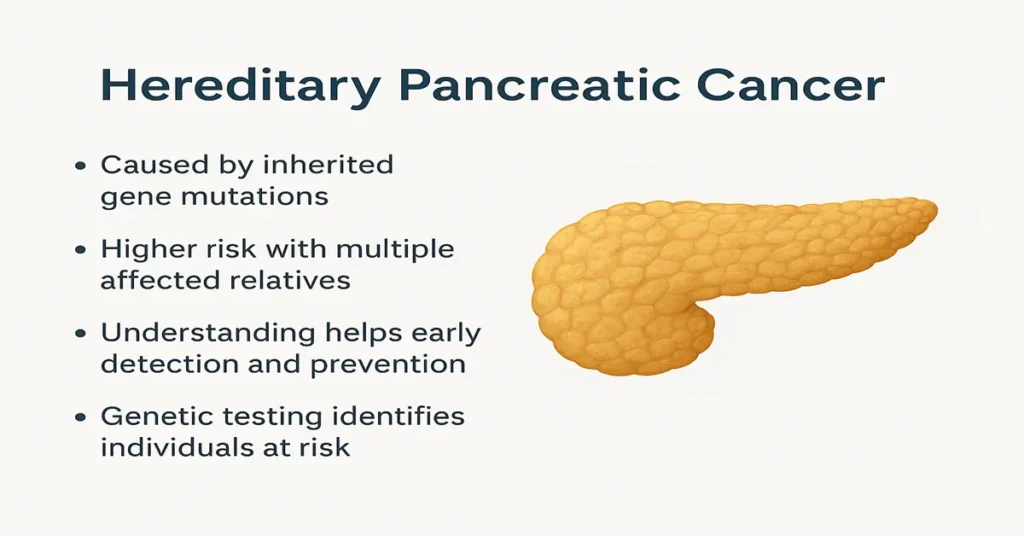
Hereditary pancreatic cancer refers to pancreatic cancer that develops because of inherited genetic mutations passed from parents to children. Unlike sporadic cases, hereditary pancreatic cancer tends to cluster in families and may affect multiple close relatives across generations. Individuals carrying certain inherited gene mutations—such as BRCA1, BRCA2, PALB2, CDKN2A, or genes linked to Lynch syndrome—have a higher lifetime risk of developing pancreatic cancer compared with the general population.
Because pancreatic cancer is often diagnosed at an advanced stage, recognizing inherited risk is especially important. Identifying genetic susceptibility early allows for structured surveillance and closer medical follow-up, which may help detect disease at an earlier, more manageable stage.
How Hereditary Pancreatic Cancer Develops in the Body
Pancreatic cancer develops within the pancreas, an organ located behind the stomach that plays a key role in digestion and blood sugar regulation. The pancreas produces digestive enzymes as well as hormones such as insulin and glucagon.
In hereditary cases, the underlying risk exists from birth due to genetic mutations present in all cells of the body. These mutations affect genes involved in DNA repair, cell cycle regulation, or tumor suppression. Over time, this reduced protective control allows pancreatic cells to accumulate damage, increasing the chance that they may grow abnormally and eventually become cancerous.
Medical Importance of Recognizing Hereditary Pancreatic Cancer
Recognizing hereditary pancreatic cancer has important clinical implications.
Early identification allows individuals at increased genetic risk to enter structured screening programs, where pancreatic changes can sometimes be detected before advanced disease develops. Genetic testing can also provide valuable information for family members, helping relatives understand their own risk and decide on appropriate monitoring.
From a medical planning perspective, knowing whether a hereditary mutation is present may influence treatment decisions if cancer develops, as some genetic subtypes respond differently to specific therapies. Overall, early recognition supports informed decision-making, coordinated care, and long-term monitoring.
Causes of Hereditary Pancreatic Cancer
Hereditary pancreatic cancer arises due to inherited mutations in genes that normally help regulate cell growth and repair DNA damage. When these genes are altered, natural safeguards against cancer formation are weakened.
Key genetic mutations associated with increased risk include BRCA1 and BRCA2, which are also linked to breast and ovarian cancer, as well as PALB2 and CDKN2A. Certain inherited syndromes, such as Peutz-Jeghers syndrome (related to STK11) and Lynch syndrome (involving genes such as MLH1, MSH2, MSH6, PMS2, and EPCAM), are also strongly associated with pancreatic cancer risk.
A strong family history is another important indicator. Risk is higher when two or more first-degree relatives are affected, when pancreatic cancer occurs across multiple generations, or when a known hereditary cancer syndrome is present in the family.
Symptoms of Hereditary Pancreatic Cancer
Symptoms of hereditary pancreatic cancer are generally the same as those seen in non-hereditary cases and often appear late in the disease course. This delayed onset of symptoms is one reason screening is emphasized for high-risk individuals.
Common symptoms may include persistent abdominal discomfort, pain that radiates to the back, unexplained weight loss, jaundice, fatigue, reduced appetite, nausea, or changes in stool appearance. In some cases, sudden onset of diabetes in an older adult may raise concern. These symptoms are not specific to hereditary disease but warrant medical evaluation when persistent.
Causes of High Risk
An individual may be considered at high risk for hereditary pancreatic cancer based on family and genetic factors. This includes having multiple close relatives with pancreatic cancer, carrying a known hereditary cancer mutation, or having a family history involving several related cancers across different organs.
People identified as high risk are typically advised to follow surveillance programs designed by specialists, which aim to monitor pancreatic health over time.
Symptoms of High-Risk Individuals
Most high-risk individuals do not experience symptoms until cancer develops. This absence of early warning signs is why genetic evaluation and scheduled screening play such an important role in high-risk groups. Regular monitoring allows doctors to look for early changes before symptoms appear.
Reference Ranges
Hereditary pancreatic cancer is not identified through standard laboratory reference ranges. Risk assessment is based on a combination of genetic testing results, family history patterns, and findings from specialized screening tools.
Genetic testing reports mutations as either detected or not detected. For individuals at increased risk, screening may include imaging studies such as MRI or endoscopic ultrasound, along with selected blood markers used in monitoring. These evaluations help assess pancreatic changes rather than provide a single numeric “normal” value.
Sample Types Used
Genetic risk assessment is usually performed using DNA obtained from a blood sample, saliva sample, or cheek (buccal) swab. These samples allow laboratories to analyze inherited genetic mutations associated with pancreatic cancer risk.
Test Preparation
Genetic testing generally requires no fasting or special physical preparation. Patients are usually asked to provide detailed family history information and may be advised to undergo genetic counseling before and after testing. For imaging-based screening, preparation depends on the specific procedure and follows standard clinical instructions.
When to Consult a Doctor
Medical consultation is recommended for individuals with a strong family history of pancreatic cancer, those diagnosed at a young age, or those with known hereditary cancer syndromes such as BRCA-related conditions, Lynch syndrome, or Peutz-Jeghers syndrome.
Evaluation is also appropriate for unexplained weight loss, persistent upper abdominal or back pain, or sudden changes in blood sugar control. Early discussion with a healthcare professional helps determine whether genetic testing or surveillance is appropriate.
Important Word Explanations
- Hereditary: A condition passed genetically from parents to children
- Mutation: A change in DNA that may increase cancer risk
- BRCA Genes: Genes that, when altered, raise the risk of several cancers including pancreatic cancer
- Pancreas: An organ involved in digestion and blood sugar regulation
- Peutz-Jeghers Syndrome: An inherited condition associated with increased cancer risk
- MRI/EUS: Imaging methods used to examine the pancreas
- CA 19-9: A blood marker used in monitoring pancreatic cancer
~END~
Related Posts
None found