
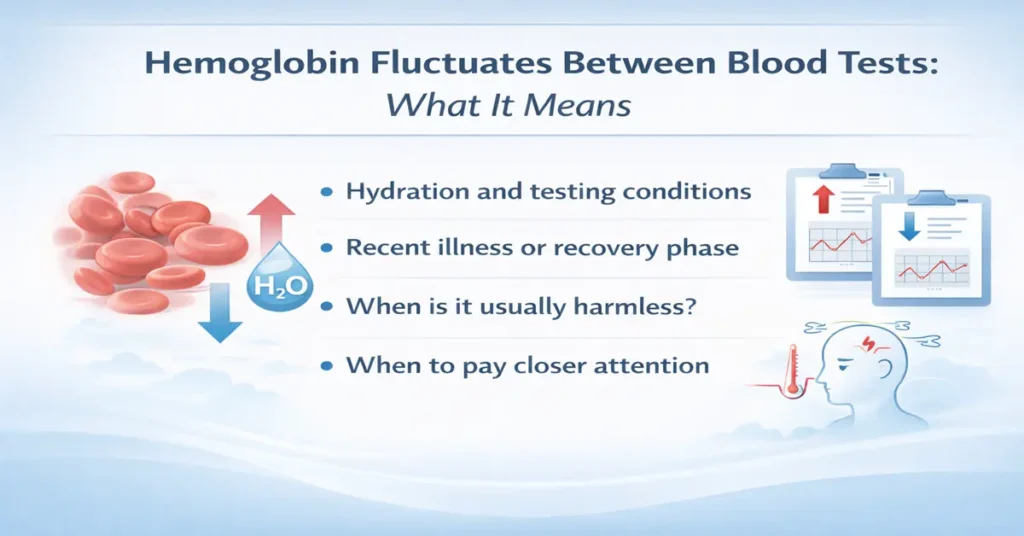
Hemoglobin Fluctuates Between Blood Tests – What It Means in Real Lab Practice
One of the most common concerns I hear at the lab counter and in OPD is this:
“My hemoglobin was fine last time, now it’s lower.”
“Last month it was low, this time it looks better.”
“Why does my hemoglobin keep changing between blood tests?”
From more than 10 years of hospital and diagnostic lab experience, I can tell you this clearly:
small hemoglobin fluctuations between tests are very common and often normal.
This article is written only to explain why hemoglobin values change from one test to another, how doctors interpret these changes, and when they matter. It does not explain what hemoglobin is, normal ranges in detail, or how to increase or reduce hemoglobin.
Understanding the Confusion First
Most people expect blood test values to behave like fixed numbers. They assume that once hemoglobin is measured, it should stay at the same level unless there is a serious problem.
In real clinical practice, blood values are dynamic, not static. Hemoglobin is especially sensitive to day-to-day changes in the body. That is why two reports taken weeks apart may not look exactly the same.
A change does not automatically mean disease, lab error, or worsening health.
Why Hemoglobin Changes Between Tests in Real Life
From routine lab experience, hemoglobin fluctuates mainly due to temporary physiological and testing-related factors, not because something serious suddenly developed.
Some of the most common real-world reasons include:
- Differences in hydration on the test day
- Timing of the test (morning vs later in the day)
- Recent illness or recovery phase
- Minor blood loss between tests
- Physical stress or fatigue
- Natural biological variation
These changes are usually small but noticeable enough to cause anxiety when comparing reports.
Hydration Makes a Bigger Difference Than Most People Realize
This is one of the most frequent reasons for fluctuation.
When the body is slightly dehydrated:
- Blood becomes more concentrated
- Hemoglobin appears higher
When hydration improves:
- Blood volume increases
- Hemoglobin appears lower
From lab practice, I have seen patients show a drop of 0.5 to 1 g/dL simply because they were better hydrated during the second test. This is not a loss of hemoglobin; it is a dilution effect.
Recovery Phase After Illness Affects Hemoglobin
Many people compare reports without considering recent health events.
After:
- Fever
- Viral infection
- Inflammation
- Hospital admission
Hemoglobin can temporarily dip and then slowly recover. This recovery may take weeks, not days. During this period, values may rise or fall slightly between tests.
Clinically, this pattern is considered expected and not alarming.
Minor Blood Loss Can Shift Numbers Briefly
Small but repeated blood losses can influence hemoglobin between tests, such as:
- Heavy menstrual cycles
- Recent blood donation
- Minor surgical or dental procedures
In these cases, hemoglobin may drop and then stabilize again. Doctors usually look at the trend, not a single value.
Lab and Testing Conditions Also Play a Role
From diagnostic lab experience, hemoglobin results can vary slightly due to:
- Different collection times
- Fasting vs non-fasting state
- Body posture during sampling
- Stress or anxiety before the test
These variations are usually within acceptable limits and are not considered errors.
How Much Fluctuation Is Usually Considered Normal
Clinically, doctors expect small changes between tests. A variation of:
- Around 0.3–1.0 g/dL
is often considered normal when explained by hydration, illness, or timing.
Doctors become more attentive when:
- There is a steady downward trend
- Changes are large and persistent
- Other blood parameters change along with hemoglobin
How Doctors Interpret Fluctuating Hemoglobin Reports
In OPD and ward practice, doctors do not react to a single number. They usually look at:
- Previous reports
- Direction of change (upward or downward trend)
- Clinical symptoms
- Other CBC parameters
If hemoglobin moves slightly up and down but remains stable overall, doctors usually consider it physiological variation.
When Fluctuation Is Usually Harmless
From routine clinical experience, hemoglobin fluctuation is usually harmless when:
- The change is small
- The patient feels well
- There are no new symptoms
- Other blood values remain stable
- The trend does not show continuous decline
In such cases, reassurance is often all that is needed.
When Doctors Pay More Attention
Doctors may look more closely if:
- Hemoglobin keeps falling on repeated tests
- Fluctuations are large and unexplained
- Symptoms like fatigue or breathlessness appear
- Other blood indices change significantly
- There is a known chronic medical condition
Even then, evaluation is gradual and step-wise, not rushed.
Should You Test Hemoglobin Frequently Because of Fluctuations?
From lab experience, frequent testing often increases confusion rather than clarity.
In most routine cases:
- Testing every few weeks is unnecessary
- Doctors prefer allowing time between tests
- Repeat testing is advised only when clinically needed
Unnecessary repeat testing often shows normal biological variation, which can cause avoidable anxiety.
What Hemoglobin Fluctuation Does NOT Mean
This situation does not automatically mean:
- Lab error
- Serious blood disorder
- Sudden anemia
- Immediate need for treatment
Most fluctuations reflect normal body adjustments, not disease.
How This Is Explained to Patients in OPD
In everyday OPD conversations, the explanation is usually simple:
“Your hemoglobin is slightly different from last time, which is common. We look at the overall trend and how you feel, not just one number.”
This approach helps patients understand that numbers must be read in context.
Test Preparation
To reduce unnecessary variation between tests:
- Stay well hydrated before blood sampling
- Avoid testing during acute illness if possible
- Follow fasting instructions properly
- Try to test at similar times of day for follow-ups
- Inform the lab about recent illness or blood loss
Consistent preparation helps in meaningful comparison.
When to Consult a Doctor
Consult a doctor if:
- Hemoglobin shows a steady decline
- Symptoms such as fatigue, dizziness, or breathlessness appear
- Fluctuations are large and persistent
- Other blood parameters are abnormal
- A doctor specifically advises follow-up
If none of these apply, routine monitoring is usually enough.
Important Word Explanations
Hemoglobin
The protein in red blood cells that carries oxygen.
CBC (Complete Blood Count)
A blood test that measures different components of blood.
Hydration
The amount of fluid in the body, which affects blood concentration.
Trend
The overall direction of change across multiple test results.
Physiological Variation
Normal changes that occur in the body without disease.
People Also Ask
Is it normal for hemoglobin to change between tests?
Yes. Small changes are common and usually normal.
Can hydration affect hemoglobin results?
Yes. Dehydration can make hemoglobin appear higher.
Should I worry if hemoglobin drops slightly?
Not usually, especially if you feel well and other values are stable.
How often should hemoglobin be repeated?
Only when advised by a doctor or if symptoms appear.
~END~