
Overview
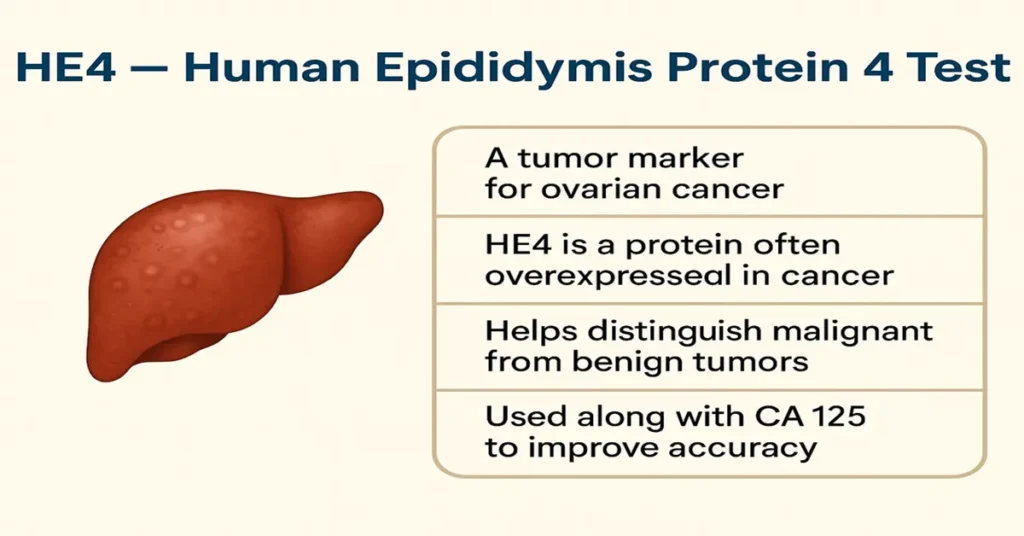
The HE4 (Human Epididymis Protein 4) Test is a tumor-marker blood test used mainly in the evaluation and follow-up of ovarian cancer, particularly epithelial ovarian cancers. HE4 is a protein that is normally present at low levels in certain body tissues. In some ovarian cancers, however, this protein is produced in much higher amounts and released into the bloodstream.
In clinical practice, the HE4 test is most valuable when used together with CA-125, as the combination improves diagnostic accuracy and helps identify higher-risk cases earlier. Compared with CA-125 alone, HE4 is considered more specific because it is less likely to be elevated due to common benign gynecological conditions such as endometriosis, fibroids, or pelvic inflammatory disease.
Because ovarian cancer often presents with vague or non-specific symptoms, HE4 plays an important role in risk assessment rather than serving as a standalone screening test.
Where HE4 Is Produced in the Body
Under normal conditions, HE4 is produced in small amounts in several tissues, including:
- The epididymis (in males)
- The respiratory tract
- Parts of the female reproductive tract, such as the fallopian tubes and endometrium
In women with certain ovarian cancers, especially epithelial types, abnormal cells begin producing HE4 in excess. This increased production leads to higher levels of HE4 entering the bloodstream, which allows detection through a simple blood test.
The key clinical point is not where HE4 is normally found, but how its production changes when malignant cells are present.
Why the HE4 Test Is Important
Although HE4 does not have a known beneficial function in routine body processes, measuring its level has important diagnostic value.
The test supports early detection of epithelial ovarian cancer, particularly when imaging findings are unclear. When combined with CA-125, HE4 contributes to risk stratification, helping clinicians judge whether a pelvic mass is more likely benign or malignant.
HE4 is also useful in monitoring disease activity over time. Changes in HE4 levels can reflect how the disease is behaving during or after treatment and may help signal recurrence earlier than symptoms alone.
Because HE4 is less frequently elevated in benign conditions, it offers greater specificity than some older tumor markers.
Causes of Low or Negative HE4 Levels
Low or normal HE4 levels generally suggest a lower likelihood of ovarian malignancy. This may be seen when no cancer is present or when a pelvic condition is benign.
Normal values may also be observed in certain ovarian cancer subtypes that do not significantly produce HE4, such as mucinous tumors. In early-stage disease, HE4 levels may still fall within the normal range.
For this reason, a negative result is reassuring but does not fully exclude disease, especially when clinical or imaging findings raise concern.
Symptoms of Low or Normal HE4 Levels
HE4 itself does not cause symptoms. When levels are within the normal range, this typically reflects the absence of active HE4-producing tumor activity. Any symptoms a patient experiences are therefore unrelated to HE4 and should be interpreted separately in the clinical context.
Causes of High or Positive HE4 Levels
Elevated HE4 levels most commonly reflect the presence of epithelial ovarian cancer, particularly serous and endometrioid subtypes. In these cancers, abnormal epithelial cells actively overproduce the protein.
HE4 may also rise in some cases of endometrial cancer and, less commonly, in other malignancies such as lung or pancreatic cancer. Mild elevations can occasionally be seen in non-cancerous situations, including reduced kidney function, but this occurs far less frequently than with CA-125.
Because of this pattern, persistently high HE4 levels warrant careful clinical correlation.
Symptoms When HE4 Levels Are High
Raised HE4 levels do not cause symptoms by themselves. Instead, they act as a signal that an underlying condition may be present.
Symptoms seen in ovarian cancer are often subtle and non-specific. These may include ongoing abdominal bloating, pelvic discomfort, early fullness while eating, urinary urgency, unexplained fatigue, or gradual weight loss. Because such symptoms can be easily overlooked or attributed to other causes, tumor-marker testing can provide important additional information.
Reference Ranges for HE4 Test
HE4 reference values vary according to menopausal status:
- Premenopausal women: typically below 70 pmol/L
- Postmenopausal women: typically below 140 pmol/L
Laboratory-specific ranges may differ slightly depending on testing methods. Results are always interpreted alongside clinical findings, imaging studies, and other tumor markers.
Sample Type Used for the HE4 Test
The HE4 test is performed on a blood sample, using serum or plasma. No tissue sample is required. In most cases, the test is ordered together with CA-125 to allow combined risk assessment.
Test Preparation
No special preparation is usually required. Fasting is not necessary. Patients are generally advised to inform their doctor about current medications, hormonal therapy, or known kidney disease, as these factors may influence interpretation.
Smoking immediately before testing is usually discouraged, and recent clinical findings should always be shared with the treating physician.
When to Consult a Doctor
Medical evaluation is advised if symptoms such as persistent bloating, pelvic pain, early satiety, or urinary pressure continue without a clear explanation. Consultation is also important for individuals with a strong family history of ovarian or breast cancer or when imaging reveals an ovarian mass with uncertain features.
For patients already undergoing treatment for ovarian cancer, regular follow-up using HE4 may help track disease behavior. Any return or worsening of symptoms after treatment should prompt reassessment.
Important Word Explanations
- Tumor Marker: A substance produced by cancer cells or released in response to cancer activity
- Epithelial Ovarian Cancer: The most common form of ovarian cancer, arising from the surface lining of the ovary
- ROMA Score: A risk calculation combining HE4 and CA-125 levels
- Benign: Non-cancerous
- Malignant: Cancerous and capable of spreading
- Overexpression: Production of a substance at much higher levels than normal
~END~
Related Posts
None found