
Overview
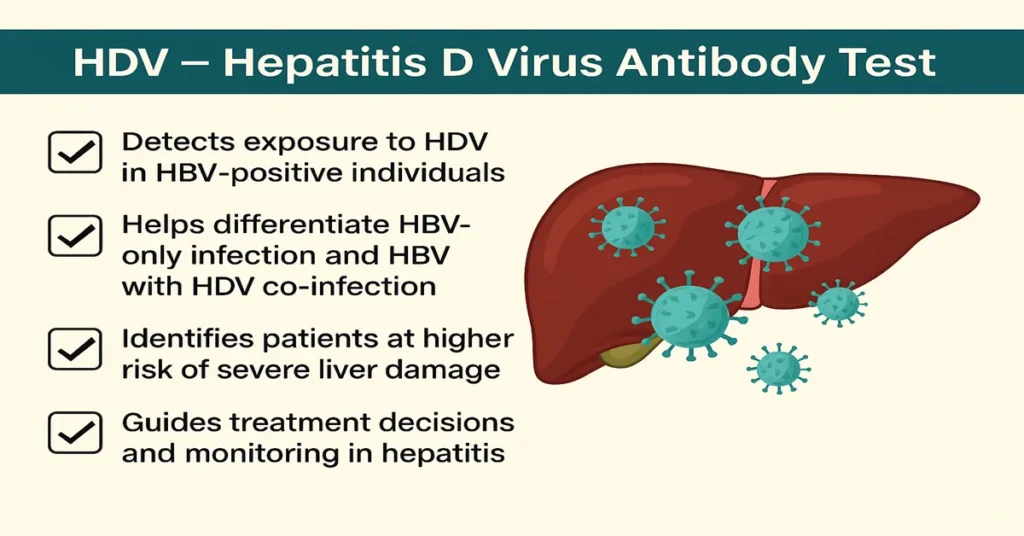
The HDV Antibody Test is a blood test used to detect antibodies formed against the Hepatitis D Virus (HDV), also called the delta virus. HDV is a unique virus because it cannot survive or multiply on its own. It requires the presence of Hepatitis B Virus (HBV) to replicate.
For this reason, HDV infection occurs only in people who already have hepatitis B. Infection may happen at the same time as HBV (co-infection) or may develop later in someone with long-standing HBV (superinfection). From a clinical perspective, superinfection is usually more severe and is associated with faster liver damage and a higher risk of complications.
The HDV antibody test is therefore an important investigation in people with hepatitis B who show unexpected worsening of liver tests or more aggressive disease progression.
How HDV Behaves in the Body
HDV is not produced by the human body. After entering the bloodstream, the virus travels to the liver and infects hepatocytes, the main liver cells. Unlike complete viruses, HDV lacks the ability to replicate independently and relies entirely on hepatitis B surface antigen to complete its life cycle.
Antibody Production
Once HDV infects the liver, the immune system responds by producing antibodies, mainly IgM and IgG types. These antibodies circulate in the blood and are detected by the HDV antibody test.
Role of HBV
HDV cannot multiply without HBV. In people with chronic hepatitis B, the presence of HDV often leads to more aggressive liver inflammation, accelerated scarring, and reduced liver reserve. This interaction explains why HDV infection is taken seriously in clinical practice.
Medical Importance of the HDV Antibody Test
The HDV antibody test has particular importance in patients already known to have hepatitis B.
It helps determine whether a person has ever been exposed to hepatitis D. Identifying HDV exposure allows doctors to distinguish between HBV-only infection and combined HBV-HDV infection, which behaves differently and often progresses more rapidly.
From a monitoring standpoint, HDV positivity signals a higher risk of complications such as cirrhosis, liver failure, and hepatocellular carcinoma. For this reason, detecting HDV antibodies prompts closer follow-up and further testing to assess disease activity.
Causes of Low or Negative HDV Antibody Levels
A negative HDV antibody result generally indicates that there has been no exposure to hepatitis D.
In very early infection, antibodies may not yet be detectable. Similarly, individuals with reduced immune function may produce lower antibody levels, which can occasionally result in a false-negative result.
Even when HDV antibodies are negative, liver-related symptoms may still occur if hepatitis B is present, as these symptoms would be related to HBV rather than HDV.
Symptoms of Low/Negative Levels
Low or negative HDV antibody levels do not cause symptoms on their own. In the absence of HDV infection, symptoms—if present—are usually due to hepatitis B or another liver condition. Common HBV-related symptoms may include fatigue, mild jaundice, or discomfort in the liver area.
Causes of High or Positive HDV Antibody Levels
A positive HDV antibody test indicates exposure to hepatitis D at some point.
This may reflect an active co-infection with hepatitis B, a superinfection developing on top of chronic HBV, or a past infection where antibodies remain detectable even after viral activity has declined. In some individuals, HDV infection becomes chronic and leads to ongoing liver inflammation.
Because antibodies alone cannot confirm whether the virus is currently active, doctors often request HDV RNA testing to determine ongoing viral replication.
Symptoms When HDV Levels Are High
Elevated HDV antibody levels themselves do not cause symptoms. Clinical features arise from liver inflammation and damage.
Patients may experience fatigue, weakness, reduced appetite, jaundice, dark urine, pale stools, nausea, or discomfort in the right upper abdomen. When infection is chronic or severe, signs of advanced liver disease may appear, such as abdominal fluid accumulation, easy bruising, leg swelling, or changes in mental clarity. These findings indicate significant liver involvement and require prompt medical attention.
Reference Ranges
HDV antibody results are typically reported in qualitative terms.
A negative result means no HDV antibodies are detected, suggesting no evidence of infection.
A positive result means HDV antibodies are present, indicating past or current infection. In such cases, HDV RNA testing is usually required to assess whether the virus is actively replicating.
Sample Type Used for HDV Testing
The HDV antibody test is performed on a blood sample, usually serum, collected from a vein.
It is often ordered alongside hepatitis B markers, liver function tests, and, when indicated, HDV RNA testing or imaging studies to evaluate liver status.
Test Preparation
No fasting is required for HDV antibody testing. Patients should inform their doctor about ongoing antiviral therapy or recent blood transfusions, as these factors may influence interpretation. Sudden worsening of liver symptoms in someone with hepatitis B should prompt timely testing.
When to Consult a Doctor
Medical consultation is recommended for anyone with known hepatitis B who develops new or worsening symptoms, such as increasing fatigue, jaundice, dark urine, abdominal swelling, or leg edema.
Testing is also advised when liver enzymes rise unexpectedly or when there is concern for rapid disease progression. Individuals with risk factors such as unprotected sexual exposure or needle sharing should seek evaluation as well.
Important Word Explanations
- HDV (Hepatitis D Virus): A defective virus that requires hepatitis B virus to replicate
- Co-infection: HBV and HDV acquired at the same time
- Superinfection: HDV infection occurring in someone with chronic HBV
- Antibodies: Immune proteins formed in response to infection
- HDV RNA Test: Detects active replication of hepatitis D virus
- Cirrhosis: Advanced scarring of the liver
~END~
Related Posts
None found