
Introduction
The Beta-hCG test is one of the most widely used and clinically important hormone tests in medicine. It plays a central role in confirming pregnancy, monitoring early pregnancy progress, and identifying certain hormone-producing tumors.
Human Chorionic Gonadotropin (hCG) is a hormone produced primarily during pregnancy. Measuring the beta subunit of this hormone gives the test its accuracy and specificity. In routine practice, Beta-hCG helps doctors confirm pregnancy at a very early stage, assess whether a pregnancy is progressing as expected, and evaluate specific cancers where this hormone may be produced abnormally.
What is Beta-hCG (Human Chorionic Gonadotropin – Beta Subunit)?
Beta-hCG is a hormone released shortly after fertilization by cells that later form the placenta. It can be detected in blood and urine soon after implantation, making it one of the earliest measurable indicators of pregnancy.
The hCG molecule consists of two parts: an alpha subunit and a beta subunit. The beta subunit is unique to hCG and allows laboratories to distinguish it from similar hormones such as LH, FSH, and TSH. For this reason, modern testing focuses specifically on Beta-hCG.
Outside pregnancy, detectable Beta-hCG may sometimes be seen in certain tumors that produce this hormone inappropriately.
Where is Beta-hCG Produced in the Body?
During Pregnancy
Beta-hCG is produced by syncytiotrophoblast cells of the placenta soon after the fertilized egg attaches to the uterine wall. During early pregnancy, it supports hormonal stability until the placenta becomes fully functional.
In Certain Cancers
Some abnormal cells, particularly in germ cell tumors of the testis or ovaries, may produce Beta-hCG. In rare cases, tumors of other organs such as the stomach or liver may also show low-level production.
Main Functions and Importance of Beta-hCG
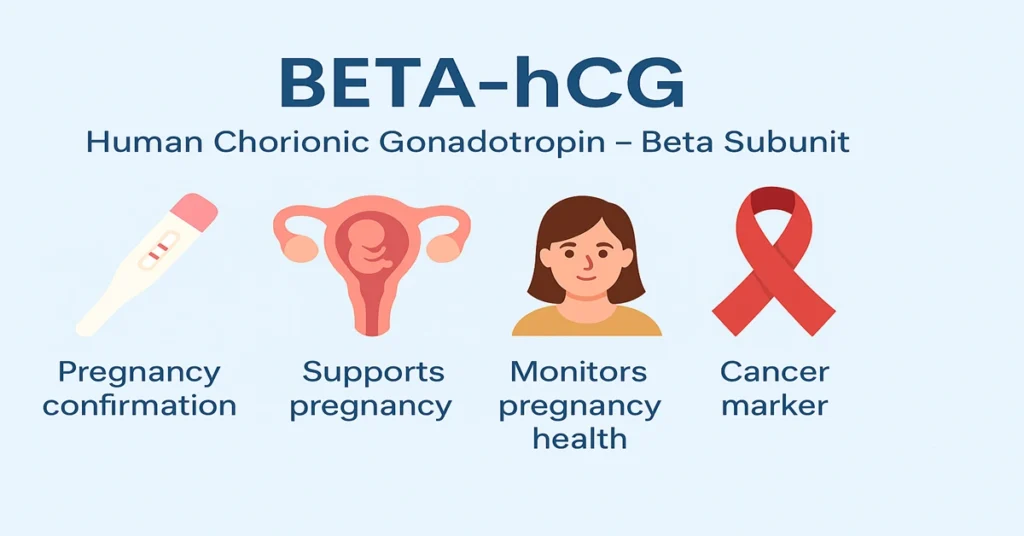
1. Pregnancy Confirmation
Beta-hCG is the earliest reliable laboratory marker of pregnancy. It can be detected in blood several days before a missed period, allowing early confirmation when clinical signs are still absent.
2. Supports Early Pregnancy
In early pregnancy, Beta-hCG maintains the corpus luteum, which produces progesterone. This hormonal support helps preserve the uterine lining until placental hormone production is established.
3. Monitors Pregnancy Health
Serial Beta-hCG measurements help clinicians assess whether a pregnancy is progressing normally. Certain patterns—such as unexpectedly slow rise or unusual elevations—can signal conditions that require closer evaluation.
4. Cancer Marker
In non-pregnant individuals, elevated Beta-hCG may act as a tumor marker, particularly for testicular cancer, ovarian germ cell tumors, and choriocarcinoma. It is also used to monitor treatment response and detect recurrence.
Causes of Low Beta-hCG Levels
Low Beta-hCG values may be seen in early pregnancy when implantation has occurred recently or when a pregnancy is not developing as expected. In clinical practice, low or slowly rising levels may prompt further evaluation.
In non-pregnant individuals, very low Beta-hCG levels are normal and carry no clinical concern.
Symptoms of Low Beta-hCG
Beta-hCG itself does not cause symptoms. Any symptoms present are related to the underlying condition, such as vaginal bleeding or pelvic discomfort in pregnancy-related complications.
Causes of High Beta-hCG Levels
Normal Causes
During early pregnancy, Beta-hCG levels rise rapidly as part of normal development. Higher-than-average levels may be seen in multiple pregnancies or certain placental conditions.
Cancer-Related Causes
Elevated Beta-hCG outside pregnancy may be associated with testicular cancer, ovarian germ cell tumors, or choriocarcinoma. In rare situations, other malignancies may produce small amounts.
False or Temporary Elevations
Recent pregnancy, miscarriage, or medications containing hCG can lead to detectable levels for a period of time and should be considered during interpretation.
Symptoms of High Beta-hCG Levels
Beta-hCG does not directly cause symptoms. During pregnancy, higher levels are often associated with common early pregnancy symptoms such as nausea or breast tenderness. In non-pregnant individuals, symptoms depend entirely on the underlying condition producing the hormone.
Reference Ranges of Beta-hCG Levels
In Pregnancy (Blood Levels)
Beta-hCG values vary widely during pregnancy and depend strongly on gestational age. Early pregnancy is characterized by a rapid rise, while later stages show stabilization and gradual decline.
In Non-Pregnant Individuals
In males and non-pregnant females, Beta-hCG levels are typically very low or undetectable.
Clinical interpretation focuses more on trends over time rather than a single value, especially in early pregnancy.
Sample Type and Test Details
- Sample Type: Blood (serum)
- Tube Used: Red-top (plain) tube
- Test Method: Quantitative immunoassay
- Fasting Required: Not required
Test Preparation
No special preparation is required for the Beta-hCG test. If fertility treatments or recent pregnancy events are relevant, they should be communicated to the healthcare provider, as they can influence results.
For pregnancy monitoring, repeat testing at defined intervals provides more meaningful clinical information than a single measurement.
When to Consult a Doctor
Medical consultation is advised if:
- Beta-hCG levels are inconsistent with gestational age
- Symptoms such as abdominal pain, bleeding, or dizziness occur in early pregnancy
- Beta-hCG is detected in non-pregnant individuals
- The test is being used to monitor known cancer
Early evaluation helps clarify the cause and guides appropriate next steps.
Important Word Explanations
- hCG (Human Chorionic Gonadotropin): Hormone produced mainly during pregnancy
- Beta Subunit: Specific part of hCG used for accurate laboratory measurement
- Corpus Luteum: Temporary hormone-producing structure in the ovary during early pregnancy
- Ectopic Pregnancy: Pregnancy developing outside the uterus
- Molar Pregnancy: Abnormal placental growth associated with high hCG
- Choriocarcinoma: Rare cancer producing high hCG levels
- Hyperemesis Gravidarum: Severe pregnancy-related vomiting linked with high hCG
~END~
Related Posts
None found
Pingback: MCV Test (Mean Corpuscular Volume): Normal Range, Causes, Symptoms & Preparation
I am typically to blogging and i really recognize your content. The article has actually peaks my interest. I’m going to bookmark your site and keep checking for brand new information.