
Haptoglobin Test: Purpose, High & Low Levels, Symptoms, Normal Range & Complete Guide
Overview
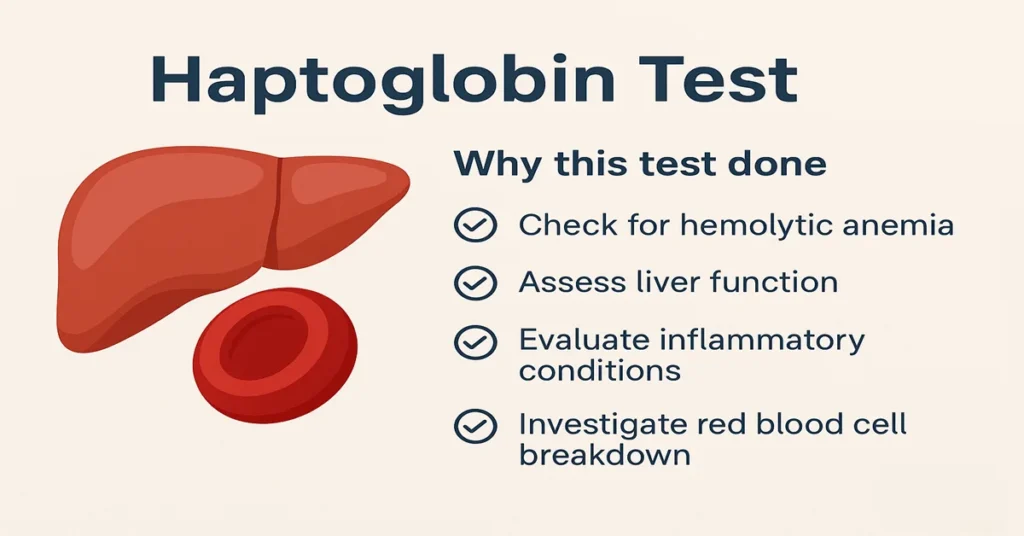
The Haptoglobin Test measures the level of haptoglobin, a protein produced by the liver that plays an important protective role in the bloodstream. When red blood cells break down, they release hemoglobin into circulation. Free hemoglobin can be harmful if left unbound. Haptoglobin attaches to this free hemoglobin, allowing it to be safely cleared from the body.
Clinically, this mechanism helps conserve iron, limits oxidative damage, and protects the kidneys from injury. Because of this role, haptoglobin testing is especially useful when doctors are evaluating suspected hemolytic anemia, where red blood cells are being destroyed faster than they can be replaced. The test is also helpful in the broader assessment of liver function, inflammatory states, and autoimmune or blood-related conditions. In routine practice, haptoglobin results are often interpreted alongside tests such as LDH, bilirubin, and reticulocyte count to understand the overall pattern rather than relying on a single value.
Where Is Haptoglobin Produced in the Body?
Haptoglobin is produced almost entirely in the liver.
It is synthesized by hepatocytes, the main functional cells of the liver, and then released into the bloodstream. Because the liver is the sole source of haptoglobin, any condition that affects liver health can influence its circulating levels. At the same time, increased red blood cell destruction can lower haptoglobin as it becomes consumed while binding free hemoglobin.
Main Functions and Importance of Haptoglobin
Haptoglobin supports several protective processes in the body, particularly during red blood cell breakdown.
1. Binds Free Hemoglobin
When red blood cells rupture, hemoglobin is released into the plasma. Haptoglobin quickly binds this hemoglobin, forming a stable complex that limits its harmful effects.
2. Prevents Iron Loss
Hemoglobin contains iron, which the body needs to conserve. By binding free hemoglobin, haptoglobin helps prevent iron loss through the kidneys and urine.
3. Protects the Kidneys
Unbound hemoglobin can damage kidney tissue. The haptoglobin–hemoglobin complex is safely removed by the liver, reducing the risk of kidney injury.
4. Acts as an Acute Phase Reactant
Haptoglobin is one of the proteins that increase during inflammation or physical stress. Levels may rise during infections, inflammatory conditions, trauma, surgery, or other stress states, which is why elevated values are often interpreted in an inflammatory context rather than as a primary disease.
Causes of Low Haptoglobin Levels
Low haptoglobin levels most often point toward increased red blood cell destruction or reduced liver production.
1. Hemolytic Anemia
This is the most common clinical reason for low haptoglobin. As red blood cells break down, haptoglobin binds the released hemoglobin and becomes depleted. This pattern is seen in various hemolytic conditions.
2. Liver Disease
Because haptoglobin is made in the liver, conditions that impair liver function—such as chronic hepatitis or cirrhosis—may reduce its production.
3. Genetic Deficiency (Rare)
A small number of individuals have inherited low or absent haptoglobin levels without active disease.
4. Blood Transfusion Reactions
Incompatible transfusions can cause rapid red blood cell destruction, leading to consumption of circulating haptoglobin.
Symptoms of Low Haptoglobin Levels
Low haptoglobin itself does not cause symptoms. Any symptoms present usually reflect the underlying hemolysis rather than the haptoglobin level.
Common clinical features associated with hemolysis may include fatigue, pallor, jaundice, dark-colored urine, shortness of breath, or a rapid heartbeat. In longer-standing cases, spleen enlargement may also be noted.
Causes of High Haptoglobin Levels
Elevated haptoglobin levels are usually related to inflammation rather than red blood cell destruction.
1. Inflammatory Conditions
Chronic or acute inflammatory diseases can increase haptoglobin production as part of the body’s stress response.
2. Tissue Injury or Burns
Significant physical stress, injury, or surgery can raise acute-phase proteins, including haptoglobin.
3. Certain Cancers
Some malignancies are associated with persistent inflammation, which may elevate haptoglobin levels.
4. Nephrotic Syndrome
Altered protein handling in kidney disease can influence circulating protein levels, including haptoglobin.
Symptoms of High Haptoglobin Levels
High haptoglobin levels do not cause symptoms on their own. Any symptoms present usually relate to the underlying inflammatory or systemic condition, such as fever, pain, swelling, weight loss, or persistent fatigue.
Reference Ranges
A commonly used adult reference range is:
30 – 200 mg/dL
Interpretation is always clinical:
- Low levels suggest hemolysis or reduced liver production
- Normal levels make significant hemolysis less likely
- High levels point toward inflammation, stress, or tissue injury
Exact ranges may vary slightly between laboratories.
Sample Type
The test requires a blood sample, collected from a vein.
Either serum or plasma may be used, depending on laboratory protocols.
Test Preparation
No fasting is required for this test. Normal diet and hydration can be continued.
Patients should inform their doctor or laboratory staff if they have recently had an infection, blood transfusion, or are taking medications known to affect red blood cells or inflammation. These details help ensure accurate interpretation.
When to Consult a Doctor
Medical advice should be sought if symptoms suggest possible hemolysis or liver involvement, such as persistent fatigue, pale or yellow skin, dark urine, breathlessness, or unexplained weakness.
Evaluation is also appropriate for individuals with a known family history of hemolytic disorders, recent exposure to drugs that can trigger red blood cell breakdown, or signs of liver disease. Early assessment helps guide further testing and monitoring when red blood cell or liver conditions are suspected.
Important Word Explanations
- Spleen Enlargement: Increase in spleen size due to increased red blood cell breakdown
- Hemolysis: Destruction of red blood cells
- Hemoglobin: Oxygen-carrying protein inside red blood cells
- Acute Phase Reactant: Protein that rises during inflammation or stress
- Hepatocytes: Main functional cells of the liver
- Hemolytic Anemia: Anemia caused by excessive red blood cell destruction
- Inflammation: The body’s response to injury, infection, or stress
~END~
Related Posts
None found