
Overview
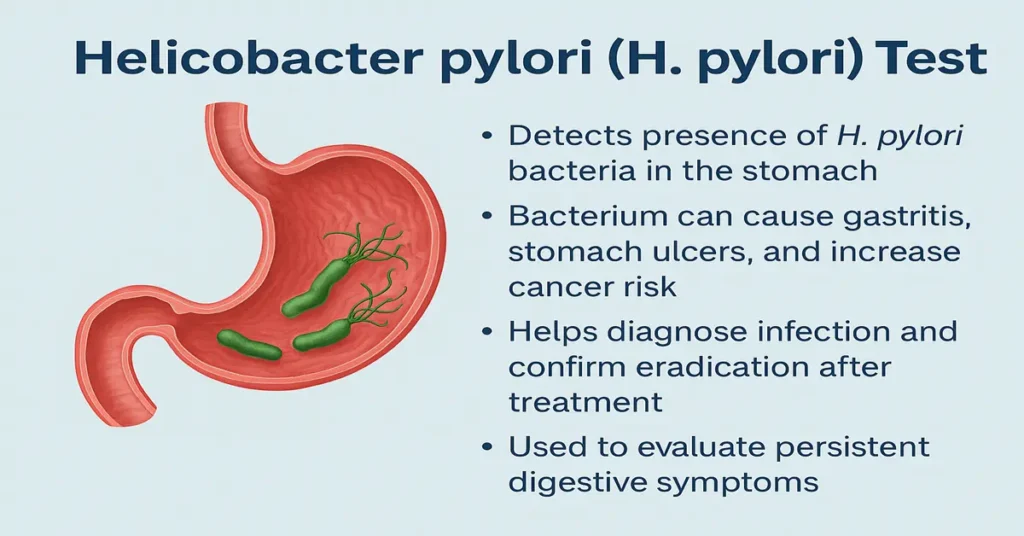
The Helicobacter pylori (H. pylori) Test is used to detect infection with H. pylori, a spiral-shaped bacterium that colonizes the stomach and the upper part of the small intestine. This organism can weaken the stomach’s protective lining, leading over time to chronic gastritis, peptic ulcer disease, and, in long-standing untreated cases, an increased risk of stomach cancer.
H. pylori infection is very common worldwide, particularly in areas where sanitation, food hygiene, or clean water access is limited. Many infected individuals remain symptom-free for years, which is why the infection often goes unnoticed. Testing becomes especially important when a person has persistent digestive complaints or a history suggestive of ulcer disease.
Clinically, the test is used to confirm an active infection, assess the cause of long-term upper digestive symptoms, and verify whether the bacteria have been successfully eliminated after treatment.
How H. pylori Enters and Behaves in the Body
H. pylori is not naturally present in the human body. It enters through external exposure, most commonly via contaminated food or water, or through close contact such as shared utensils or saliva within households.
After entering the stomach, the bacterium settles in the stomach lining (mucosa). Its spiral shape allows it to move through the mucus layer that protects the stomach wall. H. pylori produces enzymes such as urease, which help neutralize stomach acid in its immediate surroundings. This allows the bacterium to survive in an otherwise hostile acidic environment and persist for long periods.
Because of these survival mechanisms, the immune system often cannot clear the infection on its own, leading to chronic inflammation.
Why the H. pylori Test Is Important
Testing for H. pylori plays a key role in routine gastrointestinal evaluation.
Early detection helps identify one of the most common underlying causes of chronic gastritis and peptic ulcer disease. From a clinical perspective, identifying the infection allows doctors to address the root cause rather than treating symptoms alone.
Detecting and managing the infection also reduces the risk of complications such as bleeding ulcers, recurrent ulcer disease, and long-term gastric damage. In selected patients, it may help lower the future risk of stomach cancer.
The test is equally important after treatment, as confirming eradication ensures that the infection has truly cleared and is not silently continuing.
Causes of Low or Negative H. pylori Levels
A negative test result usually means there is no active H. pylori infection in the stomach at the time of testing.
In some cases, recent use of antibiotics, proton pump inhibitors (PPIs), or bismuth-containing medications can temporarily suppress the bacteria. This may lead to a false-negative result if testing is performed too soon.
Testing very shortly after completing treatment can also give misleading results, as residual suppression may mask surviving bacteria. For accurate interpretation, timing and medication history are always taken into account.
Symptoms of Low/Negative Levels
Low or negative test results do not cause symptoms on their own. If digestive symptoms persist despite a negative result, they are likely due to other conditions such as acid reflux, non-H. pylori gastritis, medication-related irritation, or functional digestive disorders.
A negative result simply indicates that H. pylori is not the cause of the current symptoms.
Causes of High or Positive H. pylori Levels
A positive test result indicates an active H. pylori infection in the stomach.
This may reflect a newly acquired infection, a long-standing untreated infection, or, in some cases, reinfection after previous successful treatment. Chronic infection allows ongoing irritation of the stomach lining and increases the likelihood of ulcer formation.
From a laboratory perspective, a positive result confirms the presence of bacterial activity that requires clinical attention.
Symptoms When H. pylori Levels Are High
H. pylori itself does not directly cause symptoms, but the inflammation and tissue damage it produces can lead to noticeable digestive complaints.
Common symptoms include upper abdominal discomfort or burning pain, bloating, nausea, excessive burping, reduced appetite, and indigestion. Pain may be more noticeable when the stomach is empty.
More serious symptoms, usually related to ulcer complications, include vomiting blood, black or tar-colored stools, and severe or worsening abdominal pain. These signs require urgent medical evaluation.
Reference Ranges for H. pylori Test
Interpretation depends on the type of test used.
In urea breath tests and stool antigen tests, results are reported as positive or negative for active infection. These tests are preferred for diagnosing current infection and for confirming eradication.
Blood antibody tests indicate exposure to H. pylori but cannot reliably distinguish between past and current infection, as antibodies may remain detectable for years. For this reason, they are not recommended for confirming cure.
Biopsy testing, performed during endoscopy, detects the bacteria directly from the stomach lining and is used in selected or complex cases.
Sample Types Used
The type of sample depends on the chosen test method. This may include a breath sample, stool sample, blood sample, or a small tissue sample collected during endoscopy.
Each method has specific clinical indications and limitations, and selection is based on symptoms, prior treatment, and availability.
Test Preparation
Preparation varies by test type.
For breath and stool tests, medications such as PPIs and antibiotics usually need to be stopped in advance to avoid false results. These tests are often performed on an empty stomach.
Blood antibody testing requires no special preparation but has limited value for follow-up.
Biopsy testing requires standard fasting as advised before endoscopy.
Following preparation instructions carefully improves test accuracy.
When to Consult a Doctor
Medical evaluation is recommended for ongoing stomach pain, burning discomfort related to meals, unexplained weight loss, black stools, vomiting blood, or persistent indigestion.
Consultation is also important for individuals with a history of peptic ulcers, a family history of stomach cancer, or symptoms that return after prior H. pylori treatment.
Early assessment helps prevent complications and ensures that the underlying cause of symptoms is correctly identified.
Important Word Explanations
- H. pylori: A bacterium that infects the stomach lining
- Gastritis: Inflammation of the stomach lining
- Peptic Ulcer: A sore in the stomach or upper intestine
- Urea Breath Test: Detects H. pylori activity through breath analysis
- Stool Antigen Test: Identifies bacterial proteins in stool
- Biopsy: A tissue sample taken during endoscopy
- PPI: Proton pump inhibitor, a medicine that reduces stomach acid
~END~
Related Posts
None found