
Globulin Test: Meaning, Normal Range, High & Low Levels, Causes, Symptoms, and Complete Guide
Introduction
Proteins play a role in nearly every system of the human body, and globulins represent one of the most important protein groups in circulation. Unlike albumin, which is a single dominant protein, globulin refers to a broad family of proteins with different structures and responsibilities. Together, they support immune defense, transport essential substances, regulate inflammation, and assist in maintaining normal blood functions.
The Globulin Test measures the total level of these proteins in the blood. It is most often interpreted alongside Total Protein and the Albumin/Globulin (A/G) Ratio. When reviewed together, these values help clinicians assess immune activity, liver function, kidney health, and the possibility of chronic infection or abnormal protein production.
This overview explains the Globulin Test in a clear, clinical, and reassuring manner, suitable as a first reference point for patients and healthcare learners.
What Is Globulin?
Globulin is not a single substance but a collective term for several proteins circulating in blood plasma. These proteins differ in size and function, yet they work in coordination to support immunity, transport molecules, and regulate inflammatory responses.
The Globulin Test does not measure individual globulin types separately. Instead, it reflects the overall balance of this protein group. Abnormal values often signal broader physiological changes rather than a problem with one specific protein.
Where Are Globulins Produced in the Body?
Globulins originate from two main systems in the body.
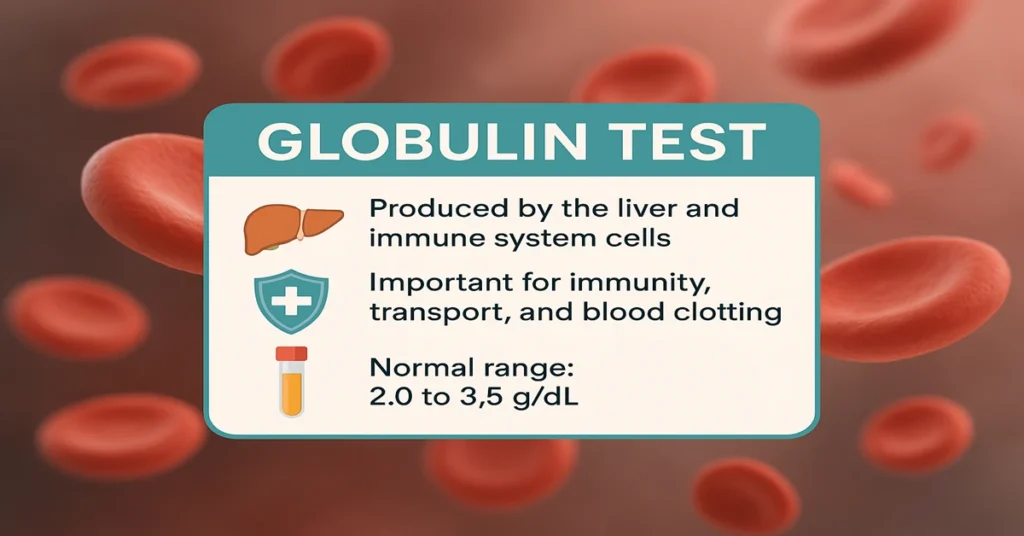
Alpha and beta globulins are produced primarily by the liver. These proteins are involved in transporting fats, hormones, vitamins, and minerals such as iron throughout the bloodstream.
Gamma globulins, also known as immunoglobulins or antibodies, are produced by plasma cells and lymphocytes within the immune system. They play a central role in defending the body against infections and in maintaining immune memory.
Because globulins come from both the liver and immune cells, changes in their levels often reflect interactions between metabolism and immune activity.
Functions and Importance of Globulins
Globulins serve multiple essential functions, and their clinical importance becomes evident when levels rise or fall outside the normal range.
Support Immune Defense
Gamma globulins form the backbone of antibody-mediated immunity. They help the body recognize and neutralize bacteria, viruses, and other foreign substances, and they contribute to long-term immune protection.
Transport of Key Substances
Alpha and beta globulins act as carrier proteins, moving hormones, lipids, iron, vitamins, and certain medications through the blood so they can reach their target tissues.
Regulation of Inflammation
Some globulins help modulate inflammatory responses. This regulation allows the immune system to respond effectively without causing unnecessary tissue damage.
Role in Blood Clotting
Specific globulin fractions are involved in coagulation pathways, supporting normal clot formation and preventing excessive bleeding.
Because of these wide-ranging roles, globulin levels offer valuable insight into immune status, liver function, and chronic inflammatory processes.
Causes of Low Globulin (Hypoglobulinemia)
Low globulin levels usually indicate reduced production or increased loss of these proteins rather than an isolated disorder.
This may occur when liver function is impaired, limiting the production of certain globulins. Kidney conditions can also lead to protein loss through urine. Disorders of the immune system may reduce antibody production, while long-standing nutritional or absorption problems can affect overall protein synthesis.
In some cases, suppression of immune activity over time may also lower globulin levels. Often, more than one contributing factor is present.
Symptoms of Low Globulin
Symptoms associated with low globulin levels are usually related to the underlying condition. Common clinical patterns include increased susceptibility to infections, slower recovery from illness, and general fatigue. When low globulin is part of a broader protein imbalance, swelling or muscle loss may also be observed. These findings prompt clinicians to look beyond the number itself and evaluate the broader clinical picture.
Causes of High Globulin (Hyperglobulinemia)
Elevated globulin levels typically reflect prolonged immune stimulation or abnormal protein production.
Chronic infections and autoimmune conditions can lead to sustained antibody production, raising globulin levels over time. Certain liver disorders may shift protein balance toward globulins while albumin declines. In some situations, abnormal proliferation of plasma cells results in excess production of specific globulin fractions.
High globulin is therefore viewed as a signal that further evaluation may be required to identify the underlying process.
Symptoms of High Globulin
High globulin levels do not cause symptoms directly. Instead, symptoms relate to the condition responsible for the increase. These may include persistent fatigue, unexplained weight loss, recurrent infections, bone discomfort, or signs of chronic inflammation. The pattern and persistence of symptoms guide further testing.
Reference Range (Normal Values)
Typical adult reference range for globulin is:
Globulin: 2.0 – 3.5 g/dL
Reference limits may vary slightly between laboratories.
Globulin is usually calculated using the formula:
Globulin = Total Protein – Albumin
Clinicians often interpret this value together with the A/G Ratio, as shifts in this ratio can provide additional context regarding immune activity or protein balance.
Sample Type and Collection
Sample Type: Serum
Tube Used: Red-top (plain) tube
The test requires a routine venous blood sample and is commonly performed as part of total protein or liver-related panels.
Test Preparation
Special preparation is usually not required for globulin testing. Normal meals and fluids are generally permitted unless the test is combined with other investigations that require fasting. It is important to inform the healthcare provider about ongoing medications, as some drugs can influence protein levels.
When to Consult a Doctor
Medical review is advised when globulin levels are persistently abnormal or accompanied by symptoms such as repeated infections, unexplained fatigue, weight loss, bone pain, swollen lymph nodes, or prolonged fever. Interpretation is always done alongside other laboratory results and clinical findings to determine significance.
Important Word Explanations
- Globulin: A group of blood proteins involved in immunity, transport, and inflammation control.
- Hypoglobulinemia: Lower-than-normal globulin levels.
- Hyperglobulinemia: Higher-than-normal globulin levels.
- Immunoglobulins: Antibodies produced by immune cells.
- A/G Ratio: The ratio of albumin to globulin in blood.
- Multiple Myeloma: A disorder of plasma cells associated with abnormal protein production.
~END~