
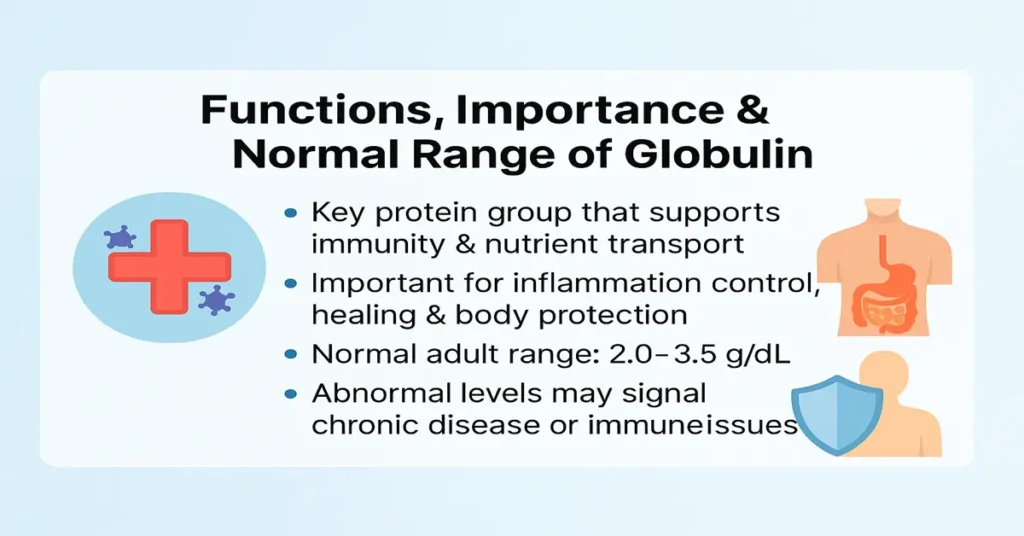
Functions, Importance & Normal Range of Globulin
Overview
Globulin is a major group of proteins present in the blood and plays a central role in immunity, transport of essential substances, and maintaining internal balance. Unlike albumin, which is a single protein, globulin is a collective term that includes alpha, beta, and gamma globulins. Each group has a different function, but together they support immune defence, inflammation control, liver function, and metabolism.
In routine lab practice, globulin is usually reviewed as part of total protein or calculated using total protein minus albumin. When doctors see an abnormal globulin value, they often pause and correlate it with symptoms, liver status, immune activity, and sometimes long-standing infections. Understanding what globulin does helps patients and clinicians interpret reports with more confidence.
This article explains the function of globulin, why it matters, normal ranges at different life stages, and when abnormal levels need attention.
What Does Globulin Do?
Globulins perform multiple essential functions that keep the body protected and balanced.
Supports immunity
Gamma globulins include antibodies. These are the proteins that recognise and fight bacteria, viruses, and other harmful organisms. Without adequate gamma globulins, the body becomes prone to repeated infections.
Transports nutrients and hormones
Alpha and beta globulins act as carrier proteins. They transport iron, copper, cholesterol, lipids, fat-soluble vitamins, and certain hormones to where they are needed.
Helps with blood clotting and healing
Some globulin proteins are involved in clotting mechanisms and tissue repair, especially during injury or inflammation.
Controls inflammation
Globulins help regulate the inflammatory response. Clinically, raised globulin often reflects ongoing inflammation somewhere in the body.
Maintains fluid balance
Although albumin is the main protein for fluid control, globulin also contributes to maintaining proper distribution of fluids in the bloodstream.
Together, these functions explain why globulin is considered a core protective protein system.
Why Is Globulin Important?
Globulin levels give doctors indirect but valuable information about several organ systems.
Indicator of immune activity
Low globulin can suggest weak immunity, while high globulin often reflects immune activation due to infection or inflammation.
Reflects liver function
The liver produces most globulin proteins. Abnormal levels may point toward liver stress or chronic liver disease.
Helps identify chronic conditions
Persistently abnormal globulin values are commonly seen in autoimmune disorders, chronic infections, inflammatory diseases, and some blood conditions.
Supports recovery and healing
Adequate globulin levels are important for wound healing and recovery after illness or surgery.
Guides further testing
When globulin is abnormal, doctors may order additional tests such as serum protein electrophoresis to understand which globulin fraction is affected.
In everyday clinical settings, globulin acts as a signal marker, prompting deeper evaluation when needed.
Role of Globulin in the Body
Globulin contributes to several key biological processes.
Immune defence
Gamma globulins neutralise pathogens and help the body remember previous infections.
Transport system
Globulins carry essential substances such as iron, hormones, fatty acids, vitamins, and medications, ensuring proper distribution.
Inflammation regulation
They help maintain balance between adequate immune response and excessive inflammation.
Metabolic support
Beta globulins play a role in lipid metabolism and cholesterol transport.
Detox support
Some globulins bind toxins and assist the liver in processing harmful substances.
Because of these roles, even small changes in globulin levels can reflect meaningful changes inside the body.
Normal Globulin Levels (Age-Wise)
Globulin levels vary slightly with age due to changes in immunity and metabolism.
Newborns
2.0 – 3.5 g/dL
Levels may be lower initially as immunity is still developing.
Children
2.5 – 3.8 g/dL
Immune activity increases, leading to higher globulin production.
Adults
2.0 – 3.5 g/dL
This is the most commonly used reference range.
Older adults (above 65 years)
2.3 – 3.8 g/dL
Slight increases may be seen due to chronic low-grade inflammation.
Ranges can vary slightly between laboratories.
Normal Globulin Levels (Gender-Wise)
Globulin values are generally similar in men and women.
Men
2.1 – 3.7 g/dL
Women
2.0 – 3.5 g/dL
Minor differences may occur due to hormonal and metabolic variations, but these are usually not clinically significant.
Globulin Levels During Pregnancy
Pregnancy alters blood volume and immune balance, which can affect globulin levels.
First trimester
2.0 – 3.3 g/dL
Second trimester
2.1 – 3.4 g/dL
Third trimester
2.3 – 3.6 g/dL
Mild changes are normal. Doctors become concerned only if levels are markedly high or low or if symptoms are present.
When Abnormal Globulin Levels Become Risky
Abnormal globulin values are not dangerous by themselves, but they become important when persistent or symptomatic.
Low globulin becomes concerning when
There are frequent or severe infections
There is malabsorption or chronic diarrhea
Liver function is impaired
Kidneys are losing protein
Healing is poor and immunity is weak
Very low levels can significantly reduce immune protection.
High globulin becomes concerning when
There is chronic inflammation or autoimmune disease
Infections are long-standing
Liver disease is present
Blood tests show abnormal antibody patterns
There are symptoms like fever, night sweats, weight loss, or joint pain
In such cases, doctors often recommend further evaluation with tests like serum protein electrophoresis.
Test Preparation
For accurate globulin or total protein testing:
Drink normal amounts of water
Avoid alcohol for 24 hours
Eat regular meals unless advised otherwise
Inform the doctor about medications or supplements
Avoid heavy exercise before the test
Rest briefly before blood collection
Good preparation helps avoid misleading results.
When to Consult a Doctor
Consult a doctor if:
Globulin levels remain abnormal on repeat tests
You have frequent infections or prolonged illness
There is unexplained fatigue or weakness
You notice weight loss, fever, or night sweats
Liver or kidney disease is suspected
Reports show abnormal protein patterns
Early evaluation helps identify the cause and prevents complications.
Important Word Explanations
Globulin: A group of blood proteins involved in immunity, transport, and inflammation
Gamma globulins: Antibody-containing globulins
Hyperglobulinemia: High globulin levels
Hypoglobulinemia: Low globulin levels
SPEP: Test that separates different protein fractions
Autoimmune disorder: Condition where the immune system attacks the body
People Also Ask
Is an abnormal globulin level serious?
Not always. Mild changes are common and often temporary. Persistent or large changes need evaluation.
Can globulin levels change temporarily?
Yes. Infections, inflammation, or dehydration can cause short-term changes.
Does high globulin always mean autoimmune disease?
No. It can also occur with infections or chronic inflammation.
When do doctors usually worry about globulin levels?
When levels stay abnormal over time or are associated with symptoms.
Is repeat testing common for globulin?
Yes. Repeat tests help confirm trends and rule out temporary changes.
Can normal globulin still hide disease?
Sometimes. That’s why globulin is interpreted along with other tests and symptoms.
~END~
Related Posts
None found