
Overview
The Ganglioside Antibodies Test is a blood test used to detect antibodies directed against gangliosides. Gangliosides are specialized glycolipids that form an important part of nerve cell membranes, particularly within the myelin sheath. They play a key role in protecting nerve fibers and ensuring smooth transmission of nerve signals.
When the immune system mistakenly targets these gangliosides, autoantibodies are produced. Their presence is strongly linked to autoimmune neurological disorders, especially those affecting peripheral nerves. In clinical practice, this test is most commonly used to support the diagnosis of conditions such as Guillain-Barré syndrome (GBS), chronic inflammatory demyelinating polyneuropathy (CIDP), multifocal motor neuropathy (MMN), and Miller Fisher syndrome, a recognized variant of GBS.
An additional value of the test is its ability to help differentiate between disease subtypes, based on which specific ganglioside antibody is detected, such as GM1, GD1a, GD1b, or GQ1b.
Where Are Gangliosides and Antibodies Produced?
Gangliosides (Normal tissue components)
Gangliosides are naturally present in nerve tissue and are especially concentrated in peripheral nerves and the myelin sheath. They are also found in the brain and spinal cord. Their role is largely structural and functional, helping maintain nerve integrity, protect axons, and support effective communication between nerve cells.
Ganglioside Antibodies (Autoantibodies)
Ganglioside antibodies are produced by B lymphocytes, a type of white blood cell involved in immune defense. In autoimmune conditions, the immune system misidentifies gangliosides as harmful, leading to antibody formation against nerve components. This immune attack disrupts normal nerve function and contributes to autoimmune neuropathy.
Main Functions and Importance of the Test
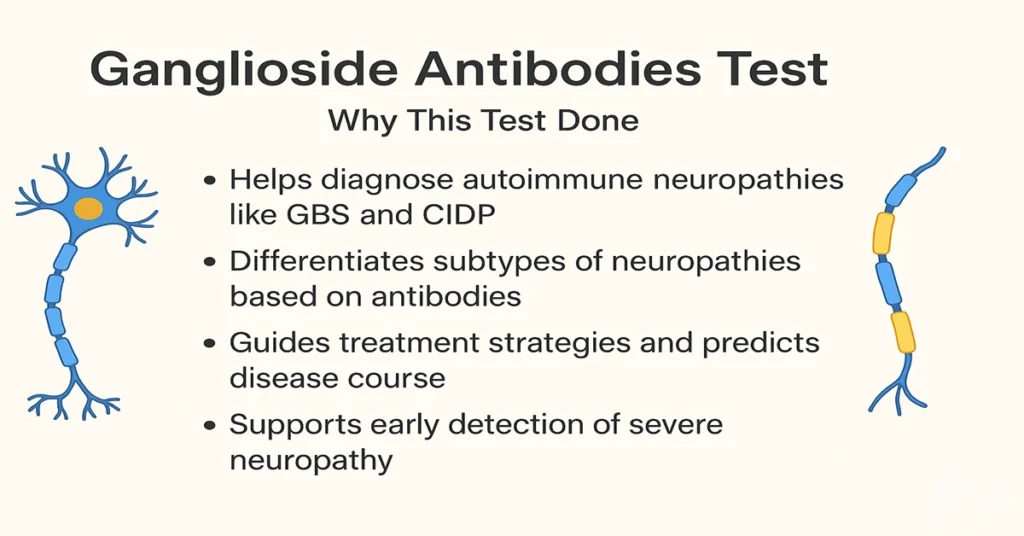
The Ganglioside Antibodies Test is an important tool in neurological evaluation, particularly when nerve symptoms progress rapidly or the diagnosis is uncertain.
1. Helps Diagnose Autoimmune Neuropathies
The test supports the diagnosis of autoimmune nerve disorders such as GBS, CIDP, MMN, and Miller Fisher syndrome, especially when clinical findings and nerve studies suggest immune-mediated disease.
2. Helps Identify the Subtype of Neuropathy
Different antibodies are associated with different clinical patterns. For example, GM1 antibodies are often seen in MMN, GD1a antibodies are linked with certain acute motor forms of GBS, GD1b antibodies with sensory neuropathies, and GQ1b antibodies are classically associated with Miller Fisher syndrome. Identifying the antibody pattern helps clinicians refine the diagnosis.
3. Guides Treatment Planning
Specific antibody profiles may suggest how active or aggressive the immune process is. This information helps neurologists plan appropriate therapy and monitoring strategies.
4. Helps Predict Severity
Higher antibody levels are often seen in more active or rapidly progressive autoimmune neuropathies, supporting closer clinical observation.
Causes of Low / Negative Levels
Low or undetectable ganglioside antibody levels are generally considered normal.
1. Normal Healthy Individuals
Most people do not have measurable ganglioside antibodies.
2. Absence of Autoimmune Neuropathy
When the test is negative, nerve symptoms may be due to non-immune causes such as metabolic disorders, vitamin deficiencies, mechanical nerve compression, or degenerative conditions.
3. Disease in Remission
In some patients with previously active autoimmune neuropathy, antibody levels may fall during periods of reduced immune activity or after treatment.
Symptoms of Low / Negative Levels
Low or negative antibody levels do not cause symptoms. A negative result simply suggests that active autoimmune nerve damage is unlikely. If neurological symptoms are present, they are typically explained by another underlying cause.
Causes of High / Positive Ganglioside Antibody Levels
Positive results indicate immune activity directed against nerve components.
1. Guillain-Barré Syndrome (GBS)
Certain GBS subtypes, particularly acute motor axonal neuropathy, are associated with specific ganglioside antibodies.
2. Chronic Inflammatory Demyelinating Polyneuropathy (CIDP)
CIDP is a long-term autoimmune condition in which antibodies may contribute to ongoing nerve inflammation.
3. Multifocal Motor Neuropathy (MMN)
MMN is commonly associated with GM1 IgM antibodies and presents with asymmetric motor weakness.
4. Miller Fisher Syndrome
This GBS variant is strongly associated with GQ1b antibodies and typically presents with eye movement abnormalities, loss of reflexes, and coordination problems.
5. Post-Infectious Autoimmune Activation
Ganglioside antibodies may appear after certain infections, reflecting immune cross-reactivity. This has been observed following bacterial and viral illnesses.
Symptoms of High / Positive Levels
Symptoms vary depending on the specific autoimmune neuropathy involved.
1. Muscle Weakness
Weakness often begins in the legs and may progress upward, particularly in acute conditions.
2. Numbness and Tingling
Sensory disturbances occur due to nerve inflammation or demyelination.
3. Difficulty Walking or Balancing
Damage to sensory or motor nerves can affect coordination and gait.
4. Muscle Twitching or Cramps
These features are commonly reported in MMN or CIDP.
5. Severe Symptoms (in advanced cases)
Breathing difficulty, swallowing problems, facial weakness, or paralysis may occur in rapidly progressive disease. These findings require urgent medical attention.
Reference Ranges
Results are generally reported as:
- Negative: No detectable ganglioside antibodies
- Positive: Presence of IgG and/or IgM antibodies against specific gangliosides
There is no universal numeric reference range, as results depend on the antibody type tested and the laboratory method used. Any positive result is considered abnormal and suggests autoimmune nerve involvement.
Sample Type
The test requires a blood (serum) sample. Standard serum collection is sufficient, and no special collection tube is typically required.
Test Preparation
No fasting is needed. Patients can continue their usual diet. It is helpful to inform the doctor about recent infections, vaccinations, or use of immunosuppressive medications, as these factors may influence interpretation.
When to Consult a Doctor
Medical evaluation is advised if symptoms such as unexplained muscle weakness, sudden difficulty walking, numbness or tingling in the limbs, facial weakness, breathing difficulty, or swallowing problems occur.
Rapidly worsening neurological symptoms require immediate attention, particularly when conditions such as Guillain-Barré syndrome or severe autoimmune neuropathy are suspected.
Important Word Explanations
- Gangliosides: Specialized fats in nerve membranes that support nerve function
- Autoantibodies: Antibodies that mistakenly attack the body’s own tissues
- GBS: An acute autoimmune condition causing rapidly progressive weakness
- CIDP: A chronic autoimmune disorder affecting peripheral nerves
- MMN: An autoimmune condition causing mainly motor weakness
- Miller Fisher Syndrome: A variant of GBS affecting eye movements and coordination
~END~
Related Posts
None found