
G6PD Test: Purpose, High/Low Levels, Symptoms, Normal Range & Complete Guide
Overview
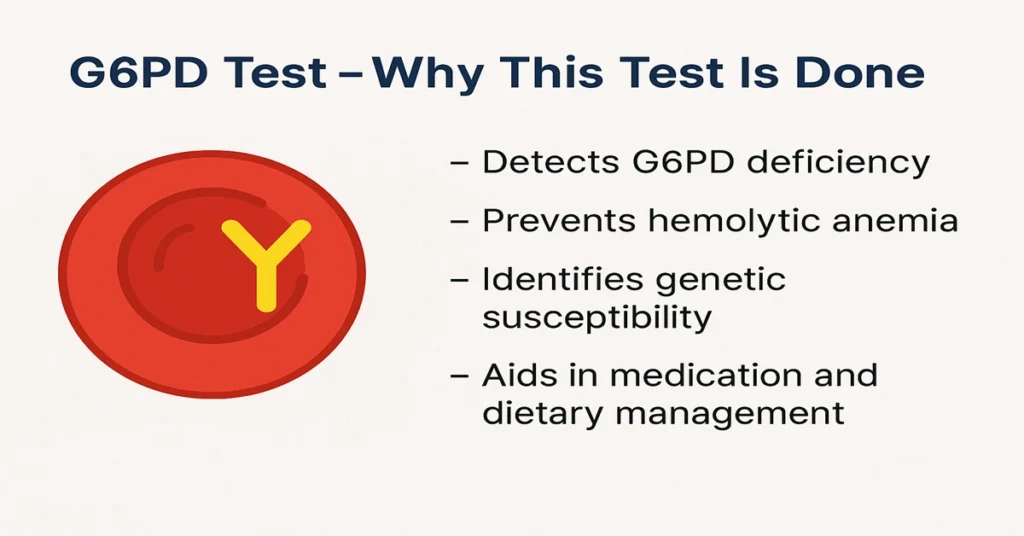
The G6PD Test measures the level or activity of the enzyme Glucose-6-Phosphate Dehydrogenase (G6PD) in red blood cells. This enzyme plays a critical protective role by helping red blood cells withstand everyday oxidative stress. When G6PD activity is low, red blood cells become vulnerable and may break down prematurely under certain conditions.
People with reduced G6PD levels can develop hemolytic anemia when exposed to specific triggers such as infections, certain medications, or foods like fava beans. In these situations, red blood cells are destroyed faster than the body can replace them, leading to sudden anemia. G6PD deficiency is an inherited condition and is seen much more often in males because the responsible gene is located on the X chromosome. Identifying this condition early helps prevent avoidable and potentially serious complications.
Where Is G6PD Produced in the Body?
G6PD is produced inside red blood cells and remains active throughout their lifespan. Its production is controlled by the G6PD gene located on the X chromosome.
Because of this genetic pattern, males are more commonly and more clearly affected, as they carry only one X chromosome. Females have two X chromosomes and may be carriers or show variable enzyme activity depending on which X chromosome is active in their red blood cells.
Main Functions and Importance of G6PD
G6PD is essential for the survival and stability of red blood cells, particularly during physical or chemical stress.
1. Protects Red Blood Cells from Oxidative Stress
Red blood cells are constantly exposed to oxidative substances generated during normal metabolism. G6PD helps neutralize these harmful molecules, preventing damage to the red blood cell membrane. When enzyme activity is low, red blood cells become fragile and prone to destruction.
2. Helps Maintain NADPH Levels
G6PD is required for the production of NADPH, a molecule that supports antioxidant defenses inside red blood cells. NADPH helps regenerate protective substances such as reduced glutathione, which shields cells from oxidative injury.
3. Prevents Hemolysis
Adequate G6PD activity allows red blood cells to survive stressful conditions. In deficiency states, exposure to even mild oxidative triggers can lead to rapid hemolysis, causing anemia, jaundice, and other related findings.
4. Becomes Critical During Stress
The importance of G6PD increases during infections, fever, medication exposure, or dietary triggers. Individuals with low activity are at greatest risk during these periods.
Causes of Low / Deficient G6PD Levels
Low G6PD activity is the key abnormal finding and is most often due to inherited causes.
1. Genetic Mutation
G6PD deficiency is usually inherited. Different genetic variants exist, and the severity of enzyme reduction can vary between individuals.
2. Infections
Infections increase oxidative stress in the body and can precipitate hemolysis in individuals with underlying G6PD deficiency.
3. Medications
Certain drugs can increase oxidative stress within red blood cells, triggering hemolysis in susceptible individuals.
4. Fava Beans (Favism)
Fava beans contain substances that promote oxidative stress and are a well-known trigger for hemolytic episodes in people with G6PD deficiency.
Symptoms of Low / Deficient G6PD Levels
Symptoms usually appear only during a hemolytic episode, while many individuals remain symptom-free between episodes.
Common features include yellowing of the skin or eyes due to rising bilirubin, fatigue and weakness from anemia, dark-colored urine caused by hemoglobin release, shortness of breath, rapid heartbeat, and pale skin. The severity of symptoms depends on the degree of enzyme deficiency and the strength of the trigger.
Causes of High G6PD Levels
Elevated G6PD activity is uncommon and generally not harmful.
1. Increased Young Red Blood Cells
Young red blood cells, known as reticulocytes, naturally contain higher G6PD activity. After a hemolytic episode, increased reticulocyte production may temporarily raise measured enzyme levels.
2. Laboratory Factors
Some testing methods may show higher values depending on assay sensitivity.
3. Rare Genetic Variants
A few rare variants may be associated with higher baseline enzyme activity.
Symptoms of High G6PD Levels
High G6PD levels do not cause symptoms. When seen, they usually reflect bone marrow recovery following recent red blood cell loss rather than a disease process.
Reference Ranges
Reference ranges vary between laboratories. Typical values include:
- 5.5 – 20.5 U/g Hb: Normal activity
- Below reference range: G6PD deficiency (severity varies)
Low activity confirms G6PD deficiency when interpreted in the appropriate clinical setting.
Sample Type
The test requires a blood sample, usually collected in an EDTA (purple-top) tube, which allows accurate measurement of enzyme activity.
Test Preparation
No fasting is required. Testing should ideally be avoided during or immediately after a hemolytic episode, as the presence of young red blood cells may give a falsely normal result. It is important to inform the doctor about recent infections, medications, or family history of G6PD deficiency.
When to Consult a Doctor
Medical attention should be sought if signs of hemolysis appear, such as unexplained fatigue, yellowing of the skin or eyes, dark urine, rapid heartbeat, or breathlessness. Evaluation is also important after exposure to known triggers.
In newborns, prolonged or unexplained jaundice should prompt consideration of G6PD testing. Early identification supports safer medical decisions and reduces the risk of serious complications.
Important Word Explanations
- Enzyme Deficiency: Reduced activity or amount of an enzyme
- Hemolysis: Breakdown of red blood cells
- Oxidative Stress: Cellular damage caused by reactive molecules
- NADPH: A protective molecule that helps defend red blood cells
- Favism: Hemolysis triggered by eating fava beans
- Reticulocytes: Young red blood cells with higher enzyme activity
~END~
Related Posts
None found
I liked how simply everything is explained.