
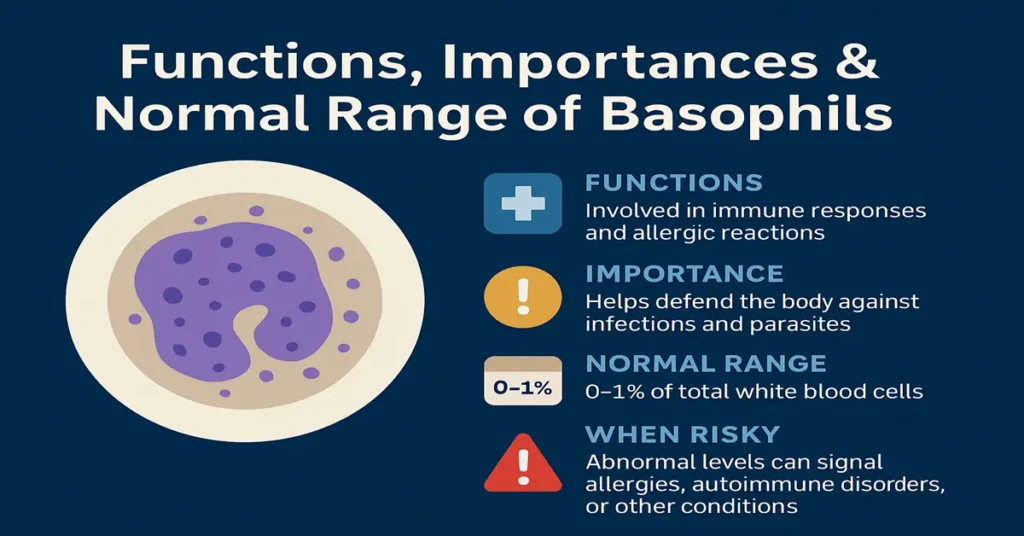
Functions, Importance & Normal Range of Basophils
Basophils are one of the rarest types of white blood cells (WBCs). Even though they usually make up less than 1% of total WBCs, they play a very specific and important role in the immune system. Basophils help control allergic reactions, influence inflammation, support blood flow during immune responses, and assist other immune cells when the body is under stress.
In routine lab practice, basophils are assessed as part of the Complete Blood Count (CBC). Because their normal numbers are very low, even a small rise or fall can give useful clues about allergies, inflammation, hormonal balance, or long-standing immune activity. Understanding basophils helps patients and clinicians interpret CBC reports more confidently.
What Does the Basophil Parameter Do?
Basophils act like early warning cells. When the body encounters allergens, infections, or irritants, basophils release substances such as histamine, heparin, and cytokines.
These chemicals help by increasing blood flow to affected areas, guiding other immune cells to the site, and triggering allergic or inflammatory responses when needed. Although basophils are few in number, their chemical effect is strong, which is why their activity matters more than their count alone.
Why Basophils Are Important
Basophils contribute to immune balance in several ways.
They help identify allergic reactions early, which is why conditions like asthma, allergic rhinitis, or skin allergies often show changes in basophil levels. They also participate in inflammation control, ensuring the response is strong enough to protect the body but not excessive.
Basophils support other immune cells, including eosinophils and neutrophils, and release heparin to reduce unwanted clot formation during inflammation. Clinically, persistently raised basophils may alert doctors to chronic immune or hormonal problems, such as thyroid disorders.
Role of Basophils in the Body
Basophils have a focused but powerful role.
They are central to allergic reactions, where histamine release leads to itching, redness, sneezing, or swelling. They assist in defending against parasitic infections and help regulate immune balance so the body does not overreact.
Basophils also influence inflammation, a normal healing process after injury or infection, and help protect tissues in organs like the lungs and skin, where allergens commonly enter.
Normal Range of Basophils
Basophils are reported in two ways: percentage of total WBCs and Absolute Basophil Count (ABC).
Age-wise reference ranges are as follows.
Newborns
Percentage: 0.1–1.0%
ABC: 10–200 cells/µL
Infants (1 month to 1 year)
Percentage: 0.1–0.6%
ABC: 10–150 cells/µL
Children (1–10 years)
Percentage: 0.1–0.6%
ABC: 10–100 cells/µL
Adults (men and women)
Percentage: 0–1%
ABC: 0–100 cells/µL
Older adults (60+ years)
Percentage: 0–1.2%
ABC: 10–120 cells/µL
Basophils remain low throughout life, which is normal.
Gender-Wise Basophil Ranges
There is no meaningful difference between men and women.
Men: 0–1%
Women: 0–1%
In women, minor temporary fluctuations can occur during menstruation or hormonal changes, but these usually stay within the normal range.
Basophil Range During Pregnancy
Pregnancy naturally alters the immune system.
First trimester
0–1%, as immune sensitivity increases
Second trimester
0.1–1.2%, mild rise related to hormones
Third trimester
0.2–1.2%, slight increase as the body prepares for delivery
These changes are expected unless basophils rise well above the normal upper limit.
When Abnormal Basophil Levels Become Risky
High basophils, also called basophilia, are usually seen when levels exceed 1% or the absolute count goes beyond 100 cells/µL. This may be associated with allergies, asthma, chronic sinusitis, hypothyroidism, chronic infections, autoimmune disorders, or recovery after illness. Rarely, very high and persistent levels may point toward bone marrow or blood-related disorders.
Low basophils, known as basopenia, are very common and usually harmless. They are often seen with stress, pregnancy, severe infections, hyperthyroidism, or steroid use. Basopenia is rarely a concern unless other blood counts are also abnormal.
Test Preparation
Basophils are measured through a standard CBC test. No fasting is required. Staying hydrated, avoiding heavy exercise before testing, and informing the doctor about medications help ensure accurate interpretation. Testing in the morning is usually preferred.
When to Consult a Doctor
Medical advice is recommended if basophils remain high on repeated tests, allergy or asthma symptoms persist, unexplained fever or weight loss occurs, breathing becomes difficult, or other white blood cell counts are abnormal. In such cases, doctors may look for underlying allergic, hormonal, inflammatory, or blood-related causes.
Important Word Explanations
Histamine
A chemical released during allergic reactions that causes itching, swelling, and sneezing
Heparin
A natural blood-thinning substance released by basophils
Basophilia
Higher-than-normal basophil levels
Basopenia
Lower-than-normal basophil levels
Inflammation
The body’s protective response to infection or injury
Cytokines
Chemical signals that help immune cells communicate and move
People Also Ask
Is a high basophil count serious?
Most of the time it is not. Mild elevation commonly reflects allergies or inflammation.
Can basophil levels change temporarily?
Yes. Allergic reactions, infections, stress, or pregnancy can cause short-term changes.
Does high basophils always mean disease?
No. Many healthy people with allergies can show mildly raised basophils.
When do doctors usually worry about basophils?
When levels stay high for several weeks or rise along with other abnormal blood results.
Is repeat testing common for basophils?
Yes. Doctors often repeat a CBC to see whether the change is temporary or persistent.
Can low basophils be dangerous?
Usually no. Low basophils alone rarely indicate a serious problem.
~END~