
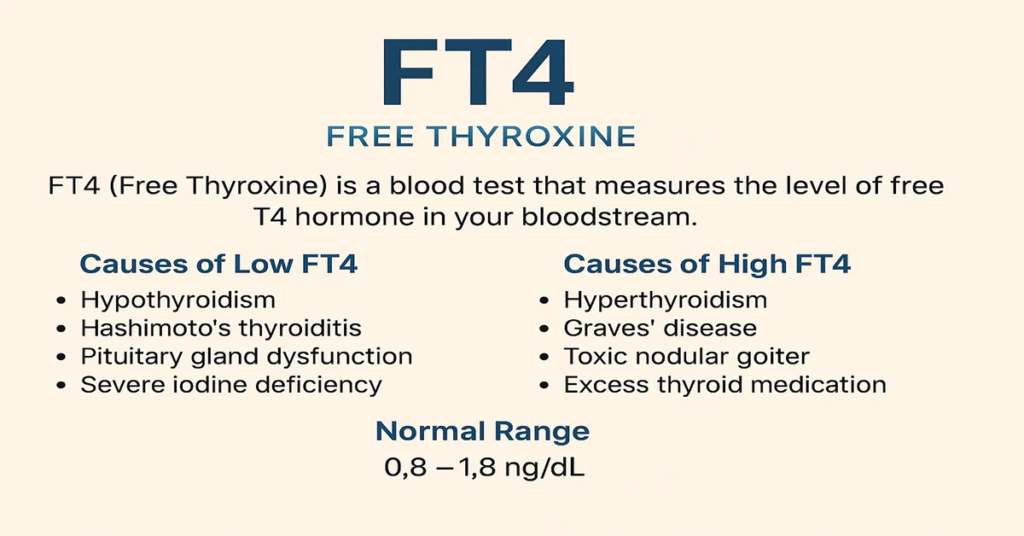
FT4 (Free Thyroxine) Test – Complete Detailed Guide
Introduction
The FT4 (Free Thyroxine) Test is a core investigation used to assess how effectively the thyroid gland is functioning. The thyroid has a broad influence across the body, helping regulate metabolism, energy use, body temperature, heart activity, digestion, and mental clarity. When thyroid hormone balance shifts, these systems often respond in noticeable but sometimes subtle ways.
The FT4 test specifically measures the free, unbound portion of thyroxine circulating in the blood. This fraction is not attached to transport proteins and is immediately available for use by body tissues. Because of this, FT4 provides a more accurate reflection of thyroid hormone activity than total T4 in many clinical situations, particularly when protein levels are altered by pregnancy, medications, or systemic illness.
In routine practice, FT4 is used to help diagnose thyroid disorders, clarify abnormal TSH results, and monitor thyroid-related conditions over time.
What is FT4?
FT4 refers to Free Thyroxine, the unbound form of the thyroid hormone T4. The thyroid gland produces two main hormones: T4, which acts primarily as a circulating reserve, and T3, which is the more active hormone at the tissue level.
Most T4 in the bloodstream is attached to carrier proteins and remains inactive. Only a small percentage circulates freely. This free portion is what the FT4 test measures, offering insight into how much thyroid hormone is actually available to the body at any given moment.
Clinically, this distinction matters. Changes in protein binding can alter total T4 levels without reflecting true thyroid function, whereas FT4 remains a more stable indicator of hormonal availability.
Where is FT4 Produced in the Body?
FT4 is produced exclusively by the thyroid gland, located at the front of the neck. Its production is regulated through a well-coordinated feedback system.
The pituitary gland releases Thyroid Stimulating Hormone (TSH), which signals the thyroid to produce T4 and T3. Once released into the bloodstream, most T4 binds to carrier proteins, while a small fraction remains free. This free portion is what laboratories measure as FT4.
This regulatory loop functions like a thermostat. When thyroid hormone levels fall, TSH rises to stimulate production. When hormone levels increase, TSH falls. Disruption at any level of this system can result in abnormal FT4 values.
Functions and Importance of FT4
Although FT4 is less biologically active than T3, it plays a central role in thyroid hormone balance because it serves as the main source from which T3 can be produced when needed.
FT4 contributes to metabolic regulation by influencing how efficiently the body uses energy, processes nutrients, and maintains internal temperature. It supports normal heart rhythm, muscle tone, and physical endurance. In the nervous system, adequate FT4 levels help maintain concentration, memory, and emotional stability.
FT4 is also important for growth and development, particularly during childhood, and supports normal digestive function by helping maintain intestinal motility. In practical terms, FT4 acts as a steady hormonal reserve that allows the body to adapt to changing metabolic demands.
Causes of Low FT4 Levels
Low FT4 levels generally indicate reduced thyroid hormone production or impaired regulation of the thyroid system. This pattern is commonly associated with hypothyroid states.
Common Causes
Low FT4 may be seen when the thyroid gland itself is underactive, when autoimmune processes affect hormone production, or when pituitary signaling is reduced. Certain medications and medical treatments can also influence FT4 levels. In some cases, systemic illness can temporarily suppress thyroid hormone activity without permanent thyroid disease.
Symptoms of Low FT4 (Hypothyroidism)
When FT4 levels are reduced, metabolic processes tend to slow.
Individuals may experience persistent fatigue, gradual weight gain, sensitivity to cold, dry skin, hair thinning, constipation, and slowed heart rate. Mood changes, reduced concentration, and subtle swelling may also occur. These changes often develop gradually, which is why early thyroid dysfunction can be overlooked.
Causes of High FT4 Levels
High FT4 levels suggest excessive thyroid hormone release or increased thyroid activity, a pattern typically associated with hyperthyroidism.
Common Causes
This may occur due to autoimmune stimulation of the thyroid, hormone-producing nodules, inflammation of the thyroid gland, or excess thyroid hormone exposure. Hormonal changes during pregnancy or from certain medications can also influence FT4 values. Rarely, pituitary-related causes may be involved.
Symptoms of High FT4 (Hyperthyroidism)
Elevated FT4 accelerates metabolic activity throughout the body.
Common clinical features include palpitations, nervousness, heat intolerance, increased sweating, unintentional weight loss, tremors, sleep disturbance, and increased bowel activity. Muscle weakness and fatigue may occur despite increased energy expenditure. Persistent elevation places strain on the cardiovascular system over time.
Reference (Normal) Ranges
Reference ranges can vary slightly by laboratory, but commonly accepted values include:
Free T4 (FT4): 0.8 – 1.8 ng/dL
Values below this range may suggest reduced thyroid hormone activity, while values above it may indicate increased activity. FT4 results are always interpreted alongside TSH and, when appropriate, FT3 to form a complete clinical picture.
Sample Type and Collection
Sample Type: Serum (blood)
Tube Used: Red Top (Plain) or SST
Fasting: Usually not required
A small blood sample is collected from a vein. Results are typically available within one working day, depending on laboratory processing.
Test Preparation
Most individuals do not need special preparation for an FT4 test.
Biotin supplements should be avoided for at least 48 hours prior to testing, as they can interfere with assay accuracy. All medications, particularly thyroid hormone therapy, should be disclosed to the clinician. Thyroid medication timing on the day of testing should follow medical advice.
When to Consult a Doctor
Medical review is recommended if symptoms such as unexplained weight changes, persistent fatigue, palpitations, temperature intolerance, hair or skin changes, menstrual irregularities, or concentration difficulties are present.
Abnormal FT4 results often prompt further evaluation, which may include repeat testing, additional thyroid hormone measurements, antibody testing, or imaging studies, depending on the clinical context.
Important Word Explanations
Thyroid Gland
A gland in the neck that produces hormones regulating metabolism and energy use.
Thyroxine (T4)
The main circulating thyroid hormone that serves as a precursor to T3.
Triiodothyronine (T3)
The more active thyroid hormone that directly influences metabolic activity.
TSH (Thyroid Stimulating Hormone)
A pituitary hormone that regulates thyroid hormone production.
Hypothyroidism
A state of reduced thyroid hormone activity.
Hyperthyroidism
A state of excessive thyroid hormone activity.
Autoimmune Disease
A condition in which the immune system reacts against the body’s own tissues.
~END~
Related Posts
None found
Cool blog.
Great info.