
FT3 (Free Triiodothyronine) Test: Meaning, Normal Range, Purpose, Causes, Symptoms & Complete Guide
Overview
The FT3 (Free Triiodothyronine) Test measures the amount of free, biologically active T3 hormone present in the blood. T3 is one of the primary hormones produced by the thyroid gland and plays a direct role in regulating metabolism, energy production, heart activity, brain function, and overall cellular performance.
In the bloodstream, most T3 remains attached to transport proteins and is inactive. The FT3 test focuses only on the unbound fraction — the portion that actually enters tissues and produces metabolic effects. For this reason, FT3 provides valuable insight into how actively the thyroid system is working at the tissue level.
Clinically, FT3 is especially helpful when evaluating suspected hyperthyroidism, unclear thyroid profiles, or situations where symptoms do not match TSH or T4 values. It is almost always interpreted alongside TSH and Free T4 for a complete thyroid assessment.
What is FT3 (Free Triiodothyronine)?
FT3 represents the active form of triiodothyronine that is freely available to body tissues. Unlike Total T3, which includes both bound and unbound hormone, FT3 reflects the hormone that directly influences metabolic activity.
This distinction is important in practice. Protein-bound T3 serves mainly as a reserve, while FT3 determines how strongly thyroid hormone effects are being expressed at the cellular level. Even small changes in FT3 can have noticeable physiological effects.
Where is FT3 Produced in the Body?
FT3 originates from two main pathways.
A smaller portion is produced directly by the thyroid gland itself. The majority, however, is generated outside the thyroid through conversion of T4 (thyroxine) into T3 in organs such as the liver, kidneys, muscles, and other peripheral tissues.
Only a very small fraction of total T3 circulates as free T3. This is why FT3 measurement is particularly useful — it reflects the hormone that is immediately available for use rather than stored or inactive hormone.
Main Functions and Importance of FT3
FT3 plays a central role in coordinating energy use and metabolic balance across the body.
It regulates how efficiently carbohydrates, fats, and proteins are converted into usable energy. When FT3 is low, metabolism slows; when it is high, metabolic processes accelerate.
FT3 also contributes to normal body temperature regulation, cardiovascular rhythm, muscle strength, and oxygen utilization at the cellular level. In the nervous system, it supports mental clarity, mood stability, memory, and emotional balance.
Digestive motility, reproductive hormone balance, and general stamina are also influenced by FT3 levels. In practical terms, FT3 functions as the metabolic “output signal” of the thyroid system.
Causes of Low FT3 Levels
Low FT3 levels usually indicate reduced thyroid hormone activity at the tissue level or impaired conversion of T4 into T3.
Common Causes
This pattern may be seen in underactive thyroid states, autoimmune thyroid disease, pituitary-related signaling problems, or during chronic or severe systemic illness. Certain medications and prolonged physiological stress can also suppress FT3 levels.
In hospitalized or critically ill patients, low FT3 may appear temporarily without permanent thyroid disease, reflecting an adaptive metabolic response.
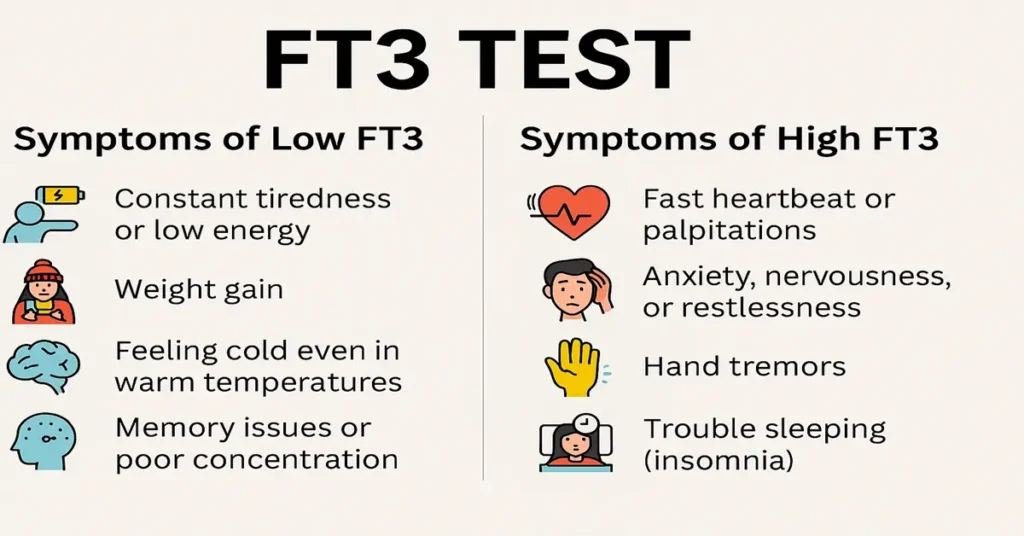
Symptoms of Low FT3 Levels
When FT3 is reduced, overall metabolic activity slows.
People may experience persistent fatigue, reduced tolerance to cold, slowed heart rate, constipation, low mood, dry skin, hair thinning, and difficulty concentrating. Subtle swelling and menstrual irregularities may develop over time.
Symptoms often progress gradually and may be mistaken for general fatigue or stress in early stages.
Causes of High FT3 Levels
High FT3 levels suggest excessive thyroid hormone activity or increased conversion of T4 into T3.
Common Causes
This pattern is most often associated with overactive thyroid conditions, autoimmune stimulation of the thyroid, overactive thyroid nodules, or inflammatory release of stored hormone. Excess hormone exposure may also elevate FT3.
High FT3 is a characteristic finding in some forms of hyperthyroidism, even when T4 levels remain within range.
Symptoms of High FT3 Levels
Elevated FT3 accelerates metabolic processes beyond normal limits.
Individuals may notice rapid or irregular heartbeat, heat intolerance, excessive sweating, tremors, nervousness, sleep disturbance, increased bowel activity, and unintended weight loss. Fatigue is common despite increased activity levels.
More pronounced elevations place additional strain on the heart and nervous system.
Reference (Normal) Ranges for FT3
Reference ranges can vary slightly between laboratories, but commonly used values include:
Free T3 (FT3): 2.3 – 4.2 pg/mL
Values below this range may suggest reduced thyroid activity, while values above it may indicate increased thyroid activity. FT3 results are always interpreted together with TSH and Free T4 for accurate clinical assessment.
Sample Type and Test Details
Sample Type: Serum (blood)
Tube Used: Red Top (Plain tube)
Fasting Required: Not usually required
FT3 testing is commonly performed alongside TSH, Free T4, Total T3, and thyroid antibody tests. Results are generally available within one working day.
Test Preparation
Most patients do not require fasting before an FT3 test.
Thyroid medications should be taken only as advised on the day of testing. Biotin supplements should be stopped several days before the test, as they can interfere with thyroid hormone assays. Medications that influence thyroid function should be disclosed to the clinician before testing.
When to Consult a Doctor
Medical review is recommended if symptoms such as unexplained weight changes, persistent fatigue, temperature intolerance, palpitations, mood changes, hair or skin alterations, or menstrual irregularities are present.
Abnormal FT3 results should always be reviewed in combination with TSH and Free T4 rather than interpreted in isolation.
Test Preparation (Detailed)
Maintaining usual daily routines before testing helps ensure reliable results. Heavy physical exertion immediately before blood collection may influence hormone levels and is best avoided.
Recent exposure to iodine-containing contrast agents or supplements should be communicated to the laboratory or clinician, as these can affect thyroid-related measurements.
Important Word Explanations
FT3 (Free Triiodothyronine)
The active thyroid hormone available for immediate use by body cells.
T4 (Thyroxine)
A precursor thyroid hormone that is converted into T3 in body tissues.
TSH (Thyroid Stimulating Hormone)
A pituitary hormone that regulates thyroid hormone production.
Hypothyroidism
A state of reduced thyroid hormone activity.
Hyperthyroidism
A state of excessive thyroid hormone activity.
Graves’ Disease
An autoimmune condition that overstimulates the thyroid gland.
Sick Euthyroid Syndrome
Temporary changes in thyroid hormone levels during severe illness.
Metabolism
The body’s process of converting nutrients into energy.
~END~
Related Posts
None found