
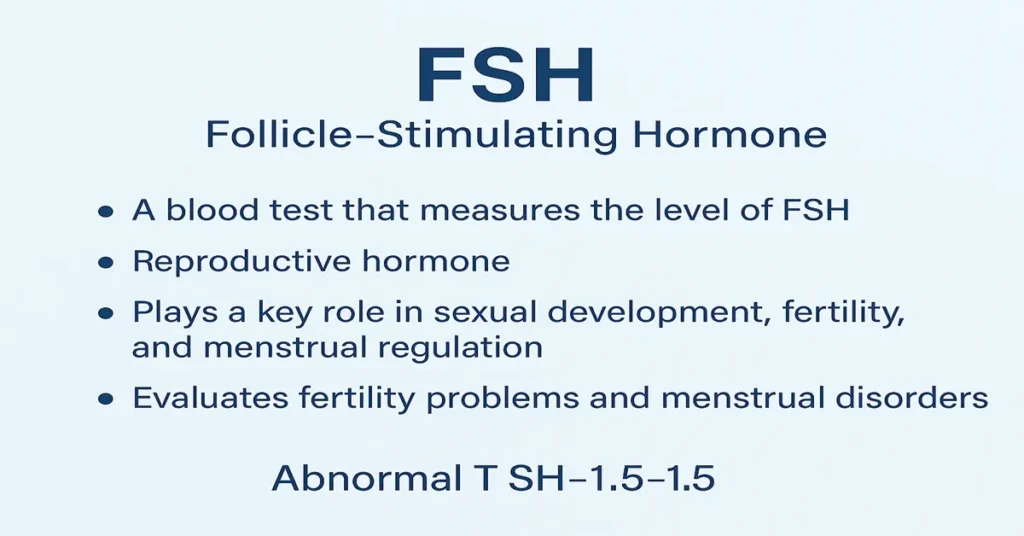
FSH (Follicle-Stimulating Hormone) Test – Complete, Easy, and Detailed Guide
Introduction
The FSH (Follicle-Stimulating Hormone) test is a routine blood test that helps doctors understand how the reproductive hormone system is functioning. FSH plays a key role in fertility, puberty, and the normal working of the ovaries in women and the testes in men. It is produced by the pituitary gland, a small gland at the base of the brain that quietly controls many of the body’s hormone signals.
Because FSH is closely linked to egg development, sperm production, and reproductive maturity, this test is commonly requested when there are concerns about fertility, irregular menstrual cycles, delayed or early puberty, or suspected hormone imbalance. In clinical practice, FSH is rarely interpreted alone. It is usually reviewed alongside related hormones to build a clearer picture of reproductive health.
What is FSH?
FSH, or Follicle-Stimulating Hormone, is a gonadotropin hormone released by the pituitary gland in response to signals from the hypothalamus. The hypothalamus produces GnRH, which acts as the command that tells the pituitary when to release FSH and LH.
FSH works in close coordination with LH (Luteinizing Hormone). Together, these hormones guide sexual development and reproductive function.
In females, FSH supports the growth and maturation of ovarian follicles, each of which contains an egg. As follicles develop, estrogen levels rise and help regulate the menstrual cycle.
In males, FSH supports sperm production by acting on specific cells within the testes and helps maintain normal testicular function over time.
The FSH test measures how actively the pituitary gland is sending reproductive signals to the ovaries or testes.
Where is FSH Produced in the Body?
FSH is produced in the anterior pituitary gland. Its release is part of a carefully balanced communication system between the brain and reproductive organs.
The hypothalamus releases GnRH, which stimulates the pituitary gland. In response, the pituitary releases FSH into the bloodstream. FSH then travels to the ovaries in females or the testes in males, where it supports hormone production and reproductive cell development.
This coordinated interaction is known as the hypothalamic–pituitary–gonadal axis. When this axis functions smoothly, puberty, fertility, and hormone balance are maintained. Disruption at any level can affect FSH levels and reproductive health.
Functions and Importance of FSH
FSH has different roles in women and men, but in both, it is essential for normal reproductive function.
In females, FSH stimulates ovarian follicles to mature during each menstrual cycle. As these follicles develop, they produce estrogen, which helps regulate the cycle and prepares the body for ovulation. Along with LH, FSH supports the timing and coordination of ovulation.
In males, FSH supports sperm production by acting on the cells responsible for nurturing developing sperm. During puberty, it plays a role in testicular maturation, and throughout adulthood it helps maintain ongoing fertility.
Overall, FSH is essential for sexual development, reproductive hormone balance, and fertility. Changes in FSH levels often serve as early signals that the ovaries or testes are not responding normally.
Causes of Low FSH Levels
Low FSH levels suggest reduced hormone signaling from the brain to the reproductive organs. This usually points toward altered function of the pituitary gland or hypothalamus rather than a problem originating in the ovaries or testes themselves.
Common Causes
Low FSH may be seen in conditions affecting pituitary or hypothalamic function, during prolonged physical or emotional stress, in severe undernutrition, or with certain medications that suppress hormone release. In some hormonal conditions, FSH may appear low or inappropriately normal despite reproductive symptoms.
Symptoms of Low FSH Levels
Symptoms vary depending on age and sex.
In females, low FSH may be associated with irregular or absent menstrual cycles, reduced estrogen effects, difficulty conceiving, or delayed puberty in younger individuals.
In males, it may be linked to reduced sperm production, fertility concerns, delayed puberty, or features associated with lower testosterone activity.
Because FSH works as part of a hormone network, symptoms often develop gradually and are usually assessed together with other hormone results.
Causes of High FSH Levels
High FSH levels generally indicate that the ovaries or testes are not responding adequately to stimulation. The pituitary gland increases FSH output in an attempt to encourage hormone production from these organs.
Common Causes
In women, elevated FSH is commonly seen during menopause and may also appear when ovarian function declines earlier than expected. In men, high FSH often reflects impaired testicular function. Genetic conditions, medical treatments affecting the gonads, or age-related changes can also influence FSH levels.
Symptoms of High FSH Levels
In females, high FSH may be associated with irregular or absent periods, difficulty conceiving, or symptoms related to reduced estrogen activity.
In males, elevated FSH can be linked to fertility issues, low testosterone-related features, or reduced testicular function.
High FSH itself is a laboratory signal rather than a diagnosis and usually prompts further hormonal evaluation.
Reference (Normal) Ranges
FSH values vary depending on age, sex, and menstrual cycle phase.
Females
- Follicular phase: 3.5 – 12.5 mIU/mL
- Ovulation phase: 4.7 – 21.5 mIU/mL
- Luteal phase: 1.7 – 7.7 mIU/mL
- Postmenopausal: 25.8 – 134.8 mIU/mL
Males
- 1.5 – 12.4 mIU/mL
Children (pre-puberty)
- Typically below 3.0 mIU/mL
Reference ranges may vary slightly between laboratories and should always be interpreted in clinical context.
Sample Type
Sample Type: Serum (blood)
Tube Used: Red Top (Plain) or SST
Fasting: Not required
The test involves a routine blood draw and is usually completed quickly.
Test Preparation
The FSH test generally does not require fasting. Patients should inform their doctor about any hormone-related medications, including birth control pills, fertility treatments, or steroid medications. In women, test timing may be aligned with the menstrual cycle for more meaningful interpretation. Heavy physical exertion just before testing is usually avoided.
When to Consult a Doctor
Medical advice is recommended if there are concerns such as irregular or absent periods, difficulty conceiving, symptoms of early menopause, delayed or early puberty, reduced libido, or unexplained fertility issues. FSH results are often reviewed together with LH, estrogen, testosterone, prolactin, or other hormone tests to better understand the overall hormonal pattern.
Important Word Explanations
FSH (Follicle-Stimulating Hormone)
A pituitary hormone that supports egg development in females and sperm production in males.
LH (Luteinizing Hormone)
A hormone that works alongside FSH to regulate ovulation and testosterone production.
GnRH
A hormone released by the hypothalamus that signals the pituitary to produce FSH and LH.
Pituitary Gland
A small gland at the base of the brain that controls multiple hormone systems.
Ovaries / Testes
Reproductive organs responsible for hormone production and egg or sperm development.
Hypogonadism
A condition in which the ovaries or testes produce insufficient hormones.
~END~
Related Posts
None found