
Overview
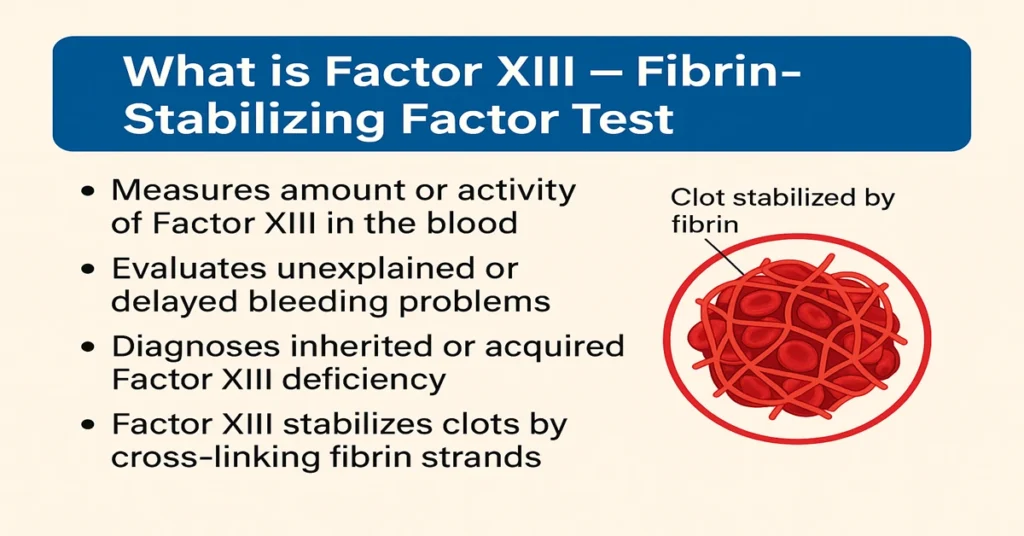
Factor XIII is a clotting protein that plays a crucial role in the final stage of blood clot formation. It is also known as the Fibrin-Stabilizing Factor. Unlike clotting factors that help start the clotting process, Factor XIII works after a clot has already formed. Its job is to strengthen that initial clot, making it stable, durable, and resistant to early breakdown.
The Factor XIII test measures either the activity of this protein or the amount present in the blood. Clinically, it is requested when bleeding patterns do not match routine clotting test results. It is particularly helpful in evaluating unexplained or delayed bleeding, poor wound healing, and certain pregnancy-related bleeding complications. Although Factor XIII deficiency is rare, it is considered significant because bleeding may appear late rather than immediately after injury.
What is the Factor XIII Test?
The Factor XIII test evaluates how effectively this clot-stabilizing protein is functioning in the body. Depending on the laboratory method, it may assess Factor XIII activity (functional performance) or Factor XIII antigen (quantity present).
This test is typically ordered when routine clotting tests such as PT and aPTT are normal, yet bleeding symptoms persist. Clinicians often think of Factor XIII testing in cases of delayed bleeding after surgery or trauma, unexplained bleeding in children, repeated pregnancy loss, or wounds that fail to heal as expected. Another key clinical clue is serious bleeding, including intracranial hemorrhage, occurring without obvious injury.
Because Factor XIII works after clot formation, its deficiency does not affect initial clotting tests. This delayed action explains why bleeding may begin hours later, once a weak clot dissolves.
Where is Factor XIII Produced in the Body?
Factor XIII is produced in more than one location, reflecting its role beyond simple clot formation. The liver contributes significantly to circulating levels, similar to many other coagulation proteins. Bone marrow cells involved in clotting and tissue repair also participate in its production.
In addition, certain white blood cells, particularly monocytes, contribute to Factor XIII related to inflammation and healing. Platelets store Factor XIII and release it directly at the site of injury, where it reinforces the forming clot. From a laboratory viewpoint, this multi-source production explains why Factor XIII behaves differently from many other clotting factors.
Main Functions and Importance of Factor XIII
Factor XIII has a distinct and specialized role in coagulation and tissue repair.
1. Strengthens and Stabilizes Clots
Once a clot has formed, Factor XIII cross-links fibrin strands. This process converts a soft, fragile clot into a firm, stable structure and helps protect it from breaking down too early.
2. Helps in Wound Healing
By stabilizing the clot framework, Factor XIII supports the early stages of tissue repair. Clinicians often associate low levels with wounds that heal slowly or reopen.
3. Maintains Pregnancy
Factor XIII contributes to stable attachment of the placenta to the uterine wall. Reduced activity has been associated with repeated pregnancy loss, often without obvious early warning signs.
4. Prevents Delayed Bleeding
While many clotting factors prevent immediate bleeding, Factor XIII is especially important in preventing bleeding that occurs hours or even a day later, after an initially formed clot fails.
Causes of Low Factor XIII Levels
Low Factor XIII levels may be inherited or acquired, and interpretation usually requires correlation with clinical history.
1. Inherited Factor XIII Deficiency
This is a rare genetic condition passed through families. Bleeding may appear early in life, sometimes presenting as umbilical stump bleeding or spontaneous intracranial bleeding.
2. Liver Disease
Since the liver contributes to Factor XIII production, liver dysfunction can reduce circulating levels, often alongside other coagulation abnormalities.
3. Autoimmune Disorders
In some cases, the immune system produces antibodies that interfere with or destroy Factor XIII, leading to acquired deficiency.
4. Severe Infections or DIC
In systemic clotting disorders such as disseminated intravascular coagulation, clotting factors may be consumed rapidly, including Factor XIII.
5. Certain Medications
Some drugs can interfere with clotting factor production or function, which may be reflected in reduced Factor XIII activity.
Symptoms of Low Factor XIII Levels
Low Factor XIII levels are often associated with delayed bleeding, which is a distinguishing feature. Bleeding may start hours after surgery or injury rather than immediately.
Other commonly observed features include easy bruising, poor wound healing, soft-tissue or muscle bleeding, and bleeding from the umbilical cord in newborns. Women may experience recurrent miscarriages. In severe deficiency, intracranial bleeding can occur, sometimes without clear trauma. The severity of symptoms varies widely depending on how low the activity level is.
Causes of High Factor XIII Levels
Factor XIII is not routinely evaluated for high levels, as excess activity rarely causes clinical problems. Mild increases may be seen during pregnancy, inflammatory states, or following tissue injury. These elevations are generally considered physiological rather than pathological.
Symptoms of High Factor XIII Levels
Elevated Factor XIII levels usually do not cause symptoms. Unlike some other clotting factors, higher levels are not strongly linked to increased clotting risk and typically do not require clinical intervention.
Reference Ranges
Factor XIII activity is usually reported as a percentage of normal activity.
- Typical reference range: 50% – 150%
Ranges may vary depending on age, laboratory methodology, and whether activity or antigen testing is performed. Very low levels, particularly below 5%, are associated with severe deficiency and higher bleeding risk.
Sample Type
The test is performed on a venous blood sample collected from an arm vein.
- Tube: Light blue top
- Additive: Sodium citrate
Sodium citrate prevents clotting within the tube, allowing accurate measurement of Factor XIII function in the laboratory.
Test Preparation
Fasting is not required for Factor XIII testing. Patients are generally advised to avoid heavy physical exertion before sample collection.
It is important to inform the doctor about current medications, including blood thinners, steroids, or anti-inflammatory drugs. A history of liver disease, recent severe infection, recurrent miscarriages, or inherited bleeding disorders should also be shared, as these details guide interpretation.
When to Consult a Doctor
Bleeding Symptoms
Medical evaluation is recommended for bleeding that begins hours after injury, excessive bleeding following surgery or dental work, frequent bruising, poor wound healing, heavy menstrual bleeding, or repeated nosebleeds.
Pregnancy Concerns
Women with recurrent miscarriages or abnormal bleeding during pregnancy should seek medical assessment.
Serious Symptoms (Emergency)
Immediate care is required for severe headache, vomiting, weakness, confusion, sudden abdominal or back pain, or bleeding that does not stop. These may indicate serious internal bleeding.
Important Word Explanations
- Factor XIII: A clotting protein that stabilizes formed clots
- Fibrin: Protein strands that form the structural framework of a clot
- Cross-linking: The process of strengthening fibrin strands
- DIC: A severe condition involving widespread clotting and bleeding
- Antigen: The amount of protein present in the blood
- Activity Test: Measures how well the protein functions
~END~
Related Posts
None found