
Overview
Factor XII, also known as the Hageman Factor, is a distinctive protein within the intrinsic pathway of the coagulation system. Unlike most clotting factors, low levels of Factor XII do not lead to bleeding problems. Individuals with very low or absent Factor XII activity usually have normal bleeding in everyday life and during surgery. Interestingly, some may show a higher tendency toward clot formation. This unusual behavior makes Factor XII more relevant for interpretation than for bleeding risk itself.
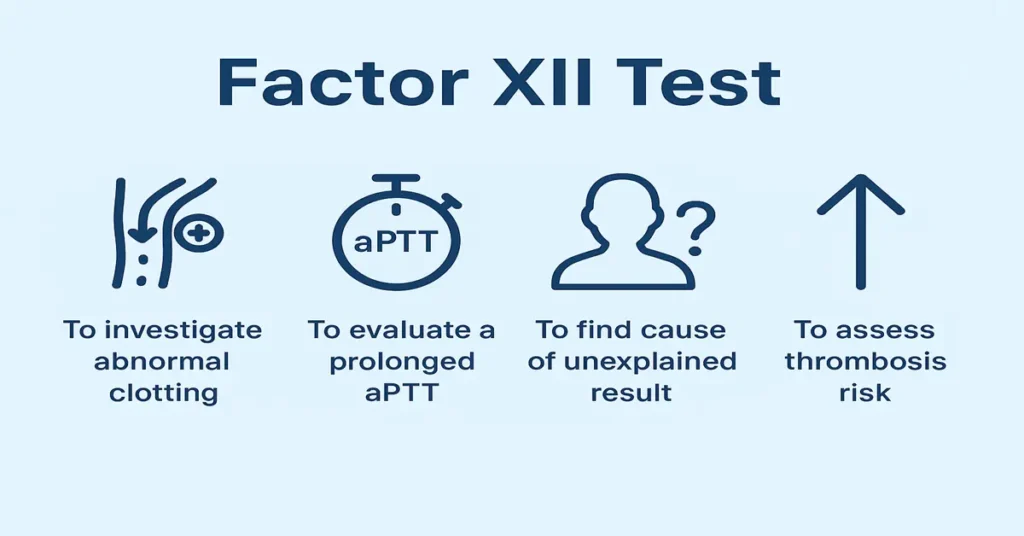
The Factor XII Activity Test is most often ordered when a routine clotting test, particularly the aPTT, is prolonged in someone who has no bleeding symptoms. In such situations, the test helps clinicians distinguish between a true bleeding disorder and a benign laboratory finding related to Factor XII deficiency.
What is Factor XII?
Factor XII is a clotting protein that circulates in the bloodstream in an inactive form. It becomes activated when it comes into contact with certain surfaces, such as exposed collagen or negatively charged areas within blood vessels. Once activated to Factor XIIa, it initiates the intrinsic pathway in laboratory clotting tests.
From a clinical perspective, Factor XII behaves differently from other clotting factors. Although it clearly affects clotting measurements in the laboratory, its absence does not impair normal hemostasis in the body. Instead, Factor XII appears to play broader roles in inflammatory pathways, fibrinolysis, immune responses, and activation of the kallikrein–kinin system.
Where is Factor XII Produced in the Body?
Factor XII is produced in the liver, similar to many other coagulation proteins. After synthesis, it enters the circulation as an inactive precursor and becomes active only when exposed to specific triggers.
These triggers include damage to the blood vessel lining, contact with negatively charged surfaces, or exposure to foreign materials such as catheter surfaces. Because liver health is essential for its production, liver disorders can influence Factor XII levels, a point routinely considered when interpreting results.
Main Functions and Importance of Factor XII
Although not required for normal bleeding control, Factor XII has several important physiological roles.
1. Activates the Intrinsic Coagulation Pathway
When activated, Factor XII initiates the intrinsic pathway by activating Factor XI. This sequence eventually leads to thrombin and fibrin formation in laboratory systems, even though it is not essential for clotting in everyday life.
2. Triggers the Kallikrein–Kinin System
Factor XII plays a central role in activating the kallikrein–kinin system, which influences blood pressure regulation, inflammation, pain signaling, and vascular permeability.
3. Plays a Role in Inflammation
Activated Factor XII promotes the formation of bradykinin through kallikrein activation. Bradykinin is involved in vessel dilation and inflammatory responses.
4. Involved in Fibrinolysis
Factor XII contributes to activation of plasminogen, supporting fibrinolysis, the natural process by which clots are broken down.
5. Unique Clinical Behavior
A key feature of Factor XII is its paradoxical nature. Deficiency does not cause bleeding, yet it may be associated with a higher tendency toward thrombosis. This distinction is important during result interpretation.
Causes of Low Factor XII Levels
Low Factor XII activity may be identified incidentally during clotting tests and can occur for several reasons.
1. Inherited Factor XII Deficiency
This rare genetic condition leads to very low or absent Factor XII activity. Affected individuals typically do not experience abnormal bleeding, despite markedly prolonged aPTT results. Some may show an increased tendency for clot formation.
2. Severe Liver Disease
Conditions such as cirrhosis, chronic hepatitis, or liver failure can reduce Factor XII production, along with other clotting proteins.
3. Nephrotic Syndrome
In nephrotic syndrome, proteins—including clotting factors—may be lost through the urine, leading to reduced circulating levels.
4. Autoimmune Conditions
In some cases, antibodies may interfere with Factor XII, reducing measurable activity.
Symptoms of Low Factor XII Levels
Factor XII deficiency is usually asymptomatic. Most individuals have no bleeding problems, even after surgery or injury, and wound healing remains normal.
In some cases, low Factor XII activity has been associated with an increased risk of clot formation, such as deep vein thrombosis or pulmonary embolism. A prolonged aPTT in an otherwise asymptomatic patient is often the first indication that Factor XII levels are low.
Causes of High Factor XII Levels
Elevated Factor XII levels may be seen in certain physiological or disease states. These include inflammation, pregnancy, hormonal therapy, some cardiovascular conditions, and certain malignancies. Higher levels are generally interpreted as markers of a pro-thrombotic tendency rather than a disease by themselves.
Symptoms of High Factor XII Levels
High Factor XII levels do not usually cause direct symptoms. However, if clotting risk is increased, individuals may experience signs related to thrombosis, such as leg swelling or pain, sudden chest discomfort with breathing difficulty, or neurological symptoms. These situations require prompt medical assessment.
Reference Ranges
Factor XII activity is commonly reported as a percentage of normal activity.
- Typical reference range: 50% – 150%
Reference ranges may vary slightly between laboratories. Low Factor XII activity often results in a prolonged aPTT despite the absence of bleeding symptoms.
Sample Type
The test is performed on a venous blood sample collected from an arm vein.
- Tube: Light blue top
- Additive: Sodium citrate
Sodium citrate binds calcium and prevents clotting within the tube, allowing accurate coagulation testing. Plasma is used for analysis.
Test Preparation
No fasting is required. Patients are usually advised to avoid heavy physical activity before sample collection.
It is important to inform the doctor about the use of anticoagulants, hormonal medications, or steroids, as well as any history of liver disease, nephrotic syndrome, or recent infections. These details assist in accurate interpretation.
When to Consult a Doctor
Unusual Bleeding
Although uncommon in Factor XII deficiency, medical advice should be sought for unexpected bleeding, excessive bruising, prolonged bleeding after surgery, or blood in urine or stool.
Symptoms of Possible Blood Clots
Urgent medical care is needed for leg pain or swelling, sudden chest pain, breathing difficulty, severe headache, or sudden loss of speech or vision. These symptoms require emergency evaluation.
Important Word Explanations
- Factor XII (Hageman Factor): A clotting protein involved in the intrinsic pathway
- Intrinsic Pathway: The internal coagulation mechanism measured by aPTT
- aPTT: A test assessing intrinsic pathway function
- Kallikrein–Kinin System: Regulates inflammation and blood vessel responses
- Fibrinolysis: The process of breaking down blood clots
- Sodium Citrate Tube: A blood collection tube used for coagulation testing
~END~
Related Posts
None found