
Overview
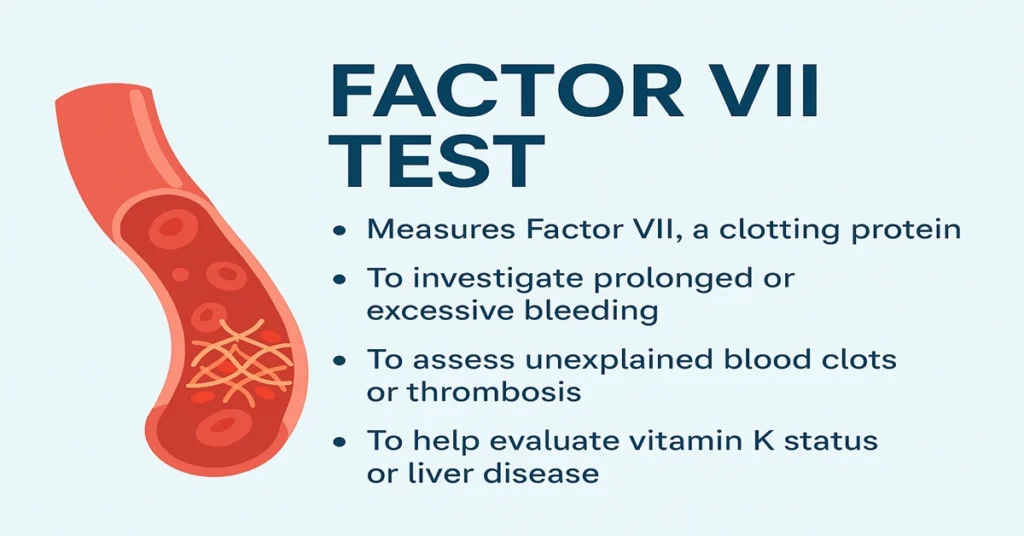
Factor VII is a blood-clotting protein that plays an important role in the very first phase of the body’s coagulation response. It is also known as Proconvertin or Stable Factor. When a blood vessel is injured, Factor VII is quickly activated to Factor VIIa and initiates the extrinsic pathway of coagulation. This early response helps convert blood from a flowing state into a stable clot, limiting ongoing bleeding.
Testing Factor VII activity is commonly used to assess unexplained bleeding or clotting tendencies, evaluate liver function–related clotting changes, detect vitamin K–related abnormalities, and monitor the effect of certain anticoagulant medications such as warfarin. In clinical practice, it is often interpreted along with other coagulation tests rather than in isolation.
What is Factor VII?
Factor VII is one of the essential components of hemostasis—the finely balanced process that allows blood to clot when needed while remaining fluid inside intact vessels. Under normal conditions, Factor VII circulates in the bloodstream in an inactive form.
When tissue damage occurs, tissue factor (TF) is released from injured cells. Factor VII binds to this tissue factor and becomes activated, forming the Factor VIIa–TF complex. This complex acts as a trigger for downstream clotting reactions that ultimately lead to clot formation. Clinicians view Factor VII as a “starter signal” for coagulation rather than a factor that works alone.
Low Factor VII activity generally signals delayed clot initiation, while higher activity may indicate a tendency toward increased clot formation. These findings are always interpreted in the clinical context.
Where is Factor VII Produced in the Body?
Factor VII is produced in the liver, similar to most other coagulation factors. Its synthesis depends on the presence of vitamin K, which is required for proper activation of the molecule.
From a laboratory perspective, this means that conditions affecting liver function or vitamin K availability can influence Factor VII levels. Because Factor VII has a relatively short half-life, it often reflects recent changes in liver function or anticoagulant effects earlier than other clotting factors.
Key points clinicians keep in mind include:
- The liver is the primary site of production
- Vitamin K is essential for activation
- Liver disease or vitamin K disruption may alter levels
Main Functions and Importance of Factor VII
Factor VII plays a focused but critical role in coagulation, particularly in the early phase of clot formation.
1. Activates the Extrinsic Pathway of Coagulation
When tissue injury occurs, Factor VII binds rapidly to tissue factor, initiating the extrinsic pathway. This pathway represents the body’s fastest response to bleeding.
2. Converts Factor X into Factor Xa
The activated Factor VII–tissue factor complex triggers the conversion of Factor X to Factor Xa, an important step in the clotting cascade.
3. Helps Produce Thrombin
Factor Xa contributes to the conversion of prothrombin into thrombin, a central enzyme in clot development.
4. Leads to Formation of Fibrin
Thrombin converts fibrinogen into fibrin strands, which stabilize the clot structure.
5. Essential for Early Bleeding Control
Adequate Factor VII activity allows bleeding to slow quickly after injury. Reduced activity can result in delayed clot formation, which becomes clinically relevant during surgery, trauma, or invasive procedures.
Causes of Low Factor VII Levels
Reduced Factor VII activity may be seen in a variety of inherited or acquired conditions. In laboratory interpretation, this finding often points clinicians toward broader evaluations rather than a single diagnosis.
1. Inherited Factor VII Deficiency
This is a rare genetic condition, usually inherited in an autosomal recessive pattern, in which the body produces insufficient or functionally impaired Factor VII.
2. Liver Disease
Because Factor VII is synthesized in the liver, conditions such as hepatitis, cirrhosis, or liver failure commonly result in reduced levels.
3. Vitamin K Deficiency
Vitamin K is required for Factor VII synthesis and activation. Reduced availability may occur due to malabsorption, liver disorders, prolonged antibiotic use, or during the newborn period.
4. Warfarin Therapy
Warfarin interferes with vitamin K activity, and Factor VII is often one of the earliest clotting factors to decrease during therapy.
5. Severe Systemic Coagulation Disorders
In conditions such as disseminated intravascular coagulation (DIC), clotting factors may be consumed faster than they are produced.
Symptoms of Low Factor VII Levels
Low Factor VII activity may present with bleeding tendencies, although the severity varies widely between individuals.
Common clinical features include easy bruising, frequent nosebleeds, prolonged bleeding after minor cuts, and excessive bleeding following surgery or dental procedures. Some individuals may notice blood in urine or stool, or heavier-than-expected menstrual bleeding.
In more severe deficiencies, internal bleeding can occur, including joint or intracranial bleeding, though this is uncommon. Clinicians assess symptoms alongside laboratory values rather than relying on numbers alone.
Causes of High Factor VII Levels
Elevated Factor VII activity is generally viewed as a marker of increased clotting potential rather than a standalone disease.
Common associations include:
1. Inflammation or Infection
Factor VII behaves as an acute-phase reactant and may rise during systemic illness.
2. Pregnancy
Clotting factors naturally increase during pregnancy as a protective mechanism against bleeding.
3. Estrogen Exposure
Oral contraceptives or estrogen therapy may increase Factor VII levels.
4. Metabolic Conditions
Obesity and metabolic syndrome have been associated with higher clotting factor activity.
5. Certain Cardiovascular Conditions
Elevated levels may be observed in individuals with higher thrombotic risk profiles.
Symptoms of High Factor VII Levels
Elevated Factor VII itself does not usually cause noticeable symptoms. However, increased clotting tendency may contribute to thrombotic events.
Warning signs that require urgent medical evaluation include leg swelling or pain suggestive of deep vein thrombosis, sudden chest pain or breathlessness, and neurological symptoms such as sudden weakness or speech difficulty. These symptoms are treated as medical emergencies.
Reference Ranges
Factor VII activity is typically reported as a percentage of normal activity.
- Approximate reference range: 50% – 150%
Laboratory ranges may vary depending on testing methods and reagents, so results should always be interpreted using the reporting laboratory’s reference values.
Sample Type
Factor VII testing is performed on a venous blood sample.
- Tube: Light blue top
- Additive: Sodium citrate
Sodium citrate prevents clotting within the collection tube, allowing accurate assessment of coagulation activity.
Test Preparation
Fasting is generally not required for Factor VII testing. Patients are usually advised to avoid strenuous physical activity before sample collection.
It is important to inform the healthcare provider about the use of anticoagulants such as warfarin, estrogen-containing medications, vitamin K supplementation, known liver disease, or a history of bleeding or clotting disorders. These details help clinicians interpret results accurately.
When to Consult a Doctor
Bleeding Symptoms
Medical advice should be sought for frequent nosebleeds, unexplained bruising, heavy menstrual bleeding, blood in urine or stool, or bleeding that is slow to stop.
Clotting Symptoms
Immediate medical attention is required for leg swelling or pain, sudden chest pain, breathlessness, severe headache, vision changes, or stroke-like symptoms.
Important Word Explanations
- Factor VII: A clotting protein that initiates the extrinsic coagulation pathway
- Proconvertin: Another name for Factor VII
- Thrombin: An enzyme essential for fibrin clot formation
- Extrinsic Pathway: The coagulation pathway activated by tissue injury
- Tissue Factor (TF): A protein released from damaged tissue that activates Factor VII
- DIC: A severe condition involving widespread clotting and bleeding
- Warfarin: An anticoagulant that reduces vitamin K–dependent clotting factors
~END~
Related Posts
None found