
Overview
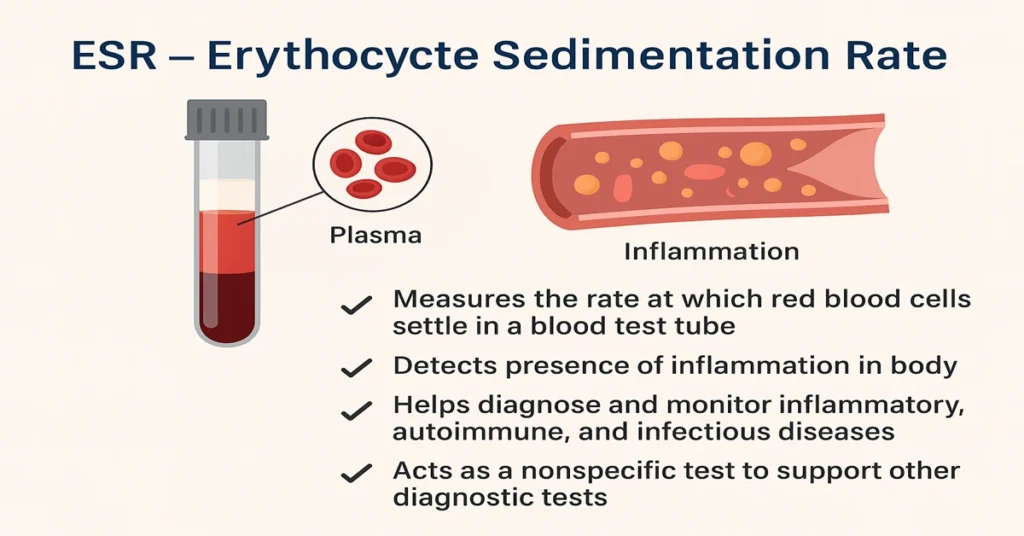
The ESR (Erythrocyte Sedimentation Rate) test is a commonly used blood test that helps doctors detect the presence of inflammation somewhere in the body. It measures how quickly red blood cells settle at the bottom of a vertical tube over one hour. Under normal conditions, red blood cells settle slowly. When inflammation is present, certain blood proteins increase and cause the cells to stick together, making them fall faster.
From a laboratory perspective, ESR is not a diagnostic test for a single disease. Instead, it acts as a broad indicator that something inflammatory may be happening. It is often used as an initial clue, especially when symptoms are vague, long-standing, or difficult to explain clinically.
What is the ESR Test?
The ESR test measures the speed at which red blood cells settle in a test tube, reported in millimeters per hour (mm/hr). A higher value means the cells are settling faster than expected, which usually reflects increased inflammatory activity in the blood.
Clinicians often request ESR as a supportive test. It may be used to screen for inflammation, to help confirm suspected inflammatory or autoimmune conditions, or to follow disease activity over time. Because the test is simple and widely available, it is frequently included in routine evaluations.
Where is ESR Produced in the Body?
ESR itself is not produced by the body. It is a laboratory measurement that reflects changes happening in the blood.
The value is influenced mainly by two factors. First are plasma proteins, especially fibrinogen and certain immunoglobulins, which rise during inflammation and are largely produced by the liver. Second are red blood cells, produced in the bone marrow, whose number, size, and shape affect how easily they settle. When these elements change, the ESR changes as a result.
Importance and Functions of the ESR Test
Despite being nonspecific, ESR remains clinically valuable in many situations. It helps identify the presence of inflammation when physical findings are unclear. It is frequently used in the assessment of chronic inflammatory and autoimmune diseases, such as rheumatoid arthritis, lupus, polymyalgia rheumatica, and temporal arteritis.
From a monitoring standpoint, ESR is useful for tracking disease activity over time. A falling ESR often aligns with reduced inflammatory activity, while a rising value may prompt further evaluation. Doctors usually interpret ESR alongside other tests, such as CRP and a complete blood count, to get a clearer picture.
Causes of Low / Negative ESR Levels
A low ESR is generally less concerning and often has limited clinical significance. It may be seen in conditions where red blood cells do not settle easily, such as when the red cell count is high or their shape is abnormal. Certain blood disorders and states with lower levels of inflammatory proteins can also result in a lower ESR.
Symptoms Related to Low ESR
Low ESR values do not cause symptoms by themselves. Any symptoms present are related to the underlying condition rather than the ESR result. For this reason, low values are usually interpreted in context rather than acted upon in isolation.
Causes of High / Positive ESR Levels
An elevated ESR usually reflects increased inflammatory proteins in the blood. This can be seen in infections, autoimmune disorders, chronic inflammatory states, kidney disease, and some cancers. ESR may also rise in non-disease states such as pregnancy or anemia, which is why it must always be interpreted carefully.
In clinical practice, a high ESR often raises a question rather than provides an answer. It tells the doctor that further evaluation may be needed to identify the cause of inflammation.
Symptoms Related to High ESR
ESR itself does not produce symptoms. The symptoms a patient experiences depend entirely on the underlying condition. These may include fever, fatigue, joint pain, weight loss, or other disease-specific features. Persistently high ESR values usually prompt doctors to look for a chronic or ongoing inflammatory process.
Reference Ranges
ESR values vary with age and sex, and mild increases can be normal in older adults. Typical reference ranges are interpreted alongside clinical findings rather than in isolation. A value outside the reference range does not automatically indicate disease, especially if symptoms and other tests are normal.
Sample Type
The test requires a venous blood sample. The blood is mixed with an anticoagulant and placed in a vertical tube. After one hour, the distance the red blood cells have settled is measured to calculate the ESR.
Test Preparation
No fasting is required for an ESR test. Patients are generally advised to avoid strenuous exercise just before testing. It is helpful to inform the doctor about pregnancy, recent infections, anemia, or medications, as these can influence the result.
When to Consult a Doctor
Medical advice is recommended if ESR is significantly elevated without a clear explanation, or if it remains high over time. Symptoms such as persistent fever, unexplained fatigue, joint pain, weight loss, or headaches with visual changes should always be discussed with a doctor. Sudden or severe symptoms require prompt evaluation, regardless of the ESR value.
Important Word Explanations
- Erythrocytes: Red blood cells that carry oxygen.
- Inflammation: The body’s response to infection or tissue injury.
- Fibrinogen: A blood protein that increases during inflammation and affects ESR.
- Autoimmune disease: A condition in which the immune system attacks the body’s own tissues.
- CRP: C-reactive protein, another marker of inflammation often used with ESR.
- Sedimentation: The settling of particles in a liquid.
- Temporal arteritis: An inflammatory condition affecting arteries in the head.
~END~
Related Posts
None found