
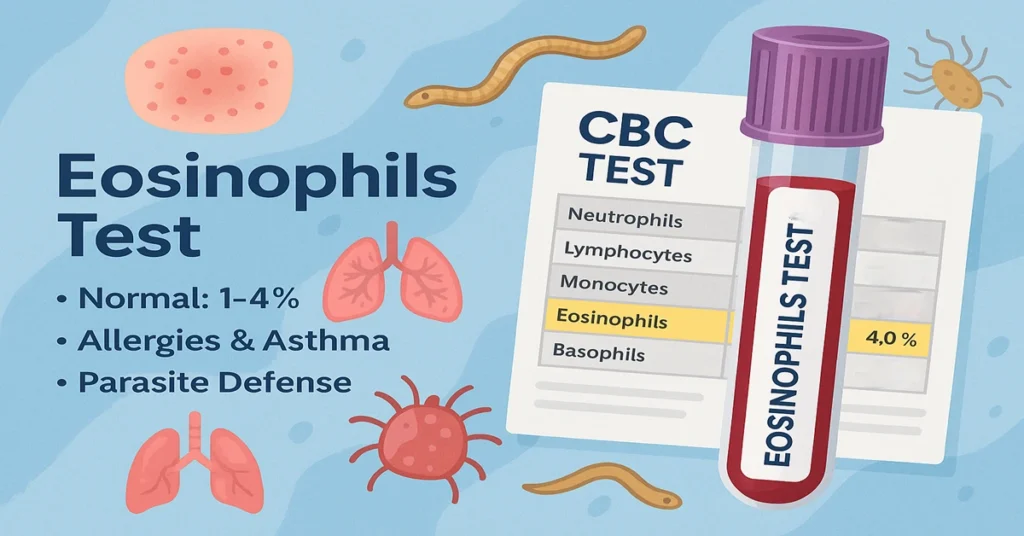
Eosinophils Test: Meaning, Normal Range, Low & High Eosinophil Causes, Symptoms, and Complete Medical Guide
What Are Eosinophils?
Eosinophils are a specific type of white blood cell and belong to the granulocyte group. They are involved mainly in immune responses related to allergies, parasitic infections, and certain inflammatory processes. Under the microscope, eosinophils are easily recognized by their reddish-pink granules, which contain substances used in immune defense.
In healthy individuals, eosinophils are present in relatively small numbers in the bloodstream. Most of their activity takes place within tissues such as the lungs, skin, and digestive tract. From a clinical point of view, this is important because changes in blood eosinophil levels often reflect what is happening in these tissues rather than a problem limited to the blood itself.
Where Are Eosinophils Produced?
Eosinophils are produced in the bone marrow from hematopoietic stem cells, the same source as other blood cells. After maturation, they enter the bloodstream briefly and then migrate into body tissues, where they remain active for longer periods.
They are commonly found in areas that frequently interact with the external environment, including the skin, respiratory tract, and gastrointestinal system. This distribution allows eosinophils to respond quickly when the body encounters allergens, parasites, or inflammatory signals.
Functions and Importance of Eosinophils
Eosinophils have specialized immune roles and contribute to maintaining balance within the immune system.
Defending Against Parasites
Eosinophils are particularly important in responses against parasitic infections. They release proteins and enzymes that damage or neutralize parasites that are too large to be handled by other white blood cells.
Allergy Response
In allergic conditions, eosinophils become activated and release inflammatory substances. This response helps identify and react to allergens, although excessive activation can contribute to allergy-related symptoms.
Controlling Inflammation
Eosinophils help regulate inflammation by releasing signals that either amplify or limit immune activity. This regulation helps protect tissues from unnecessary damage.
Releasing Enzymes and Toxins
Their granules contain immune-active substances that participate in defense mechanisms and inflammatory control.
Working With Other Immune Cells
Eosinophils interact with other immune cells such as mast cells, basophils, and lymphocytes. This coordination helps shape the overall immune response.
Clinically, eosinophils are most useful as indicators of certain immune patterns rather than as markers of a single disease.
Causes of Low Eosinophils (Eosinopenia)
Low eosinophil levels are referred to as eosinopenia. In most clinical situations, this finding reflects the body’s response to stress, illness, or medication rather than a primary disorder of eosinophils.
Steroid medications commonly suppress eosinophil levels. Acute physical stress, trauma, or surgery may also cause temporary reductions. Conditions associated with high cortisol levels can influence eosinophil production, and severe infections may shift immune activity toward other white blood cell types.
Doctors generally consider eosinopenia in context, as isolated low values are often not clinically significant on their own.
Symptoms of Low Eosinophils
Low eosinophil counts usually do not produce specific symptoms. Instead, they may signal the presence of stress, infection, or medication effects.
From a clinical perspective, attention is directed toward the underlying condition rather than the eosinophil count itself.
Causes of High Eosinophils (Eosinophilia)
High eosinophil levels are known as eosinophilia. This finding often reflects heightened immune activity.
Parasitic infections are a well-known cause. Allergic and inflammatory conditions frequently raise eosinophil levels as part of the immune response. Certain autoimmune conditions and chronic inflammatory states may also be associated with eosinophilia.
In some cases, blood-related disorders can lead to persistently elevated eosinophils. Drug-related immune reactions may also influence counts. Clinicians assess whether eosinophilia is mild and temporary or persistent and significant.
Symptoms of High Eosinophils
Symptoms associated with eosinophilia depend largely on the underlying cause rather than the eosinophil count itself. People may experience respiratory symptoms in allergic conditions, skin changes such as itching or rashes, or digestive symptoms when the gastrointestinal tract is involved.
Clinically, symptoms are interpreted as part of a broader immune or inflammatory picture rather than being attributed solely to eosinophils.
Eosinophil Reference Range
Reference ranges vary slightly between laboratories, but commonly accepted values include:
Absolute Eosinophil Count (AEC)
Normal: 0 – 500 cells/µL
Percentage of Total WBCs
Normal: 1% – 4%
Doctors consider both the absolute count and the percentage, along with other CBC values, to assess eosinophil status accurately.
Sample Type and Collection
- Sample Required: Whole blood
- Collection Tube: Lavender-top EDTA tube
Blood is drawn from a vein, usually in the arm. Eosinophil levels are measured automatically as part of a CBC with differential. Results are typically available the same day.
Test Preparation
No fasting is required for an eosinophils test. Hydration status and recent illnesses are considered during interpretation. Doctors also review medications, particularly steroids or allergy-related treatments, when evaluating eosinophil results.
The eosinophil count is almost always interpreted alongside other white blood cell parameters.
When to Consult a Doctor
Medical advice is recommended if allergic symptoms are frequent or persistent, unexplained rashes occur, or digestive or respiratory symptoms continue without a clear cause. Follow-up is also important when eosinophil levels remain consistently high or low on repeated testing.
People with chronic inflammatory conditions, suspected parasitic exposure, or ongoing immune-related symptoms may require closer evaluation. Early assessment helps clarify whether findings are reactive or require further investigation.
Important Word Explanations
- Eosinophils: White blood cells involved in allergic reactions, parasitic defense, and inflammation control.
- Eosinophilia: A condition where eosinophil levels are higher than normal.
- Eosinopenia: A condition where eosinophil levels are lower than normal.
- Granulocytes: White blood cells containing granules, including eosinophils, neutrophils, and basophils.
- CBC with Differential: A blood test that provides detailed counts of all white blood cell types.
~END~
Pingback: WBC Test (White Blood Cell Count) – Normal Range, Low & High Causes, Symptoms - ALL ABOUT TESTS