
Overview
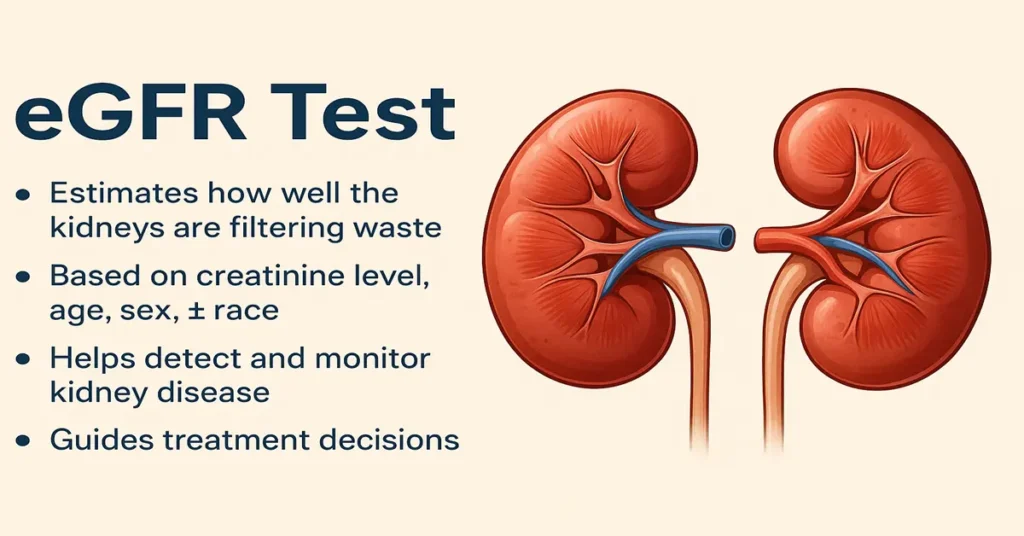
The eGFR (Estimated Glomerular Filtration Rate) test is one of the most useful blood-based indicators of how well the kidneys are working. The kidneys act as the body’s filtration system, quietly removing waste products, excess salts, and extra fluid from the blood throughout the day. The eGFR value gives clinicians a practical estimate of how efficiently this filtering process is happening.
Importantly, eGFR is not a direct measurement. It is a calculated estimate based on the blood creatinine level along with factors such as age and sex. Because kidney disease often progresses slowly and without obvious early symptoms, eGFR plays a key role in detecting reduced kidney function before complications appear.
What is eGFR?
The Estimated Glomerular Filtration Rate (eGFR) represents how much blood the kidneys can filter each minute, adjusted to a standard body surface area (mL/min/1.73 m²).
In general terms, higher values suggest better kidney filtration, while lower values signal reduced function. Values above 90 are commonly seen in healthy adults, though this varies with age. As numbers fall, doctors become more alert to the possibility of chronic or acute kidney problems and use the trend over time to guide further evaluation.
eGFR Is Not a Substance Produced in the Body
Unlike hormones or enzymes, eGFR is not something the body makes. It is a calculated figure derived mainly from the serum creatinine level.
Creatinine is a waste product formed from normal muscle activity. Healthy kidneys remove it efficiently. When kidney filtration slows, creatinine accumulates in the blood, and the calculated eGFR decreases. For this reason, eGFR reflects kidney performance rather than acting as a standalone substance.
How is eGFR Calculated?
Laboratories calculate eGFR using validated equations that combine creatinine with personal factors that influence muscle mass and kidney function. Commonly used formulas include:
- CKD-EPI equation, now preferred for most adults
- MDRD equation, used in earlier practice
- Schwartz formula, designed for children
These equations typically account for creatinine level, age, and sex, and they standardize results to a typical body size. The CKD-EPI equation is widely used today because it performs well across a broad range of kidney function.
Main Functions and Importance of the eGFR Test
1. Evaluates Kidney Function
eGFR provides a clear snapshot of how effectively the kidney filters—specifically the function of the glomeruli, the tiny filtering units inside each kidney.
2. Detects Early Kidney Changes
Early kidney disease may not cause noticeable symptoms. A falling eGFR can be the first signal that kidney function is declining.
3. Helps Monitor Chronic Kidney Disease (CKD)
Tracking eGFR over time allows doctors to see whether kidney function is stable or changing, which is often more informative than a single value.
4. Guides Medication Decisions
Many medications are cleared through the kidneys. eGFR helps clinicians decide whether standard doses are appropriate or need adjustment.
5. Assists Long-Term Planning
When eGFR becomes very low, it helps clinicians and patients plan ahead for advanced kidney care, including discussions around supportive therapies.
Normal eGFR Values by Age
Kidney filtration naturally declines with age. Younger adults often have higher values, while older adults may have lower readings that are still appropriate for their age group. For this reason, eGFR is always interpreted alongside age, medical history, and other test results.
Causes of Low eGFR Levels
A reduced eGFR usually reflects impaired kidney filtration. This may be seen in long-standing conditions such as chronic kidney disease, or in short-term situations like dehydration or acute illness. Conditions that affect kidney blood flow, kidney structure, or urinary outflow can all influence the eGFR.
Clinicians focus not only on the number itself, but also on whether the value is stable, improving, or steadily declining.
Symptoms of Low eGFR
eGFR itself does not cause symptoms. However, as kidney function declines, waste products and fluid may accumulate, leading to symptoms such as swelling, fatigue, changes in urine appearance, or difficulty concentrating. These features usually appear only when kidney impairment is more advanced.
Causes of High eGFR
Higher-than-average eGFR values are uncommon and usually not concerning. They may be seen temporarily in situations such as pregnancy or in people with low muscle mass, where creatinine levels are naturally lower. In most cases, a high eGFR does not indicate disease.
Symptoms of High eGFR
High eGFR values generally do not cause symptoms and are often found incidentally during routine testing.
How the eGFR Test is Performed
The test begins with a standard blood sample. The laboratory measures serum creatinine and then calculates eGFR automatically using an established formula. No urine sample is required for this calculation.
Who Should Get the eGFR Test?
eGFR testing is commonly recommended for people with conditions that affect kidney health, such as diabetes, high blood pressure, heart disease, or a family history of kidney problems. It is also used to monitor kidney function in older adults and in people taking medications that can affect the kidneys.
Test Preparation
No fasting is usually needed. Staying well hydrated helps ensure accurate creatinine measurement. Patients should inform their doctor about supplements, muscle-building products, or medications that may influence creatinine levels.
When to Consult a Doctor
Medical advice is recommended if eGFR remains below 60 for several months, drops suddenly compared with previous results, or is accompanied by symptoms such as swelling, breathlessness, or changes in urine. Very low values require prompt medical attention and close follow-up.
Reference Ranges for eGFR
eGFR values are interpreted in ranges that reflect kidney function stages:
- ≥90 mL/min/1.73 m²: Normal filtration, if no other signs of kidney damage
- 60–89 mL/min/1.73 m²: Mildly reduced filtration
- 30–59 mL/min/1.73 m²: Moderately reduced filtration
- 15–29 mL/min/1.73 m²: Severely reduced filtration
- <15 mL/min/1.73 m²: Kidney failure
These ranges guide monitoring and clinical decisions but are always interpreted in context.
Sample Type
The eGFR calculation is based on a blood (serum) sample used to measure creatinine. No urine collection is required for this estimate.
Important Word Explanations
- Creatinine: A waste product from muscle activity used to estimate kidney filtration.
- Glomeruli: Tiny filtering units inside the kidneys.
- CKD (Chronic Kidney Disease): Long-term reduction in kidney function.
- Acute Kidney Injury: Sudden decline in kidney function.
- Filtration Rate: The speed at which kidneys clean the blood.
- Proteinuria: Presence of protein in urine, suggesting kidney damage.
- Dialysis: A method to remove waste from the blood when kidneys can no longer do so.
~END~
Good day! Do you use Twitter? I’d like to follow you
if that would be ok. I’m definitely enjoying your blog and look forward to new posts.