
Overview
The Echinococcus Antibody Test is a blood test used to detect antibodies formed against Echinococcus species—parasitic tapeworms responsible for echinococcosis, also known as hydatid disease. This condition most often affects the liver and lungs, where it leads to the formation of fluid-filled structures called hydatid cysts.
In routine clinical practice, this test is usually requested after imaging studies such as ultrasound, CT scan, or MRI reveal cystic lesions that appear suspicious for a parasitic origin. The antibody result helps support or exclude echinococcosis as the cause and provides useful context when planning further evaluation or follow-up.
What Is an Echinococcus Antibody Test?
The Echinococcus Antibody Test measures IgG antibodies produced by the immune system in response to exposure to Echinococcus larvae. These antibodies do not appear immediately; they develop as the immune system recognizes and reacts to the parasite over time.
Doctors typically order this test when imaging findings raise concern for hydatid cysts, when a patient has lived in or traveled to regions where livestock farming is common, or when there is a clinical need to assess response after treatment or surgery. The test is not used in isolation but as a supportive tool alongside clinical findings and imaging results.
Where Are These Antibodies Produced?
Echinococcus parasites are not produced within the human body. Humans become accidental hosts after ingesting parasite eggs, usually through contaminated food, water, soil, or close contact with infected animals.
Once inside the body, the eggs release larvae that migrate through the bloodstream and settle in organs such as the liver or lungs, where they slowly form hydatid cysts. As the immune system encounters these larvae and their antigens, it produces IgG antibodies. These antibodies circulate in the blood and are what the laboratory test detects.
Main Functions and Importance of the Test
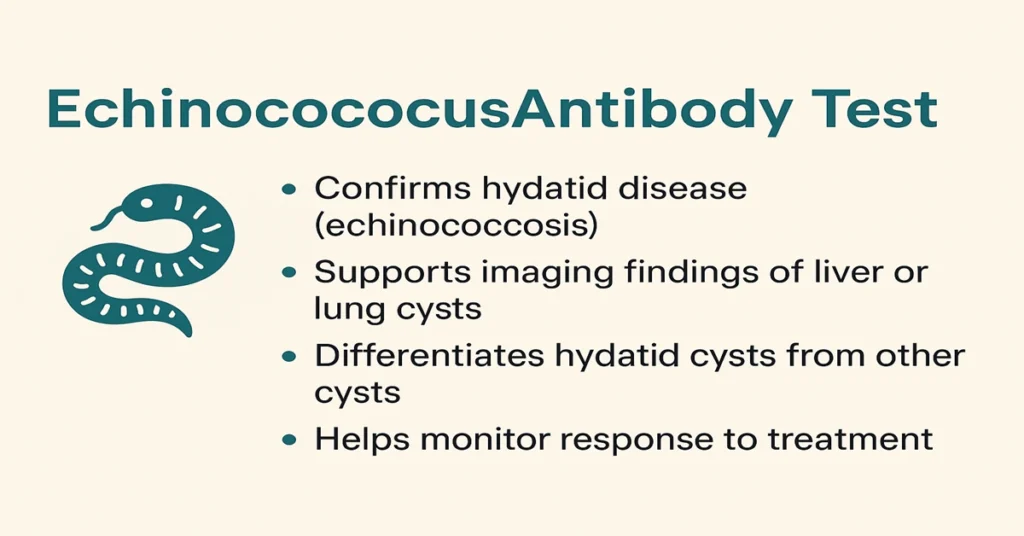
The Echinococcus Antibody Test has several important clinical roles. It helps confirm suspected echinococcosis when imaging findings are suggestive but not definitive. It also supports differentiation between hydatid cysts and non-parasitic cysts or tumors that may look similar on scans.
In patients already diagnosed with hydatid disease, antibody levels can be followed over time to provide a general sense of immune response after surgery or medical treatment. In addition, a sudden rise in antibody levels may alert clinicians to complications such as cyst leakage or rupture, which require urgent attention.
Causes of Low / Negative Antibody Levels
A negative or low antibody result can be seen in people who have never been infected. It may also occur in the very early stages of infection, before the immune system has produced measurable antibodies.
In some cases, intact or well-contained cysts provoke only a limited immune response, leading to low antibody levels despite the presence of disease. Individuals with weakened immune systems may also produce fewer antibodies, which can result in a falsely negative test.
Symptoms of Low / Negative Levels
When the test is truly negative, there are usually no symptoms related to hydatid disease. If the result is falsely negative, symptoms may still be present but are related to the physical effects of the cyst itself—such as pressure or discomfort—rather than the antibody level.
Causes of High / Positive Antibody Levels
A positive antibody test generally reflects exposure to Echinococcus. This is most commonly seen with active infection and established hydatid cysts. Antibody levels tend to be higher when cysts are leaking or ruptured, as more parasitic antigens are released into the body.
Antibodies can remain detectable for months or even years after treatment, so a positive result does not always mean ongoing active disease. Occasionally, antibodies from other parasitic infections may cross-react, leading to a false-positive result.
Symptoms of High / Positive Levels
Symptoms associated with positive antibody results depend mainly on the location and size of the cysts rather than the antibody level itself.
Liver involvement may cause abdominal discomfort, a feeling of fullness, nausea, or jaundice if bile ducts are compressed. Lung cysts can lead to cough, chest pain, or shortness of breath. Cysts in other organs are less common but can cause organ-specific symptoms.
If a cyst ruptures, symptoms can become sudden and severe, including intense pain or allergic reactions. Such situations require immediate medical care.
Reference Ranges
Interpretation varies by laboratory method, but results are generally reported as negative, equivocal, or positive. Because antibody testing alone cannot confirm disease activity, results must always be correlated with imaging findings and the overall clinical picture.
Sample Type
The test is performed on a blood (serum) sample collected from a vein. Fasting is not usually required.
Test Preparation
No special preparation is typically needed. Patients should inform their doctor about prior exposure risks, previous hydatid disease, or use of immunosuppressive medications. Bringing relevant imaging reports helps with accurate interpretation.
When to Consult a Doctor
Medical advice should be sought if symptoms such as persistent abdominal pain, chronic cough, chest discomfort, or unexplained swelling are present. Sudden severe pain, fever, or signs of an allergic reaction may indicate cyst rupture and require urgent evaluation.
Follow-up with a doctor is also important after treatment if symptoms persist or new concerns arise.
Important Word Explanations
- Echinococcus: A parasitic tapeworm that causes hydatid disease.
- Hydatid cyst: A fluid-filled cyst formed by Echinococcus larvae in organs.
- IgG antibodies: Immune proteins that indicate exposure to infection.
- ELISA: A laboratory technique used to detect specific antibodies.
- Cross-reactivity: When antibodies react with similar organisms, causing misleading results.
- Cyst rupture: A serious complication where a hydatid cyst breaks open inside the body.
~END~
Related Posts
None found