
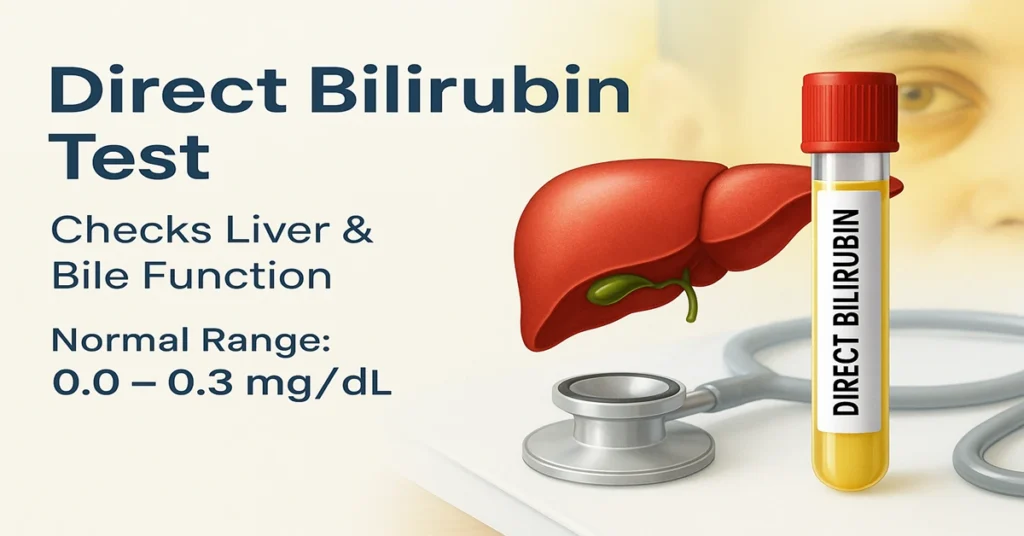
Direct Bilirubin Test: Meaning, Normal Range, High & Low Levels, Symptoms, and Complete Medical Guide
What Is Direct Bilirubin?
Direct bilirubin, also called conjugated bilirubin, is the form of bilirubin that has already been processed by the liver. When red blood cells complete their normal life cycle, they break down and release hemoglobin. This hemoglobin is converted into unconjugated (indirect) bilirubin, which cannot dissolve in water.
The liver then takes over. Inside liver cells, unconjugated bilirubin is chemically modified by attaching glucuronic acid. This step converts it into direct bilirubin, a water-soluble form that the body can safely eliminate.
Direct bilirubin is measured as part of the Total Bilirubin Test. Its level helps doctors understand whether the liver is processing bilirubin correctly and whether bile is flowing normally from the liver into the intestines.
Where Is Direct Bilirubin Produced?
Direct bilirubin is not produced in a single step. It is the result of a continuous process involving blood cells, the liver, and the bile system.
Step 1: RBC Breakdown
Old red blood cells are naturally removed from circulation, mainly in the spleen, with support from the liver and bone marrow. This breakdown forms unconjugated bilirubin, which circulates in the blood bound to proteins.
Step 2: Processing in the Liver
Unconjugated bilirubin reaches the liver, where hepatocytes perform a process known as glucuronidation. This chemical change converts bilirubin into its conjugated (direct) form.
Step 3: Excretion Through Bile
Direct bilirubin is released into bile, travels through bile ducts, and enters the intestines. Most of it leaves the body through stool, while a small amount appears in urine.
When this pathway is interrupted at any stage, direct bilirubin can accumulate in the blood.
Main Functions and Importance of the Direct Bilirubin Test
Although bilirubin itself is a waste product, measuring direct bilirubin provides important clinical clues.
Evaluates Liver Function
If liver cells are damaged or stressed, they may process bilirubin but fail to release it properly into bile. Direct bilirubin levels help reflect this pattern.
Detects Bile Flow Problems
Direct bilirubin rises when bile cannot flow freely, such as in blockages or narrowing of bile ducts.
Helps Diagnose Jaundice Type
By comparing direct and indirect bilirubin, doctors can better understand whether jaundice is related to liver cells, bile obstruction, or increased red blood cell breakdown.
Assists in Monitoring Liver Conditions
Direct bilirubin is often followed over time in people with known liver disease or those taking medications that affect liver function.
For this reason, it is commonly interpreted alongside other liver function tests rather than on its own.
Causes of Low Direct Bilirubin
Low direct bilirubin levels are usually not clinically meaningful. Since bilirubin levels naturally fluctuate, values on the lower side typically reflect normal variation rather than disease.
Mild dilution of blood, individual metabolism, or laboratory variation may contribute. In routine practice, low direct bilirubin does not require further investigation unless other test results are abnormal.
Symptoms of Low Direct Bilirubin
Low direct bilirubin does not cause symptoms. It does not affect body function and is usually found incidentally during routine blood testing.
Causes of High Direct Bilirubin (Conjugated Hyperbilirubinemia)
High direct bilirubin suggests that bilirubin has been processed by the liver but is not being excreted efficiently.
Bile Duct Obstruction
When bile flow is blocked, conjugated bilirubin backs up into the bloodstream. This pattern is commonly seen with structural or inflammatory blockage.
Liver Diseases
Liver cell injury may interfere with the transport of conjugated bilirubin into bile, even when processing is intact.
Cholestasis
Reduced bile flow, whether due to medications, hormonal changes, or inherited conditions, can raise direct bilirubin levels.
Inherited Transport Disorders
Certain rare genetic conditions affect the liver’s ability to secrete conjugated bilirubin properly.
Newborn Bile Flow Disorders
In infants, abnormalities in bile ducts can lead to significant elevation and require early evaluation.
Doctors interpret direct bilirubin alongside clinical findings and other liver markers to identify the underlying pattern.
Symptoms of High Direct Bilirubin
Symptoms are related to bile retention and liver stress rather than bilirubin itself.
Common features may include yellowing of the skin or eyes, dark urine, pale stools, itching, fatigue, and abdominal discomfort—often on the right side. These signs guide doctors toward further evaluation of the liver and bile ducts.
Direct Bilirubin Reference Range
Reference ranges vary slightly by laboratory, but commonly accepted values include:
Direct (Conjugated) Bilirubin:
0.0 – 0.3 mg/dL
Direct bilirubin typically accounts for a smaller portion of total bilirubin. Interpretation is always done in comparison with total and indirect values.
Sample Type and Collection
- Sample Type: Serum
- Collection Tube: Red-top plain tube
Blood is drawn from a vein, allowed to clot, and the serum is separated for bilirubin measurement.
Test Preparation
In most cases, no special preparation is required.
Some doctors may advise short fasting when the test is part of a full liver panel. Alcohol intake before testing can influence liver-related results and is usually avoided.
Current medications, recent illness, and hydration status are also considered during interpretation.
When to Consult a Doctor
Medical evaluation is advised if direct bilirubin remains elevated on repeat testing or if symptoms such as yellowing of the eyes, dark urine, pale stools, persistent itching, fatigue, or abdominal discomfort are present.
Early assessment helps determine whether the cause lies in the liver, bile ducts, or another related system.
Important Word Explanations
- Bilirubin: Yellow pigment formed during red blood cell breakdown.
- Conjugated Bilirubin: Water-soluble bilirubin processed by the liver.
- Unconjugated Bilirubin: Bilirubin before liver processing.
- Glucuronidation: Liver process that makes bilirubin water-soluble.
- Cholestasis: Reduced or blocked bile flow.
- Hyperbilirubinemia: Elevated bilirubin levels in the blood.
~END~