
Desmoglein Antibody Test: Purpose, Results, High/Low Levels & Complete Guide
Overview
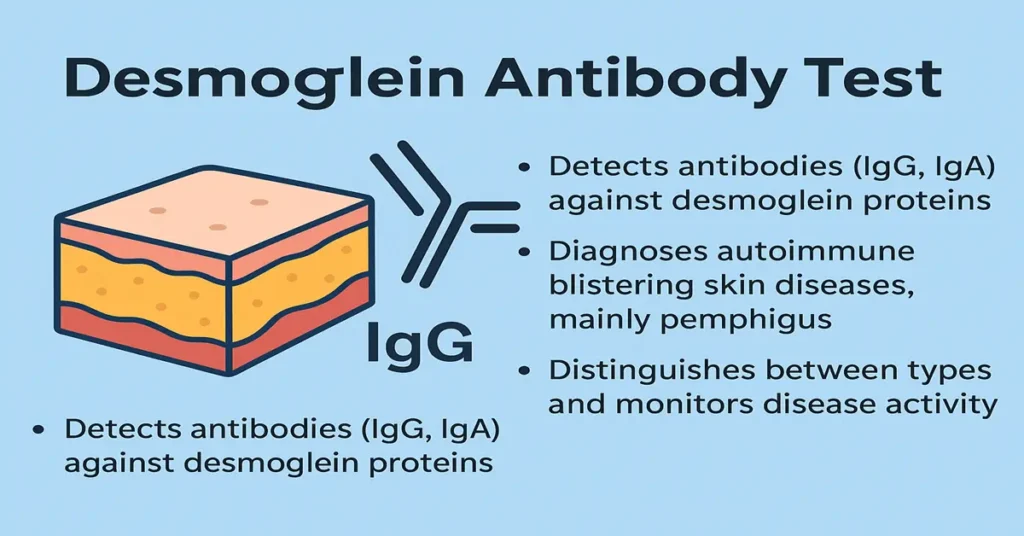
The Desmoglein Antibody Test is a specialized blood test used to detect antibodies—most commonly IgG and, in some cases, IgA—that target desmoglein proteins found in the skin and mucous membranes. The two key proteins involved are desmoglein-1 (Dsg1) and desmoglein-3 (Dsg3). These proteins are essential for keeping skin cells firmly attached to one another.
When the immune system mistakenly forms antibodies against these proteins, the connections between skin cells weaken. As a result, fragile blisters, erosions, and painful raw areas can develop on the skin or inside the mouth. From a clinical standpoint, this test is central to diagnosing autoimmune blistering disorders, particularly pemphigus vulgaris and pemphigus foliaceus.
Beyond diagnosis, the test also helps clinicians understand disease activity over time and assess how the condition is behaving during follow-up.
What Is a Desmoglein Antibody Test?
Desmogleins are part of structures called desmosomes, which act like microscopic anchors holding skin cells together. In certain autoimmune blistering diseases, the immune system produces autoantibodies against these anchors.
The Desmoglein Antibody Test measures circulating antibodies against:
- Desmoglein-1
- Desmoglein-3
These antibodies are detected using laboratory techniques such as ELISA. Measuring their presence and relative levels helps doctors determine the type of pemphigus involved and the pattern of skin or mucosal involvement.
Where Are Desmoglein Proteins Produced in the Body?
Desmoglein proteins are naturally present in tissues where strong cell-to-cell adhesion is required.
They are found predominantly in:
- The epidermis (outer layers of the skin)
- The lining of the mouth and throat
- Nasal passages
- Genital mucosa
Under normal conditions, these proteins maintain skin strength, resist friction, and support the protective barrier of the skin and mucosa. When antibodies interfere with this system, the skin becomes fragile and prone to blistering even with minimal stress.
Types of Antibodies Detected
Anti-Desmoglein-1 Antibodies
These antibodies are most often associated with pemphigus foliaceus. They mainly affect the superficial layers of the skin and typically spare the mucous membranes.
Anti-Desmoglein-3 Antibodies
These are strongly linked with pemphigus vulgaris. They involve deeper layers of the skin and mucous membranes and are commonly responsible for painful oral or throat erosions.
Combination of Both Antibodies
When both antibodies are present, it usually reflects broader disease involvement, affecting both skin and mucosal surfaces.
Main Functions and Importance of the Desmoglein Antibody Test
This test has a focused but important role in clinical dermatology.
It helps confirm the diagnosis of pemphigus and distinguish between its major subtypes based on which desmoglein is targeted. The antibody pattern also provides insight into whether mucosal involvement is likely and how extensive the disease may be.
During follow-up, antibody levels offer a useful laboratory signal of disease activity. Changes in these levels often parallel clinical improvement or worsening, helping clinicians assess trends over time. The test is also useful in separating pemphigus from other blistering conditions that can look similar on examination.
Causes of Low or Negative Levels
Low or negative antibody levels usually indicate the absence of active autoimmune blistering disease.
This may be seen in individuals without pemphigus, in patients whose disease is well controlled, or in very early stages when antibody production is minimal. In treated cases, falling levels often reflect reduced immune activity rather than complete resolution.
Symptoms When Levels Are Low or Negative
When antibody levels are low or undetectable, skin and mucous membranes typically remain intact.
Patients may notice fewer or no new blisters, improved healing of prior lesions, and less discomfort in affected areas. In those with a known diagnosis, such results usually align with a stable or improving clinical state.
Causes of High or Positive Levels
High desmoglein antibody levels are most commonly associated with autoimmune blistering disorders.
Elevated anti-desmoglein-3 levels are typical of pemphigus vulgaris, while raised anti-desmoglein-1 levels point toward pemphigus foliaceus. In some cases, both antibodies are elevated, suggesting more extensive involvement. Rarely, borderline elevations may be seen in atypical or evolving autoimmune skin conditions.
Symptoms of High or Positive Levels
Symptoms arise from loss of skin cell adhesion rather than from the antibodies themselves.
On the skin, this may appear as fragile blisters that rupture easily, leaving painful erosions or crusted areas. The skin may feel tender or burn with minor friction. When mucous membranes are involved, particularly in pemphigus vulgaris, patients often experience persistent mouth sores, throat pain, or difficulty eating due to raw lesions.
The extent and severity of symptoms vary and depend on the antibody profile and overall disease activity.
Reference Ranges
Reference ranges vary slightly by laboratory, but results are generally reported as:
- Negative: below the laboratory cutoff
- Borderline: values near the cutoff
- Positive: values clearly above the cutoff
Higher values usually correspond to more active autoimmune blistering disease, though interpretation always requires correlation with clinical findings.
Sample Type
The test is performed on a blood (serum) sample, collected through routine venipuncture. Analysis is commonly done using ELISA-based methods.
Test Preparation
No fasting is required before testing.
Patients should inform their doctor about ongoing medications, particularly steroids or immunosuppressive drugs, as these can influence antibody levels. Sharing information about symptom onset and disease history helps with accurate interpretation.
When to Consult a Doctor
A dermatologist should be consulted if unexplained blisters, raw erosions, or persistent mouth ulcers develop. Medical review is also important if lesions spread, become painful, or interfere with eating or daily activities.
For individuals already diagnosed with pemphigus, changes in symptoms or concerns about disease control often prompt repeat testing and clinical reassessment.
Important Word Explanations
- Erosion: A raw area left behind after a blister breaks.
- Desmoglein: A protein that helps skin cells adhere to each other.
- Autoimmune: A process in which the immune system attacks the body’s own tissues.
- Pemphigus: A group of autoimmune disorders causing skin and mucosal blistering.
- ELISA: A laboratory method used to detect specific antibodies in blood.
- IgG/IgA Antibodies: Types of immune proteins involved in autoimmune reactions.
~END~
Related Posts
None found