
D-Dimer Test: Purpose, High/Low Levels, Symptoms & Normal Range
Overview
The D-dimer test is a blood test used to look for evidence of abnormal blood clot formation and breakdown inside the body. D-dimer itself is a small protein fragment that appears in the blood only when a clot has been formed and is then broken down as part of the body’s natural healing process.
Under normal circumstances, clot formation and clot breakdown stay in balance. As a result, D-dimer levels in healthy individuals are usually very low. When this balance is disturbed and significant clotting occurs, higher amounts of D-dimer are released into the bloodstream.
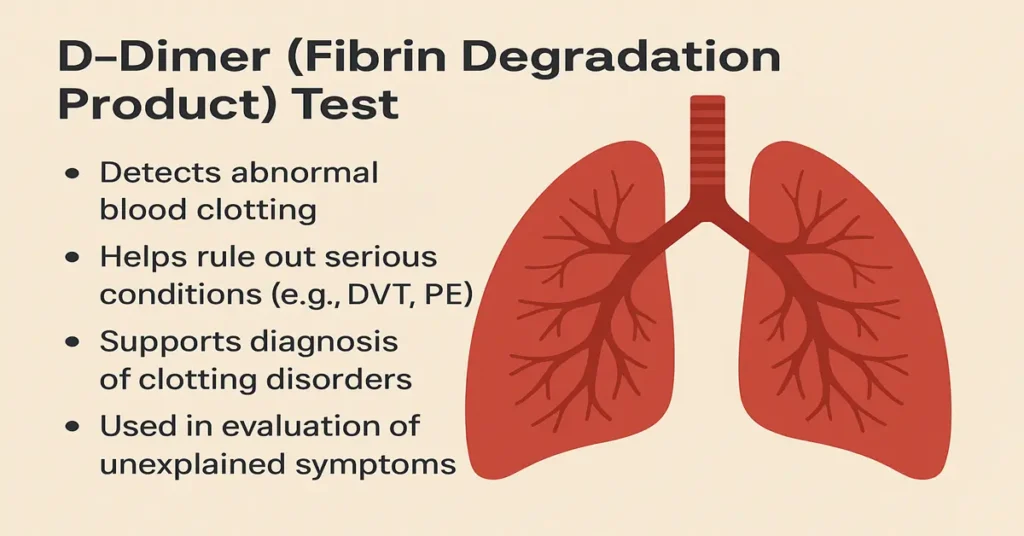
In clinical settings, this test is particularly useful in urgent situations. Doctors often rely on it to help rule out serious clot-related conditions such as deep vein thrombosis (DVT) or pulmonary embolism (PE), especially when symptoms are unclear. Its speed and reliability make it a common first-line test in emergency rooms and hospitals.
Where D-Dimer Is Produced in the Body
D-dimer is not produced by a specific organ or gland. It forms only as a by-product of clot breakdown.
When bleeding occurs, the body creates a fibrin clot to stop blood loss. Once healing begins, an enzyme system breaks this fibrin structure down. During this process, fragments of the clot—including D-dimer—enter the bloodstream and can be measured through a blood test.
Because of this mechanism, D-dimer is present only when clotting and clot breakdown are actively occurring. Its presence reflects ongoing activity rather than stored or baseline production.
Functions and Importance of the D-Dimer Test
The D-dimer test helps doctors understand whether abnormal clotting activity may be happening inside the body.
A raised level suggests that clots are being formed and dissolved more than usual. This information is valuable when assessing symptoms such as sudden leg swelling, chest pain, or unexplained breathlessness. On the other hand, a low or negative result is often just as important. In patients with a low likelihood of clotting disease, a normal D-dimer level can reliably rule out serious conditions and reduce the need for further imaging tests.
The test does not confirm a diagnosis on its own, but it guides clinical decision-making and helps determine whether additional investigations are necessary.
Causes of Low or Negative D-Dimer Levels
Low or negative D-dimer levels usually indicate that there is no significant abnormal clot formation occurring at the time of testing.
This is commonly seen in healthy individuals or in patients whose symptoms are caused by conditions unrelated to blood clots. In people already receiving anticoagulant therapy, low levels may also reflect controlled clotting activity. Clinically, a negative result provides reassurance and helps doctors safely exclude dangerous clotting disorders.
Symptoms When D-Dimer Is Low
There are no symptoms specifically caused by low D-dimer levels.
Patients with a negative result typically do not show signs associated with clot-related conditions, such as leg swelling, chest pain, or sudden breathing difficulty. When symptoms are present, they are usually due to other, non-clotting causes.
Causes of High or Positive D-Dimer Levels
High D-dimer levels indicate increased clot formation and breakdown, but they do not point to a single cause.
Elevated values are often seen in conditions such as deep vein thrombosis, pulmonary embolism, or widespread clotting disorders. They may also rise after surgery, trauma, prolonged immobility, or during severe illness. Certain physiological states, including pregnancy, and chronic conditions such as liver disease, infection, cancer, or ongoing inflammation, can also lead to higher levels.
For this reason, doctors interpret a positive D-dimer result cautiously and always in combination with symptoms, history, and other test findings.
Symptoms Associated With High D-Dimer Levels
Symptoms depend on the underlying condition rather than the D-dimer level itself.
When clots involve the deep veins of the legs, patients may notice swelling, pain, warmth, or redness in one limb. If clots affect the lungs, symptoms can include sudden chest pain, shortness of breath, dizziness, or a rapid heartbeat. In more widespread clotting disorders, unusual bleeding, bruising, or signs of organ stress may be present.
These clinical features help determine how urgently further evaluation is needed.
Reference Ranges
The commonly used reference range for D-dimer is:
Normal: less than 0.50 µg/mL FEU (fibrinogen equivalent units)
Values above this threshold suggest increased clot activity. However, interpretation always depends on age, clinical context, and the presence of symptoms. Imaging tests such as ultrasound or CT scans are often used to confirm or exclude a diagnosis when levels are elevated.
Sample Type
The D-dimer test requires a blood sample collected from a vein, usually into a tube containing anticoagulant to obtain plasma.
Laboratories analyze the sample using immunoassay-based methods, which allow rapid and reliable measurement.
Test Preparation
No fasting is required for a D-dimer test.
Patients should inform their doctor if they are taking blood-thinning medications or if they have recently had surgery, trauma, or prolonged immobility, as these factors can influence results. Drinking water beforehand can make blood collection easier.
When to Consult a Doctor
Medical attention should be sought if symptoms suggestive of clotting disorders develop, such as sudden leg swelling, unexplained chest pain, shortness of breath, or dizziness.
Consultation is also important after recent surgery, prolonged bed rest, or during serious illness if new symptoms appear. If a D-dimer result is elevated, a doctor will guide further evaluation and decide whether additional testing is needed.
Important Word Explanations
- DVT (Deep Vein Thrombosis): A blood clot in the deep veins, usually of the leg.
- Fibrin: A protein that forms the framework of a blood clot.
- Fibrinolysis: The natural process of breaking down blood clots.
- Plasmin: An enzyme responsible for dissolving fibrin clots.
- Thrombosis: The formation of an abnormal blood clot.
- Pulmonary Embolism: A clot that travels to and blocks blood vessels in the lungs.
~END~
Related Posts
None found
Awesome blog! Do you have any suggestions for aspiring writers?
I’m hoping to start my own site soon but I’m a little lost
on everything. Would you suggest starting wih a free platform like WordPress
or go for a paid option? There are so many choices out
there that I’m totally overwhelmed .. Any recommendations?
Kudos!