
Overview
Cystic Fibrosis Mutation Analysis is a genetic test used to identify changes, known as mutations, in the CFTR gene, the gene responsible for cystic fibrosis (CF). Cystic fibrosis is an inherited condition that mainly affects the lungs and digestive system, and can also involve the pancreas, intestines, sweat glands, and reproductive organs.
Under normal conditions, the CFTR gene helps control the movement of chloride and water across cell membranes. This process keeps mucus thin and easy to clear. When the gene is altered, mucus becomes thick and sticky, leading to blockage of airways and ducts and causing long-term organ stress.
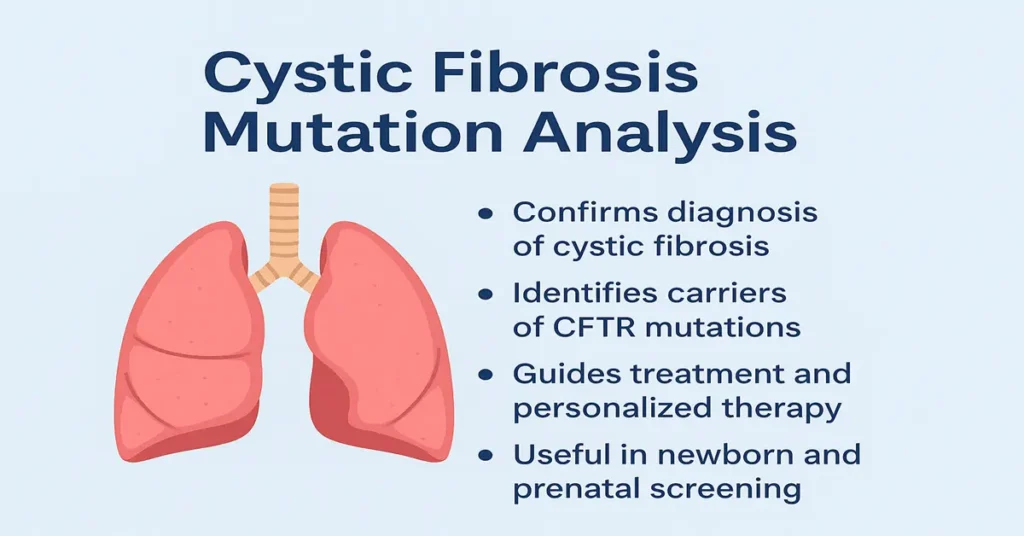
In clinical practice, this test is used not only to confirm a diagnosis but also for carrier screening, newborn screening, family planning, and guiding long-term management. Because cystic fibrosis is a lifelong genetic condition, identifying CFTR mutations early helps doctors plan care and monitoring more effectively.
Where the CFTR Gene Is Found and Produced in the Body
The CFTR gene is located on chromosome 7. It carries instructions for making the cystic fibrosis transmembrane conductance regulator (CFTR) protein.
This protein is produced mainly in epithelial cells, which line the surface of many organs, including the lungs, pancreas, intestines, sweat glands, and parts of the reproductive tract. The CFTR protein functions as a channel that regulates chloride movement, which in turn controls water balance on cell surfaces.
When this system works properly, mucus remains thin and mobile. When CFTR function is altered due to mutations, mucus thickens and interferes with normal organ function.
Importance and Functions of Cystic Fibrosis Mutation Analysis
This test plays a central role in the evaluation of cystic fibrosis and related genetic risk.
Clinically, it helps confirm the diagnosis in individuals with suggestive symptoms, such as recurrent lung infections or digestive difficulties. It is also widely used to identify people who carry a single CFTR mutation but do not have the disease themselves. These carriers are typically healthy but may pass the gene to their children.
Because many different CFTR mutations exist, mutation analysis also provides useful information for understanding disease patterns and planning individualized care. In newborn screening programs, early detection allows follow-up before complications develop. For couples planning a pregnancy, the test offers valuable insight into inherited risk.
Causes of Low/Negative Results
A low or negative result means that no CFTR mutation was detected by the testing method used.
In most cases, this indicates that the individual does not have cystic fibrosis and is unlikely to be a carrier. Occasionally, symptoms resembling CF may be due to other respiratory or digestive conditions rather than a CFTR-related disorder. Very rare mutations may not be included in limited testing panels, though modern testing methods significantly reduce this possibility.
Symptoms When Results Are Low/Negative
People with negative results usually do not have symptoms related to cystic fibrosis.
They are generally healthy, and no CF-related organ involvement is expected. In carrier-screening situations, a negative result also lowers the likelihood of passing CF to future children, although genetic counseling may still be advised in specific family contexts.
Causes of High/Positive Results
A positive result means that one or more CFTR mutations have been identified.
Finding one mutation indicates a carrier state. The person does not develop cystic fibrosis but can pass the altered gene to offspring. Finding two mutations, one inherited from each parent, confirms the diagnosis of cystic fibrosis. The combination and type of mutations influence how the disease presents and progresses.
Symptoms of High/Positive Results
When two CFTR mutations are present, symptoms typically reflect cystic fibrosis involvement.
Respiratory features may include persistent cough, thick airway secretions, and repeated chest infections. Digestive involvement can lead to poor weight gain, malabsorption, and pancreatic enzyme insufficiency. Other findings may include salty-tasting skin, recurrent sinus issues, dehydration, and, in males, fertility-related concerns.
The severity and pattern of symptoms vary depending on the specific mutations involved.
Reference Ranges
Results are reported qualitatively rather than numerically.
A negative result indicates that no CFTR mutation was detected. A positive result indicates that one or more mutations were identified. Reports usually specify the exact mutation detected and may describe whether it is commonly associated with classic or milder forms of cystic fibrosis. The ΔF508 mutation is the most frequently reported worldwide.
Sample Type Needed for Testing
Cystic fibrosis mutation analysis requires a DNA sample.
Most commonly, testing is done using a blood sample. In some cases, cheek swabs or saliva samples are used. For prenatal evaluation, samples may be obtained through chorionic villus sampling or amniotic fluid collection, depending on gestational age and clinical need.
Test Preparation
No fasting or special preparation is required for this test.
Patients are usually advised to inform the doctor if the test is being done for prenatal evaluation or assisted reproduction planning. When possible, providing a family medical history helps with result interpretation and counseling.
When to Consult a Doctor
Medical consultation is advised if a child or adult shows symptoms suggestive of cystic fibrosis, such as chronic respiratory issues, poor growth, or digestive problems. Couples who test positive as carriers, parents receiving an abnormal newborn screening report, or individuals planning pregnancy may also benefit from specialist guidance.
A positive result often leads to further discussion with healthcare providers and genetic counselors to explain the findings clearly and plan appropriate follow-up.
Important Word Explanations
- Mutation: A change in a gene that alters how it functions.
- CFTR Gene: The gene responsible for controlling salt and water movement in cells.
- Carrier: A person with one altered gene who does not have the disease.
- Prenatal Testing: Genetic testing performed during pregnancy.
- Chloride Channel: A protein pathway that helps regulate salt balance in cells.
~END~
Related Posts
None found