
Overview
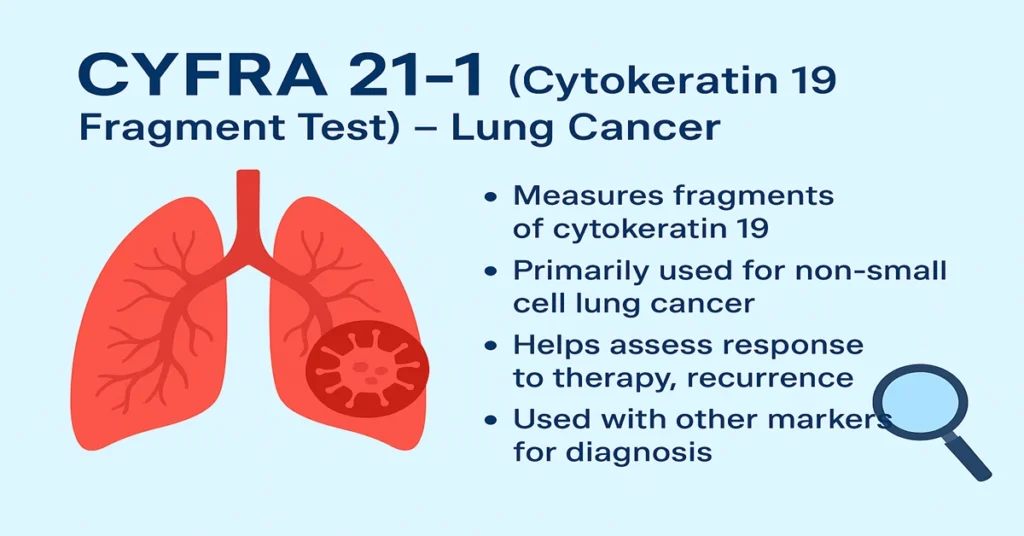
The CYFRA 21-1 Test is a tumor-marker blood test that measures fragments of cytokeratin 19, a structural protein normally present inside epithelial cells. These cells line many organs and tissues, including the lungs, bladder, cervix, and digestive tract.
In routine oncology practice, this test is most often used in the evaluation and follow-up of lung cancer, particularly non-small-cell lung cancer (NSCLC). It may also be requested in selected other epithelial cancers. CYFRA 21-1 is not intended to diagnose cancer on its own. Instead, it helps doctors understand tumor activity over time, especially during treatment and follow-up.
When epithelial cells are damaged or disrupted, fragments of cytokeratin 19 can enter the bloodstream. Measuring these fragments provides indirect information about cell turnover and disease activity.
Where It Is Produced in the Body
Cytokeratin 19 is a normal component of the internal framework of epithelial cells. It helps maintain cell shape and structural stability.
CYFRA 21-1 itself is not actively produced or secreted. It appears in the blood when epithelial cells break down. This can happen during normal cell turnover, inflammation, or more noticeably when cells are affected by malignant processes. Elevated levels reflect increased release rather than new production.
Main Functions and Importance
CYFRA 21-1 does not have a biological function once it enters the bloodstream. Its importance lies entirely in its clinical use as a marker.
In cancer care, the test supports assessment of epithelial tumors, most notably lung cancers of the non-small-cell type. Doctors use it to establish a baseline at diagnosis, to observe trends during treatment, and to watch for changes during follow-up. Falling levels often align with reduced tumor activity, while rising levels may prompt closer evaluation.
For this reason, CYFRA 21-1 is commonly interpreted alongside other tumor markers and imaging findings rather than used in isolation.
Causes of Low / Negative Levels
Low or normal CYFRA 21-1 levels generally indicate minimal release of cytokeratin fragments into the bloodstream.
Clinically, this may be seen in individuals without cancer, in patients whose disease is inactive or responding well to treatment, or in very early disease where tumor burden is small. It can also occur in cancers that do not arise from epithelial tissue.
Symptoms of Low / Normal Levels
There are no symptoms linked specifically to low or normal CYFRA 21-1 values. Patients may feel well or may be improving clinically, depending on their underlying condition.
Causes of High / Positive Levels
Raised CYFRA 21-1 levels suggest increased breakdown of epithelial cells and are most often associated with lung cancer, particularly squamous-cell carcinoma within the NSCLC group. Levels may also rise in other epithelial cancers and, less commonly, in certain non-malignant conditions.
From a clinician’s perspective, a high result is viewed as a signal rather than a diagnosis. It indicates that further correlation with imaging, clinical findings, and other laboratory tests is needed.
Symptoms of High / Positive Levels
Symptoms are related to the underlying disease rather than to the marker itself.
When lung involvement is present, patients may experience respiratory symptoms such as persistent cough, chest discomfort, or breathlessness. In cancers of other epithelial sites, symptoms vary according to the affected organ. General features such as fatigue or unintended weight loss may also be present.
Doctors consider these symptoms alongside CYFRA 21-1 trends to judge disease activity.
Reference Range
CYFRA 21-1 results are reported as numeric values, with reference limits that can vary slightly between laboratories.
Values within the normal range suggest no significant marker elevation at the time of testing. Borderline or elevated levels require careful interpretation, particularly when measured repeatedly. A rising trend over time is often more informative than a single isolated result.
Sample Type and Collection
The test is performed on a serum blood sample, collected from a vein in the arm using standard venipuncture techniques.
No special timing or fasting is usually required. In the laboratory, immunoassay-based methods are used to measure CYFRA 21-1 with high analytical sensitivity.
Understanding Your Results
CYFRA 21-1 results are always reviewed in context. Normal values support stable or inactive disease, while elevated results suggest increased epithelial cell turnover.
Oncologists interpret these findings together with imaging studies, other tumor markers, biopsy results, and the overall clinical picture. The test helps guide follow-up decisions but does not replace definitive diagnostic methods.
Test Preparation
In most cases, no specific preparation is needed.
Patients are encouraged to inform their doctor about recent infections, surgeries, or ongoing cancer treatments, as these factors can influence results. Scheduling the test away from acute inflammatory episodes may help avoid misleading elevations.
When to Consult a Doctor
Medical advice should be sought if symptoms such as persistent cough, unexplained breathlessness, chest pain, or weight loss develop or worsen. For individuals already diagnosed with cancer, regular follow-up with CYFRA 21-1 testing may be advised as part of ongoing monitoring.
Discussing results with the treating doctor helps ensure that changes in marker levels are interpreted accurately and calmly.
Important Word Explanations
- Cytokeratin 19: A structural protein found inside epithelial cells.
- CYFRA 21-1: A fragment of cytokeratin 19 measured in blood as a tumor marker.
- Tumor Marker: A substance measured in blood that reflects tumor presence or activity.
- Epithelial Cells: Cells that line organs and body surfaces such as the lungs and bladder.
- NSCLC: Non-small-cell lung cancer, a common category of lung cancer.
- False Positive: An elevated test result not caused by cancer.
~END~
Related Posts
None found