
Overview
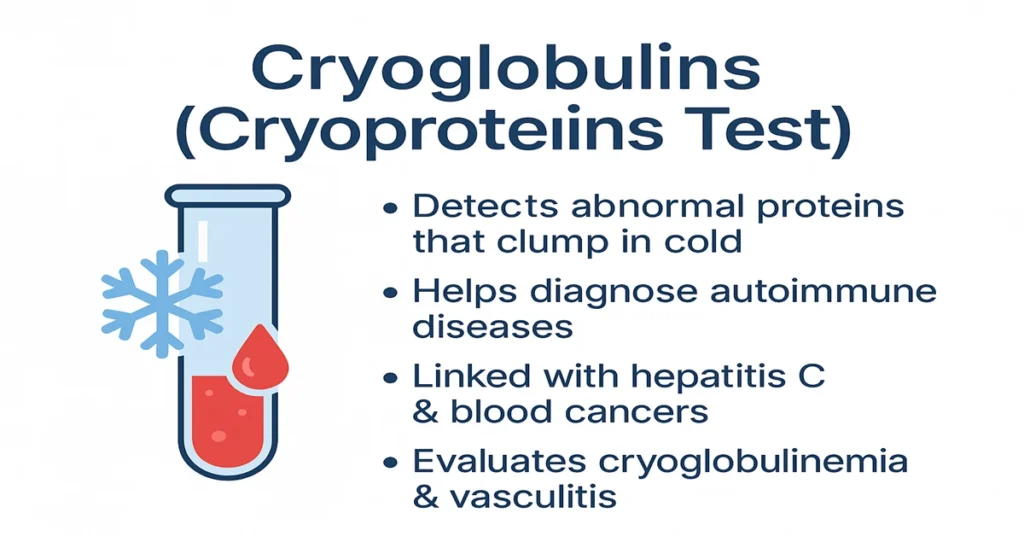
The Cryoglobulins Test, also called the Cryoglobulin Screen or Cryoproteins Test, is a specialized blood investigation used to detect abnormal proteins known as cryoglobulins in the bloodstream.
Cryoglobulins are antibodies that behave unusually with temperature changes. When blood is cooled below normal body temperature, these proteins can clump together and form visible precipitates. When the sample is warmed again, they dissolve back into the liquid phase. This temperature-dependent behavior is not seen in healthy blood.
In routine clinical practice, cryoglobulins are not found in healthy individuals. Their presence usually points toward an underlying immune-related condition, chronic infection, or certain blood disorders. This test is therefore used to support the diagnosis and monitoring of cryoglobulinemia, a condition in which these proteins interfere with normal blood flow and trigger inflammation, particularly in small blood vessels.
Where Cryoglobulins Are Produced
Cryoglobulins are abnormal immunoglobulins produced by immune cells, mainly plasma cells and B lymphocytes, within the bone marrow and lymphoid tissues.
Their production is typically linked to ongoing immune stimulation. This may occur in the setting of chronic viral infections, long-standing autoimmune diseases, or disorders of the blood and lymphatic system. From a laboratory and clinical perspective, cryoglobulins are not incidental findings; they usually reflect an underlying immune disturbance that requires further evaluation.
Main Functions and Importance
Cryoglobulins do not serve any normal or protective function in the body. Their significance is entirely clinical.
Detecting cryoglobulins helps doctors understand why a patient may be experiencing inflammation or reduced blood flow in small vessels. In practice, the test is often ordered when symptoms or laboratory findings suggest vasculitis, kidney involvement, or unexplained systemic inflammation.
The test supports evaluation in autoimmune diseases, chronic infections, and certain blood cancers. It also plays a role in monitoring known conditions where cryoglobulins are already identified, helping clinicians assess ongoing disease activity rather than offering a standalone diagnosis.
Causes of Low / Negative Cryoglobulin Levels
A negative cryoglobulin result means that no abnormal cryoproteins were detected in the blood sample. This is considered a normal finding.
Such results are commonly seen in healthy individuals and in patients whose underlying immune or infectious condition is inactive or well controlled. From a clinical viewpoint, a negative result suggests that cryoglobulin-related vessel involvement is unlikely at the time of testing.
Symptoms of Low / Negative Levels
There are no symptoms associated with a negative cryoglobulin test. The absence of cryoglobulins simply indicates that this particular immune mechanism is not contributing to a patient’s symptoms.
Causes of High / Positive Cryoglobulin Levels
A positive cryoglobulin test indicates the presence of these abnormal proteins and points toward active underlying disease processes.
In clinical settings, this finding is most often associated with chronic infections, autoimmune disorders, or blood-related malignancies. Cryoglobulins can deposit in small blood vessels, leading to inflammation and impaired circulation. The test result itself does not define the severity but signals the need to look for the source of immune activation.
Symptoms of High / Positive Levels
Symptoms related to positive cryoglobulin levels arise from their effects on blood vessels and organs rather than from the proteins themselves.
Patients may show skin changes such as purplish discoloration, cold-related color changes in fingers or toes, or delayed healing of skin lesions. Joint discomfort, nerve-related sensations like numbness or tingling, and general fatigue are also commonly reported. In some cases, kidney involvement may be suspected when swelling, changes in urine appearance, or blood pressure abnormalities are present.
Clinicians interpret these symptoms together with laboratory findings to assess the extent of cryoglobulin-related involvement.
Reference Ranges
Cryoglobulin test results are generally reported as negative or positive rather than as precise numeric values.
A negative result indicates no detectable cryoglobulins and is considered normal. A positive result confirms their presence and suggests an underlying immune, infectious, or hematological condition. Some laboratories may describe the amount semi-quantitatively, which helps clinicians understand relative activity but does not replace clinical correlation.
Sample Type and Collection Procedure
The test requires a blood sample drawn from a vein, usually from the arm. Proper sample handling is especially important for accurate results.
The blood sample must be kept warm until the serum is separated. If the sample cools too early, cryoglobulins may precipitate before analysis, leading to misleading results. Once processed, the laboratory deliberately cools the serum under controlled conditions to observe whether cryoglobulins form.
Serum is the preferred sample type, and in some cases, repeat testing may be requested to confirm findings.
Understanding Test Results
Cryoglobulin results are always interpreted in context. A negative result supports the absence of cryoglobulin-related disease activity. A positive result suggests immune complex formation and prompts further evaluation to identify the underlying cause.
Doctors often review this test alongside other investigations, such as immune markers, complement levels, infection screening, and protein studies, to build a complete clinical picture rather than relying on a single result.
Test Preparation
Fasting is usually not required for this test.
Patients are advised to inform their doctor about known autoimmune diseases, chronic infections, or immune-modifying medications. Avoiding cold exposure just before sample collection is often recommended, as temperature changes can affect sample integrity.
When to Consult a Doctor
Medical consultation is appropriate if symptoms such as unexplained skin discoloration, joint discomfort, nerve symptoms, persistent fatigue, or signs of kidney involvement are present, especially if they worsen in cold environments.
If cryoglobulinemia is suspected or confirmed, doctors focus on identifying and managing the underlying condition. The cryoglobulins test helps guide that process by clarifying whether immune-mediated protein precipitation is part of the clinical picture.
Important Word Explanations
- Cryoglobulins: Abnormal antibodies that clump together in cold temperatures and dissolve when warmed.
- Cryoglobulinemia: A condition caused by cryoglobulins affecting small blood vessels.
- Immunoglobulin: An antibody produced by immune cells.
- Raynaud’s Phenomenon: Cold-induced color changes in fingers or toes due to reduced blood flow.
- Vasculitis: Inflammation of blood vessels.
- Plasma Cells: Immune cells responsible for producing antibodies.
~END~
Related Posts
None found