
Overview
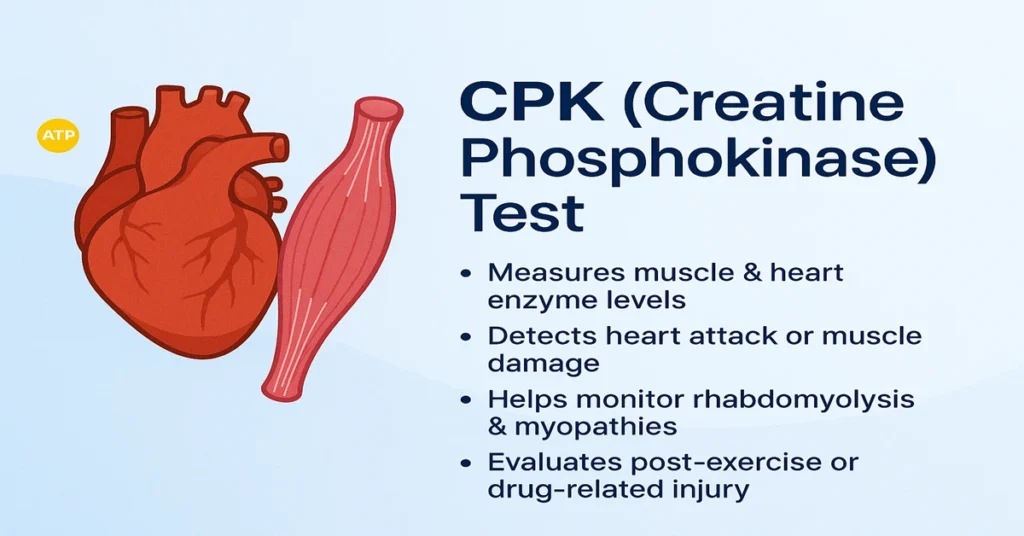
The CPK Test, also known as the Creatine Phosphokinase or Creatine Kinase (CK) Test, measures the level of the enzyme CPK in the blood. This enzyme is mainly present inside muscle cells, where it supports normal energy use, particularly during movement and physical activity.
In everyday clinical work, doctors rely on this test because CPK normally stays inside cells. When muscle tissue is stressed, injured, or damaged, the enzyme leaks into the bloodstream, leading to a measurable rise. For this reason, the test is commonly used to assess heart muscle injury, skeletal muscle damage, and certain neurological conditions.
Rather than pointing to a single diagnosis, CPK acts as a signal that muscle tissue somewhere in the body has been affected.
Where It Is Produced in the Body
CPK is produced and stored inside cells and is not meant to circulate freely in the blood under normal conditions.
It is found mainly in three tissues: skeletal muscles that control movement, the heart muscle that pumps blood, and brain tissue within the nervous system. When any of these tissues are injured or under significant stress, CPK can escape into the bloodstream.
To help identify the likely source of injury, CPK exists in different forms known as isoenzymes. These patterns assist doctors in distinguishing whether the rise is more consistent with skeletal muscle involvement, heart-related injury, or, less commonly, brain-related damage.
Main Functions and Importance
Inside the body, CPK plays a key role in energy handling within muscle cells. It supports the rapid availability of energy required for muscle contraction and sustained activity.
From a clinical perspective, the importance of the CPK test lies in its ability to reflect tissue injury. Doctors use it to assess suspected heart muscle damage, evaluate muscle disorders, monitor severe muscle breakdown, and investigate unexplained muscle pain or weakness. In hospital settings, repeated measurements are sometimes used to observe trends rather than relying on a single value.
Causes of Low CPK Levels
Low CPK levels are uncommon and usually not clinically significant.
They may be seen in individuals with reduced muscle mass, prolonged inactivity, or advanced muscle wasting. In most cases, low values are interpreted as a normal variation rather than a sign of disease.
Symptoms of Low Levels
There are typically no symptoms directly linked to low CPK levels. If symptoms such as weakness or fatigue are present, they are usually related to overall muscle condition rather than the enzyme level itself.
Causes of High CPK Levels
Elevated CPK levels are far more commonly encountered and indicate that muscle cells have released the enzyme into the bloodstream.
This may occur after heart muscle injury, physical trauma, intense or unaccustomed exercise, or in various muscle-related conditions. Certain medications and systemic illnesses can also lead to increased levels. Clinicians pay close attention not only to how high the level is, but also to how quickly it rises or falls over time.
Symptoms of High CPK Levels
Symptoms depend on the underlying cause rather than on the enzyme itself.
Patients may experience muscle pain, stiffness, swelling, or weakness. When heart muscle is involved, symptoms may include chest discomfort or breathlessness. In cases of extensive muscle breakdown, urine color changes and general fatigue may be observed. These clinical features help doctors decide how urgently the result needs to be addressed.
Reference Ranges
CPK reference ranges vary slightly between laboratories and are influenced by factors such as age, sex, and muscle mass.
Values within the normal range suggest no significant muscle injury at the time of testing. Elevated values indicate muscle stress or damage, with higher levels generally reflecting more extensive involvement. Interpretation is always done in the context of symptoms and other investigations.
Sample Type and Collection
The test is performed on a blood sample, usually serum or plasma, collected from a vein in the arm.
No special preparation is typically required. In some clinical situations, repeat samples may be taken over time to monitor changes in CPK levels, particularly after suspected heart or muscle injury.
Understanding Your Results
CPK results are best understood as part of a broader clinical picture.
Normal results suggest stable muscle tissue. Mild elevations may be temporary and related to recent physical activity or minor muscle strain. Marked elevations raise concern for more significant muscle or cardiac injury. Doctors often combine CPK findings with other tests, such as cardiac markers or kidney function tests, to clarify the cause.
Test Preparation
In most cases, fasting is not needed.
Patients are often advised to avoid heavy physical exercise before testing, as this can temporarily raise CPK levels. Informing the doctor about recent injuries, procedures, or medications helps ensure accurate interpretation.
When to Consult a Doctor
Medical review is important if symptoms such as persistent muscle pain, weakness, chest discomfort, dark-colored urine, or unexplained fatigue occur.
If CPK levels remain elevated on repeated testing, further evaluation may be recommended to identify the source of muscle injury and to guide appropriate follow-up.
Important Word Explanations
- Creatine Phosphokinase (CPK): An enzyme involved in energy production inside muscle cells.
- Creatine Kinase (CK): Another name for CPK.
- Rhabdomyolysis: Severe breakdown of muscle tissue releasing muscle contents into the blood.
- Myocardial Infarction: Heart muscle injury due to reduced blood supply.
- Isoenzymes: Different forms of the same enzyme originating from specific tissues.
- CK-MB: A form of CPK more closely associated with heart muscle.
~END~
Related Posts
None found