
Overview
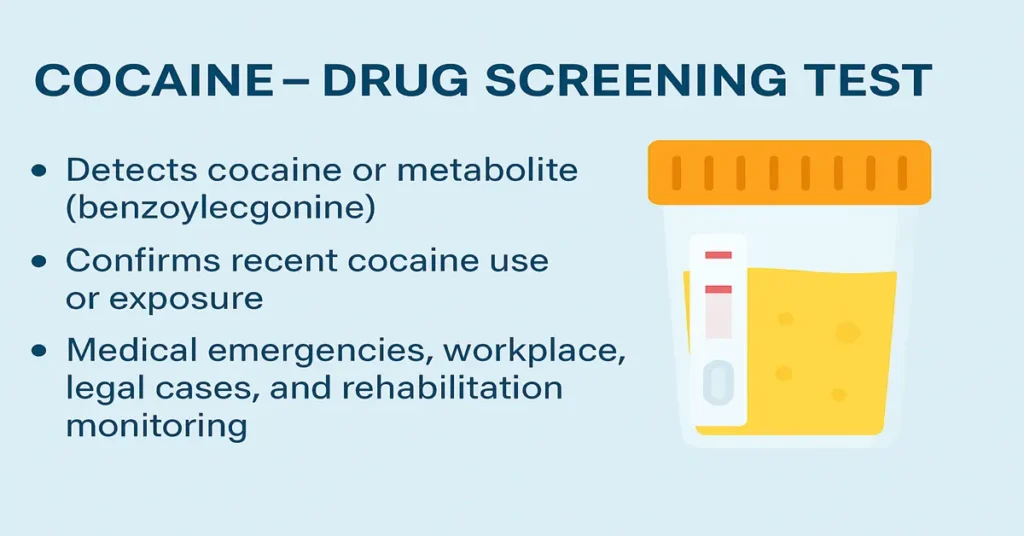
The Cocaine Drug Screening Test is a laboratory test used to detect cocaine use by identifying benzoylecgonine, the main metabolite formed when the body breaks down cocaine. Cocaine is a potent stimulant that affects the central nervous system, producing short-lived effects such as increased alertness and energy. Clinically, its significance lies not in these effects, but in the potential for serious complications involving the heart, brain, and mental health.
In medical practice, this test is commonly used in emergency settings, routine workplace screening, legal evaluations, and substance-use monitoring programs. The goal is confirmation or exclusion of recent exposure, rather than judgment or long-term diagnosis.
What Is the Cocaine Drug Screening Test?
This test determines whether cocaine has been used recently by detecting benzoylecgonine in biological samples. Cocaine itself is rapidly cleared from the bloodstream, which is why laboratories focus on its metabolite. Benzoylecgonine remains detectable for a longer period and provides a more reliable indicator of use.
The test is frequently included in standard drug panels, such as multi-drug workplace screens, and is interpreted alongside clinical context and timing of possible exposure.
How Cocaine Is Processed in the Body
Cocaine is not produced by the body. After intake—whether inhaled, smoked, injected, or swallowed—it enters the bloodstream and reaches the brain quickly. The liver then metabolizes it into several by-products, primarily benzoylecgonine.
This metabolite circulates briefly before being eliminated through urine. Because cocaine itself breaks down rapidly, most laboratory testing focuses on detecting these metabolites, which can persist for a few days depending on frequency of use and individual metabolism.
Main Functions and Importance of the Test
From a clinical and practical standpoint, the Cocaine Drug Screening Test is used to:
Confirm or rule out recent cocaine exposure
Support medical decision-making in suspected overdose or toxicity
Provide objective results for workplace or legal requirements
Assist rehabilitation programs in monitoring abstinence
Help clinicians understand unexplained symptoms where substance use is a concern
The test is intended as an objective measure and is always interpreted with clinical judgment.
Sample Types Used for Testing
Different sample types may be chosen based on the situation and required detection window:
Urine: Most commonly used; detects metabolites for several days after use
Blood: Useful in acute or emergency settings; reflects very recent exposure
Saliva: Provides short-term detection and is often used for rapid screening
Hair: Reflects longer-term exposure and is mainly used in forensic or historical assessments
Reference Ranges
Results are typically reported as positive or negative, based on laboratory cut-off values.
Negative: Cocaine metabolites not detected above the cut-off
Positive: Benzoylecgonine detected above the established threshold
Cut-off levels vary slightly by laboratory and testing method. For urine testing, commonly used thresholds are set to minimize false results while maintaining reliability.
Causes of a Low or Negative Result
A negative result generally indicates no recent cocaine use. In clinical practice, other considerations may include:
Testing performed outside the detection window
Very early testing before metabolites appear
Complete elimination of the substance before sample collection
Sample dilution or technical handling factors
When suspicion remains high, repeat testing may be considered rather than relying on a single result.
Symptoms and Meaning of a Negative Result
A negative test result does not produce symptoms on its own. It simply suggests that cocaine exposure was not detected at the time of testing. In individuals without substance use, this is considered a normal finding.
If symptoms are present despite a negative result, clinicians usually look for alternative medical explanations.
Causes of a High or Positive Result
A positive test indicates that cocaine metabolites are present above the laboratory threshold. This typically reflects recent use, regardless of the route of exposure. In rare cases, confirmatory testing may be performed to exclude analytical error.
The result itself does not measure quantity used or predict clinical severity.
Symptoms and Health Effects of a Positive Result
When cocaine use has occurred, individuals may experience a range of effects depending on dose and frequency. These can include changes in heart rate, blood pressure, mood, or behavior. From a clinical perspective, a positive result is treated as a signal to assess overall health, risk factors, and the need for further evaluation.
The test does not diagnose addiction on its own, nor does it predict outcomes. It simply confirms exposure.
How to Prepare for the Test
No specific preparation is usually required. Patients are generally advised to:
Provide accurate medication history if requested
Avoid excessive fluid intake before urine collection
Follow collection instructions carefully, especially in supervised settings
The procedure itself is brief and noninvasive in most cases.
When to Consult a Doctor
Medical advice is appropriate if:
A test result is positive and health symptoms are present
There is concern about possible false-positive results
The test is part of ongoing substance-use evaluation
Unexplained cardiac, neurological, or psychological symptoms occur
In such situations, healthcare providers focus on safety, clarification of results, and appropriate next steps rather than on the test result alone.
Important Word Explanations
- Cocaine: A stimulant drug that affects the central nervous system
- Metabolite: A substance formed when the body breaks down a drug
- Benzoylecgonine: The primary metabolite used to detect cocaine use
- Central Nervous System (CNS): The brain and spinal cord
- Cut-off Level: The minimum concentration required for a positive result
- Overdose: A harmful reaction due to excessive drug exposure
~END~
Related Posts
None found