
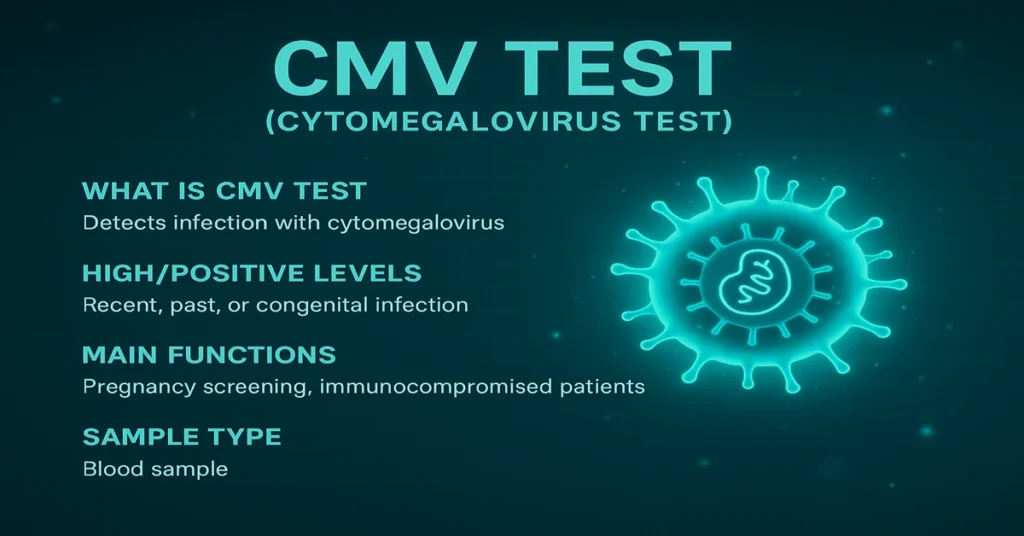
What is CMV Test?
The CMV Test is a diagnostic test used to detect infection caused by cytomegalovirus (CMV), a common virus that belongs to the herpesvirus family. In most healthy individuals, CMV infection causes few or no symptoms because the immune system keeps the virus under control. Many people are exposed to CMV at some point in their lives without ever realizing it.
Clinically, CMV becomes important in specific situations. The virus can cause significant problems in pregnant women, where it may pass to the unborn baby, in newborns, and in people with weakened immune systems, such as those with HIV/AIDS, organ transplant recipients, or patients receiving chemotherapy.
The CMV test helps doctors determine whether a person has a recent infection, a past exposure, or an active infection that may need closer monitoring.
Different test methods are used depending on the clinical question:
- CMV IgM Antibody Test – suggests recent or ongoing infection
- CMV IgG Antibody Test – indicates past infection or immune exposure
- CMV PCR (Polymerase Chain Reaction) – detects viral DNA and estimates viral activity
- CMV Antigen Test – identifies viral proteins, supporting active infection
Where It Is Produced or Found in the Body
CMV is a virus and is not produced by the human body. After exposure, the virus enters the body and triggers the immune system to produce antibodies, mainly IgM and IgG, which are measured in blood tests.
Once a person is infected, CMV usually remains in the body in a latent (inactive) state. It can reactivate later if immunity becomes weakened. This behavior is typical of herpes family viruses and explains why CMV testing is often repeated in high-risk patients.
CMV can involve several organs and tissues, including:
- Salivary glands
- Blood cells
- Liver and lungs
- Retina of the eye
- Brain
- Placenta during pregnancy, with possible transmission to the fetus
Main Functions and Importance of the Test
From a clinical perspective, the CMV test is used to clarify infection status rather than as a routine screening tool.
It helps to:
- Identify active or past CMV infection, allowing doctors to understand whether symptoms are related to CMV
- Support pregnancy evaluation, especially when maternal infection is suspected, as congenital CMV can affect fetal development
- Monitor immunocompromised patients, where CMV reactivation may lead to serious organ involvement
- Guide clinical decisions, such as whether closer observation or antiviral monitoring is required
In practice, CMV test results are always interpreted alongside symptoms, immune status, and other laboratory findings.
Causes of Low/Negative CMV Levels
A low or negative CMV result generally indicates that there is no active CMV infection at the time of testing. This may reflect:
- No prior exposure to CMV
- Testing done very early, before antibodies are detectable
- Past infection with antibody levels below detection limits
Doctors are cautious during early illness, as antibody tests may initially appear negative.
Symptoms of Low/Negative Levels
Low or negative CMV results do not cause symptoms. They simply suggest that CMV is unlikely to be the cause of current clinical concerns. If symptoms persist and suspicion remains, repeat testing or alternative investigations may be considered.
Causes of High/Positive CMV Levels
Positive CMV results indicate that the immune system has reacted to the virus or that viral material is present. Interpretation depends on the test type:
- IgM positivity usually reflects recent or active infection
- IgG positivity indicates past exposure or established immunity
- Detectable CMV DNA by PCR points to active viral replication
These findings signal immune activity rather than disease severity on their own.
Symptoms of High/Positive CMV Levels
Symptoms vary widely based on immune status.
In healthy individuals, CMV infection is often mild or silent, sometimes resembling a flu-like illness with fever, fatigue, and muscle aches.
In pregnant women, active infection raises concern for fetal transmission, even if maternal symptoms are mild or absent.
In newborns with congenital CMV, clinical features may include growth issues, jaundice, seizures, or later hearing and developmental problems.
In immunocompromised patients, CMV can involve multiple organs, leading to lung, liver, eye, or nervous system involvement. These situations require careful medical assessment.
Reference Ranges
CMV test interpretation depends on the method used. Typical reporting includes:
- CMV IgM antibody: negative or positive based on laboratory cut-offs
- CMV IgG antibody: negative or positive, indicating exposure history
- CMV PCR: undetectable or detectable viral DNA
Exact reference values vary by laboratory, and results are interpreted in clinical context.
Sample Type
- Blood (serum) for CMV IgM and IgG antibody tests
- Plasma for CMV PCR testing
- In newborns, urine, saliva, or blood samples may be used
- In severe cases, additional samples such as cerebrospinal fluid or tissue may be analyzed
Test Preparation
No fasting is required for CMV testing. Patients are usually advised to inform their doctor if they are pregnant, immunocompromised, or taking medications that affect immunity.
For newborns, timing of sample collection is important, as early testing helps distinguish congenital infection from later exposure.
When to Consult a Doctor
CMV testing may be discussed if:
- A pregnant woman develops unexplained fever, fatigue, or swollen glands
- A newborn shows hearing, growth, or developmental concerns
- An immunocompromised patient develops visual, respiratory, or neurological symptoms
- There is suspicion of viral infection affecting multiple organs
In such situations, CMV testing helps clarify diagnosis and guide further evaluation.
Important Word Explanations
- CMV (Cytomegalovirus): A common virus belonging to the herpesvirus family
- IgM Antibody: An early antibody indicating recent infection
- IgG Antibody: A long-lasting antibody showing past exposure
- PCR (Polymerase Chain Reaction): A test that detects viral DNA
- Congenital Infection: Infection passed from mother to baby during pregnancy
- Viral Load: The amount of virus detected in the blood
~END~
Related Posts
None found