
What is Clotting Time (CT)?
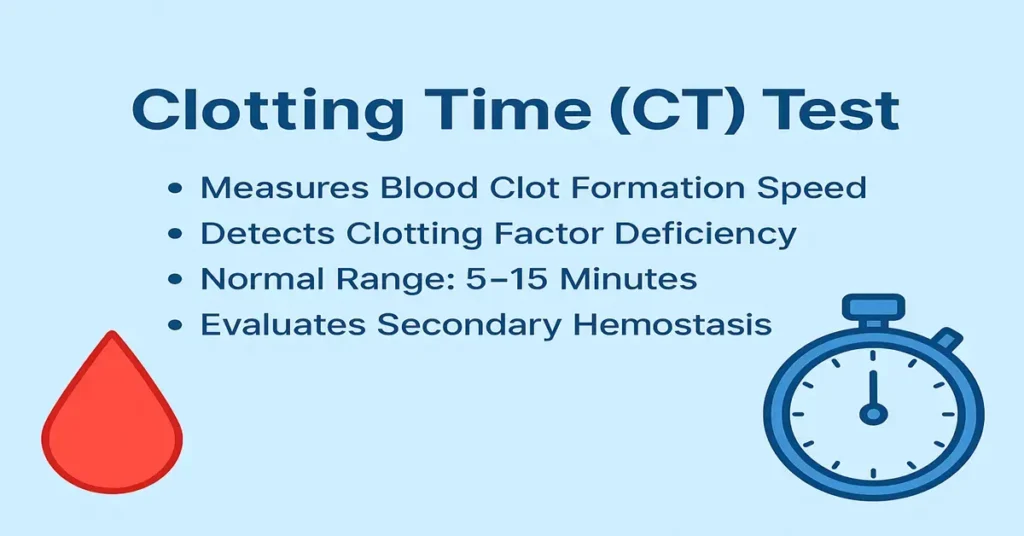
Clotting Time (CT) is a basic laboratory test that measures how long it takes for blood to form a visible clot after it has been collected in a test tube. In practical terms, it reflects how efficiently the blood’s clotting factors work together to stop bleeding through secondary hemostasis.
Unlike Bleeding Time (BT), which looks at platelets and small blood vessels, Clotting Time focuses on the plasma proteins involved in the coagulation cascade. These proteins ultimately lead to the formation of fibrin, which stabilizes a blood clot.
In simple comparison:
- Bleeding Time (BT): Assesses platelet function and vessel response
- Clotting Time (CT): Assesses clotting factors and the coagulation process
Although CT was widely used in the past, it is now largely replaced by more specific and reliable tests such as Prothrombin Time (PT) and Activated Partial Thromboplastin Time (aPTT). Today, CT is mainly of historical or supportive value, especially in settings where advanced tests are not readily available.
Where It Is Controlled or Produced in the Body
Clot formation depends on several coordinated components rather than a single organ.
Clotting Factors (Liver-derived):
Most clotting factors are produced in the liver and circulate in the blood in an inactive form. When a blood vessel is injured, these factors are activated in a stepwise sequence. Vitamin K is essential for the production of several key clotting factors.
Platelets:
While platelets are not the main focus of the CT test, they provide a surface that supports clotting reactions and helps speed up fibrin formation.
Calcium Ions:
Calcium acts as a cofactor in many steps of the coagulation cascade, allowing clotting proteins to interact effectively.
Intrinsic Pathway:
Clotting Time primarily reflects the intrinsic pathway of coagulation, which is triggered when blood comes into contact with certain surfaces, such as glass in a test tube.
Together, these elements ensure that clotting occurs in a controlled and timely manner when bleeding happens.
Main Functions and Importance of the Clotting Time Test
Assessment of Clotting Factors
CT gives a broad idea of whether clotting factors involved in the intrinsic pathway are functioning adequately.
Detection of Coagulation Disorders
A prolonged clotting time can suggest deficiencies or functional problems in clotting factors, as seen in inherited bleeding disorders.
Distinguishing Bleeding Mechanisms
CT can help separate platelet-related problems from coagulation factor problems when interpreted alongside Bleeding Time:
- Normal BT with prolonged CT points toward a coagulation factor issue
- Prolonged BT with normal CT suggests a platelet or vascular issue
Historical Screening Role
Clotting Time was once used routinely before surgical or dental procedures. Because it lacks precision and sensitivity, it has been replaced by modern coagulation tests in most clinical settings.
Causes of Low Clotting Time (Shorter than Normal)
A shorter-than-normal clotting time means blood clots relatively quickly. This finding is uncommon and often has limited clinical significance.
It may be seen transiently in situations where blood concentration or clotting tendency is increased. In most cases, it is interpreted cautiously and in clinical context.
Symptoms of Low Clotting Time
Shortened clotting time usually does not produce symptoms by itself. When clinically relevant, it may simply signal a tendency toward faster clot formation rather than causing direct complaints.
Causes of High Clotting Time (Prolonged CT)
A prolonged clotting time indicates delayed clot formation and suggests an issue within the coagulation system.
Common clinical associations include:
Clotting Factor Deficiencies
Inherited conditions such as hemophilia involve reduced or absent clotting factors, leading to delayed clotting.
Severe Liver Disease
Since most clotting factors are produced in the liver, advanced liver dysfunction can reduce their levels and prolong CT.
Vitamin K Deficiency
Insufficient vitamin K affects the synthesis of several clotting factors and can lengthen clotting time.
Disseminated Intravascular Coagulation (DIC)
In this serious condition, widespread clotting consumes clotting factors, resulting in delayed clot formation later.
Anticoagulant Medications
Drugs that interfere with clotting factor activity can prolong CT.
Snake Envenomation
Certain snake venoms directly damage clotting factors, leading to markedly prolonged clotting times.
Symptoms of High Clotting Time
When clotting time is prolonged, bleeding may last longer than expected, even after minor injuries.
Patients may notice:
- Easy or unexplained bruising
- Prolonged bleeding from cuts
- Nose or gum bleeding
- Heavy menstrual bleeding
- Joint or muscle bleeding in severe disorders
These symptoms reflect impaired clot stabilization rather than the test itself.
Reference Ranges
Reference ranges vary with method and laboratory conditions, but commonly:
- Normal: about 5–15 minutes
- Shortened: less than 5 minutes (uncommon, often not significant)
- Prolonged: more than 15 minutes, suggesting clotting factor deficiency or dysfunction
Results can differ depending on whether the capillary tube method or Lee–White method is used.
Sample Type and Testing Procedure
Sample Type:
Blood collected from a vein or fingertip, depending on the method used.
Procedure:
The blood is placed in a glass tube. The tube is gently tilted at regular intervals until a clot forms. The time from collection to clot formation is recorded as the clotting time.
This test is simple and does not require advanced equipment, which is why it may still be used in limited-resource settings.
Test Preparation
No fasting is required.
Patients should inform the clinician about:
- Any known bleeding or liver disorders
- Current medications, especially blood thinners
- Recent illnesses or exposures that may affect clotting
Medication adjustments, if needed, should always be done under medical supervision.
When to Consult a Doctor
Medical advice is recommended if there is:
- Frequent or unexplained bleeding or bruising
- Prolonged bleeding after minor injuries
- Heavy or irregular menstrual bleeding
- Blood in urine or stools
- A family history of bleeding disorders
- An unexpectedly prolonged clotting time on testing
Doctors often follow up CT results with more specific tests such as PT, aPTT, fibrinogen levels, platelet count, or liver function tests to clarify the underlying cause.
Important Word Explanations
- Hemostasis: The body’s natural process of stopping bleeding
- Clotting Factors: Plasma proteins that work together to form a stable clot
- Hemophilia: An inherited disorder caused by missing or defective clotting factors
- Vitamin K: A nutrient needed for the liver to produce certain clotting factors
- Thrombosis: Formation of an unwanted blood clot within a vessel
- Anticoagulants: Medications that slow or prevent blood clotting
~END~
Related Posts
None found