
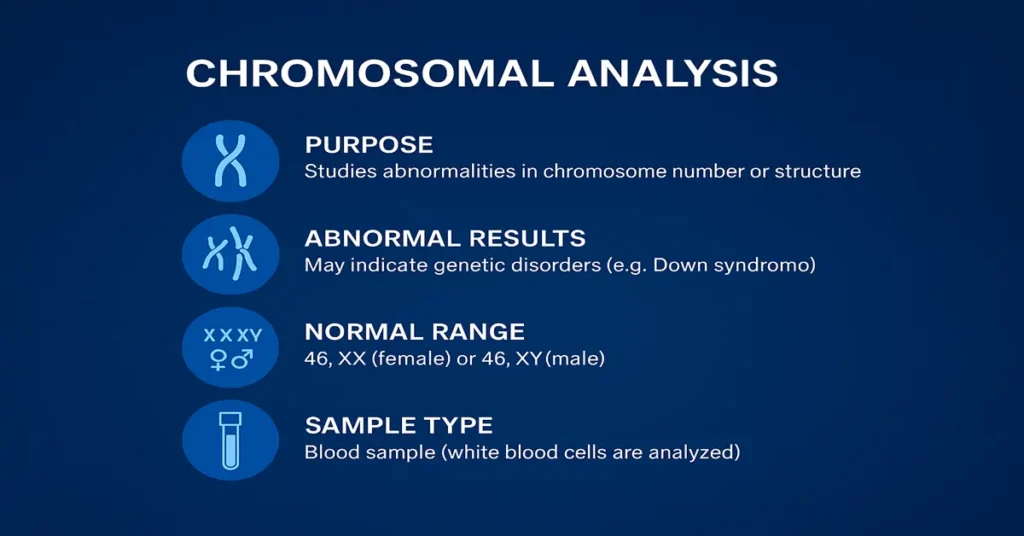
What is Chromosomal Analysis?
Chromosomal Analysis, also known as karyotyping or cytogenetic analysis, is a laboratory test used to examine a person’s chromosomes. Chromosomes are thread-like structures found inside the nucleus of cells, and they carry DNA—the genetic instructions that guide growth, development, and normal body function.
In clinical practice, this test helps identify abnormalities in the number or structure of chromosomes. Such changes can be linked to genetic syndromes, infertility, repeated miscarriages, developmental delays, or certain cancers. Because chromosomes reflect the body’s genetic framework, this test provides doctors with a broad and reliable overview of an individual’s genetic makeup.
Where Chromosomes are Found in the Body
Chromosomes are present in the nucleus of nearly every cell in the body. Each person inherits one set of chromosomes from their mother and one set from their father.
Under normal circumstances, humans have 46 chromosomes, arranged in 23 pairs:
- 22 pairs of autosomes, which carry most genetic traits
- 1 pair of sex chromosomes, which determine biological sex (XX in females, XY in males)
Any deviation from this usual number or structure may affect development, reproduction, or overall health, which is why chromosomal analysis is considered when such concerns arise.
Main Functions and Importance
Chromosomes carry genes that act as instructions for how the body forms and functions. Studying them can clarify the underlying cause of many medical conditions.
Chromosomal Analysis is particularly useful for:
- Understanding genetic information, offering insight into inherited traits and developmental patterns
- Detecting hereditary conditions, including common chromosomal syndromes such as Down syndrome, Turner syndrome, Klinefelter syndrome, Edwards syndrome, and Patau syndrome
- Evaluating infertility and recurrent pregnancy loss, where subtle chromosomal rearrangements may affect egg or sperm cells
- Supporting prenatal and cancer diagnosis, by identifying chromosomal changes in unborn babies or acquired abnormalities seen in blood cancers such as leukemia and lymphoma
From a clinical perspective, this test often answers questions that routine blood tests cannot.
Causes of Abnormal (Low/Negative) Results
An abnormal chromosomal finding indicates that one or more chromosomes are missing, altered, or rearranged. These changes usually occur during cell division and are not caused by lifestyle or recent illness.
Common types of abnormalities include:
- Monosomy, where one chromosome from a pair is missing
- Deletion, involving loss of a segment of a chromosome
- Inversion, where a chromosome segment is reversed within the same chromosome
- Translocation, in which material is exchanged between chromosomes
- Mosaicism, where both normal and abnormal cell lines are present in the same individual
These findings help explain certain clinical patterns rather than predict symptoms on their own.
Symptoms of Low/Abnormal Chromosome Findings
Symptoms vary widely depending on which chromosome is affected and how extensive the change is. In practice, doctors may see:
- Unusual physical features or short stature
- Developmental or learning delays
- Reproductive difficulties, including infertility or recurrent miscarriages
- Specific chromosomal patterns associated with blood cancers
Not every chromosomal abnormality causes obvious symptoms, which is why testing is often guided by clinical suspicion.
Causes of High/Positive Findings
A “high” or positive result typically means there is extra chromosomal material, such as an additional chromosome or duplicated segment. These changes are usually present from birth and reflect a genetic condition rather than an acquired disease.
Examples include:
- Trisomy, where an extra chromosome is present (such as trisomy 21 in Down syndrome)
- Duplications, involving extra copies of part of a chromosome
- Sex chromosome variations, such as XXY or XYY patterns
These findings help clarify the genetic basis of observed clinical features.
Symptoms of High/Positive Findings
The clinical impact depends on the specific abnormality. Possible features may include:
- Congenital abnormalities affecting organs such as the heart
- Distinct facial or physical characteristics
- Developmental or learning challenges
- Differences in sexual development or fertility
Doctors interpret these findings carefully, focusing on how they relate to the individual’s overall health and development.
Reference Ranges
Chromosomal analysis does not use numeric ranges like routine blood tests. Results are reported descriptively, for example:
- 46, XX – typical female karyotype
- 46, XY – typical male karyotype
- Abnormal karyotype – any change in chromosome number or structure (such as 47, XX, +21)
The report serves as a genetic map rather than a measure of severity.
Sample Type
Chromosomal analysis requires cells that are actively dividing. Depending on the clinical situation, samples may include:
- Peripheral blood, where white blood cells are cultured
- Amniotic fluid, for prenatal testing
- Bone marrow, commonly used in leukemia or lymphoma evaluation
- Chorionic villus sampling (CVS), for early pregnancy genetic assessment
The choice of sample depends on the reason for testing.
Test Preparation
In most cases, no special preparation or fasting is required. For prenatal or invasive samples, doctors provide specific guidance regarding timing and safety.
Patients are usually advised to inform their doctor about recent radiation exposure or medications, as these can sometimes influence cell division in laboratory cultures.
When to Consult a Doctor
Chromosomal analysis may be discussed if:
- There is unexplained infertility or repeated pregnancy loss
- A child shows developmental delay, learning difficulties, or unusual physical features
- There is a known family history of genetic disorders
- Evaluation is underway for blood cancers or unexplained blood abnormalities
- Delayed puberty or atypical sexual development raises concern
In these settings, the test helps clarify whether a chromosomal factor is contributing to the clinical picture.
Important Word Explanations
- Chromosome: A structure within cells that carries genetic material (DNA)
- Karyotype: The visual arrangement of chromosomes used for analysis
- Trisomy: Presence of an extra chromosome
- Monosomy: Absence of one chromosome from a pair
- Translocation: Exchange of genetic material between chromosomes
- Mosaicism: Presence of both normal and abnormal cells in one individual
~END~
Related Posts
None found