
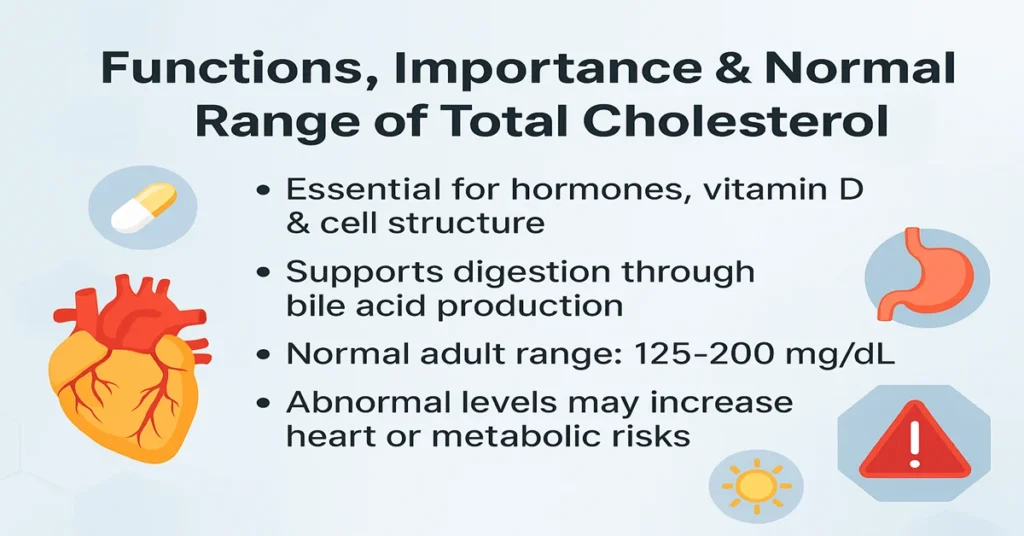
Functions, Importance & Normal Range of Total Cholesterol
Overview
Cholesterol is a natural, waxy substance produced mainly by the liver. Although it often gets a bad reputation, cholesterol is essential for life. It is required to make hormones, vitamin D, bile acids for digestion, and to maintain the structure of every cell in the body.
In routine OPD and lab practice, cholesterol testing is one of the most commonly ordered investigations because it gives a broad picture of heart health, metabolic balance, liver function, and long-term disease risk. Problems arise not because cholesterol exists, but when its levels move too far above or below the normal range.
This article explains what total cholesterol does, why it is important, how it functions in the body, normal reference ranges across age, gender, and pregnancy, and when abnormal values become clinically concerning.
What Does Total Cholesterol Do?
Total cholesterol is a combined value that includes:
LDL (Low-Density Lipoprotein)
HDL (High-Density Lipoprotein)
VLDL (Very Low-Density Lipoprotein)
Triglyceride-related lipid particles
Together, these reflect how fats are being produced, transported, and cleared in the body.
Builds hormones
Cholesterol is the raw material for important hormones such as estrogen, testosterone, cortisol, and progesterone. Without adequate cholesterol, hormone production becomes inefficient.
Forms cell membranes
Every cell in the body relies on cholesterol to keep its membrane stable yet flexible. Very low cholesterol weakens cells, while excess cholesterol may accumulate inside blood vessels.
Helps produce vitamin D
When sunlight hits the skin, cholesterol is converted into vitamin D, which is vital for bone strength, immunity, and muscle function.
Supports digestion
The liver uses cholesterol to form bile acids, which help digest fats and absorb fat-soluble vitamins (A, D, E, and K).
Aids tissue repair
Cholesterol participates in cell repair and recovery, especially after injury or illness.
Clinically, cholesterol is not harmful by default. The imbalance is what causes problems.
Why Is Cholesterol Important?
Cholesterol levels give doctors insight into multiple body systems, not just the heart.
Indicator of cardiovascular risk
High LDL increases the risk of plaque formation in arteries, while HDL helps remove excess cholesterol and protect blood vessels.
Reflects liver function
Because the liver produces cholesterol, abnormal levels may suggest liver stress, fatty liver, or metabolic imbalance.
Supports brain and nerve function
Cholesterol is essential for nerve insulation (myelin) and brain chemicals involved in memory, focus, and mood regulation.
Guides prevention strategies
Doctors use cholesterol levels to decide whether lifestyle changes, monitoring, or medications are needed.
Signals metabolic health
Cholesterol abnormalities often coexist with diabetes, obesity, thyroid disorders, and insulin resistance.
In real-world practice, cholesterol is viewed as a systemic health marker, not just a heart number.
Role of Cholesterol in the Body
Cholesterol plays several critical roles simultaneously.
Hormone production
All steroid hormones depend on cholesterol as their base structure.
Cell repair and protection
It strengthens cell membranes and helps cells recover from stress or damage.
Nerve insulation
Cholesterol forms myelin, which allows fast and accurate nerve signal transmission.
Fat digestion and absorption
Without cholesterol-based bile acids, the body cannot absorb essential fats or vitamins.
Metabolic stability
Cholesterol participates in multiple biochemical pathways that regulate energy and organ function.
Because of these roles, both excessively high and abnormally low levels can be harmful.
Normal Total Cholesterol Levels (Age-Wise)
Cholesterol levels change with age due to hormones, metabolism, and lifestyle.
Children (5–19 years)
120 – 170 mg/dL
Lower levels are expected due to active metabolism.
Adults (20+ years)
125 – 200 mg/dL
This is the standard reference range for most adults.
Older adults (50+ years)
150 – 220 mg/dL
A mild rise is commonly seen due to slower metabolism and hormonal changes.
Exact ranges may vary slightly between laboratories.
Normal Cholesterol Levels (Gender-Wise)
Hormonal differences explain small variations between men and women.
Men
125 – 200 mg/dL
Men often have higher LDL and lower HDL.
Women
130 – 210 mg/dL
Estrogen usually keeps HDL higher before menopause. After menopause, LDL often rises.
Interpretation is based more on overall risk profile than gender alone.
Cholesterol Levels During Pregnancy
Pregnancy causes a physiological rise in cholesterol, which is normal and necessary.
First trimester
170 – 230 mg/dL
Second trimester
190 – 260 mg/dL
Third trimester
220 – 300 mg/dL
This rise supports fetal growth, hormone production, and milk preparation. Cholesterol levels usually return to pre-pregnancy values after delivery.
When Abnormal Cholesterol Levels Become Risky
Both high and low cholesterol can be clinically significant.
High cholesterol becomes concerning when:
LDL exceeds 160 mg/dL
HDL falls below 40 mg/dL
Triglycerides rise above 200 mg/dL
There is diabetes, obesity, smoking, or high blood pressure
There is a strong family history of heart disease
Risks include heart attack, stroke, atherosclerosis, and peripheral artery disease.
Low cholesterol becomes concerning when:
Total cholesterol drops below 120 mg/dL
LDL falls below 50 mg/dL
There is unexplained weight loss or weakness
Very low levels may be associated with hormone imbalance, mood changes, weak immunity, poor digestion, and in rare cases, bleeding-type strokes.
Clinically, doctors always interpret cholesterol along with symptoms and other tests, not in isolation.
Test Preparation
For accurate total cholesterol results:
Fast for 9–12 hours if advised
Drink water normally
Avoid alcohol for 24 hours
Avoid heavy or fatty meals the night before
Avoid intense exercise before testing
Inform the doctor about medications or supplements
Rest briefly before blood collection
Good preparation reduces false readings.
When to Consult a Doctor
Consult a doctor if:
Cholesterol remains consistently high or low
You have chest pain, breathlessness, or leg pain
You have diabetes, thyroid, or liver disease
There is a strong family history of heart disease
You notice fatigue, mood changes, or unexplained weakness
Triglycerides are markedly elevated
Early evaluation prevents long-term complications.
Important Word Explanations
LDL (Low-Density Lipoprotein): Cholesterol that can accumulate in arteries
HDL (High-Density Lipoprotein): Cholesterol that helps remove LDL
Triglycerides: Blood fats linked to sugar and calorie excess
Atherosclerosis: Narrowing and hardening of arteries
Hypercholesterolemia: High cholesterol levels
Hypocholesterolemia: Low cholesterol levels
People Also Ask
Is total cholesterol alone enough to assess heart risk?
Not completely. Doctors also look at LDL, HDL, triglycerides, and overall risk factors.
Can cholesterol levels fluctuate naturally?
Yes. Illness, stress, diet changes, and pregnancy can cause temporary changes.
Does normal cholesterol mean no heart disease risk?
Not always. Other factors like diabetes, smoking, and blood pressure still matter.
When do doctors worry most about cholesterol?
When levels stay abnormal over time or are combined with other risk factors.
Is repeat cholesterol testing common?
Yes. Repeat tests help confirm trends and response to lifestyle changes.
Can cholesterol be too low to be healthy?
Yes. Very low levels can affect hormones, immunity, and brain function.
~END~