
Overview
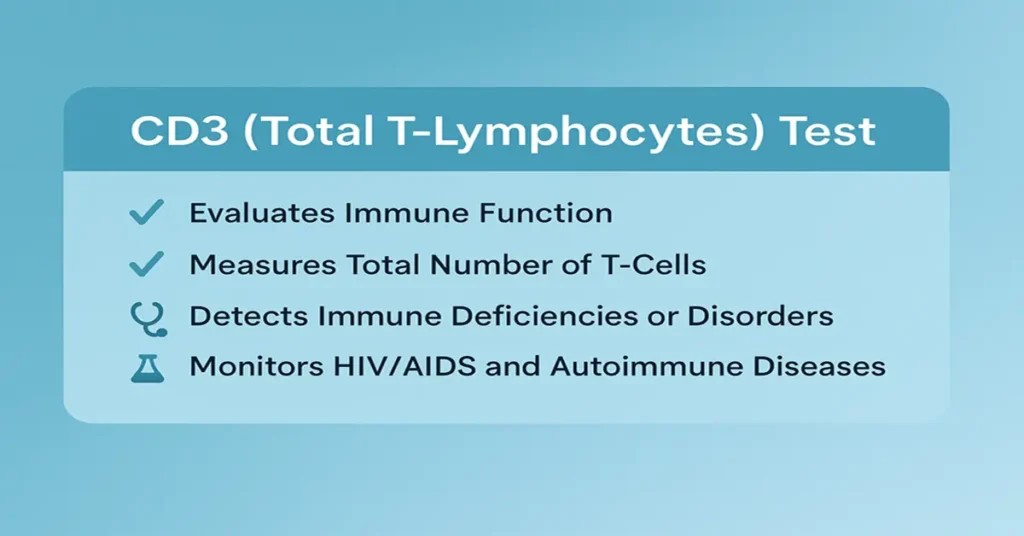
The CD3 (Total T-Lymphocytes) Test is a blood test that measures the total number of T-cells circulating in the bloodstream. T-cells are a core component of the immune system. They help recognize infections, eliminate infected or abnormal cells, and coordinate immune responses with other white blood cells.
This test detects CD3, a protein complex present on the surface of all mature T-lymphocytes. Because every mature T-cell carries the CD3 marker, the result reflects the overall T-cell population. Clinically, it is used to assess immune strength and balance in conditions such as HIV infection, immune deficiencies, autoimmune disorders, and in patients receiving immune-suppressing treatments after chemotherapy or organ transplantation.
Where It Is Synthesized or Produced in the Body
T-lymphocytes develop through a structured process within the body:
Production:
T-cell precursors are formed in the bone marrow, along with other blood cells.
Maturation:
These immature cells migrate to the thymus gland, where they mature and acquire specific surface markers, including CD3. This step is essential for proper immune recognition and function.
Circulation:
Once mature, T-cells circulate between the blood, lymph nodes, spleen, and other lymphoid tissues, remaining ready to respond to infections or abnormal cells.
Because CD3 is present on all mature T-cells, it serves as a reliable marker of total T-cell status in the body.
Main Functions and Importance
The CD3 test provides a broad view of cell-mediated immunity, which is the arm of the immune system responsible for direct cellular defense.
T-cells are involved in identifying virus-infected cells, coordinating immune activity through signaling molecules, and maintaining immune regulation so that responses are effective but not excessive. They also play a role in cancer surveillance by detecting abnormal cells early.
From a clinical standpoint, measuring CD3 helps estimate the total T-cell pool rather than focusing on a single subtype. It is commonly used to evaluate immune suppression, track immune recovery after treatments that affect white blood cells, and support monitoring in chronic conditions where immune balance is critical, such as HIV infection.
Causes of Low CD3 (T-Cell) Levels
A low CD3 count usually reflects reduced immune capacity. This may occur when T-cells are being destroyed, underproduced, or suppressed.
Common clinical settings include advanced HIV infection, inherited immune deficiency disorders, and the effects of chemotherapy or radiation therapy. Bone marrow failure states can also reduce T-cell production. In addition, long-term use of immunosuppressive medicines, such as those prescribed after organ transplantation or for autoimmune diseases, can lower CD3 levels.
Symptoms of Low CD3 (T-Cell) Levels
When T-cell numbers are reduced, the immune system becomes less effective at controlling infections. Patients may experience frequent or unusually severe infections, slower recovery from common illnesses, or infections caused by organisms that rarely affect people with normal immunity.
General symptoms such as persistent fatigue, weight loss, or prolonged fever may also be present. Persistently low CD3 levels usually prompt further evaluation to understand the underlying cause rather than being interpreted in isolation.
Causes of High CD3 (T-Cell) Levels
An elevated CD3 count is less common and often reflects immune activation rather than a primary problem with the test itself.
Temporary increases can occur during early or active infections as the immune system responds. Chronic immune stimulation, as seen in some autoimmune conditions, may also raise T-cell numbers. In rare cases, markedly high counts are associated with disorders where T-cells multiply abnormally, such as certain leukemias or lymphomas.
Symptoms of High CD3 (T-Cell) Levels
Symptoms depend on the underlying condition driving the increase. Some people may have joint pain, rashes, or inflammatory symptoms related to autoimmune disease. Others may experience fever, night sweats, or enlarged lymph nodes when abnormal T-cell proliferation is present.
An elevated CD3 value alone does not confirm disease. Doctors usually interpret it alongside other immune markers, such as CD4 and CD8 counts, and the patient’s clinical picture.
Reference Ranges
Reference ranges can vary slightly between laboratories, but typical adult values are:
- Absolute CD3 T-cell count: 1,000 – 2,000 cells/µL
- CD3 percentage of lymphocytes: 60 – 85%
Values below these ranges suggest immune suppression, while higher values may reflect immune activation or, less commonly, abnormal cell proliferation.
Sample Type and Testing Method
Sample Type:
Venous blood collected from a vein in the arm.
Testing Method:
The test is performed using flow cytometry, a specialized laboratory technique. Cells are labeled with fluorescent markers that bind specifically to CD3 proteins and then passed through a laser-based analyzer. This allows precise counting and characterization of T-cells.
Flow cytometry often measures CD3 along with other markers such as CD4 and CD8 to give a more complete immune profile.
Test Preparation
No fasting or special preparation is required. Patients should inform their doctor about ongoing treatments, especially chemotherapy, steroids, or immunosuppressive medications, as these can influence results.
If possible, testing is best performed when there is no acute infection, since temporary immune changes can affect T-cell counts.
When to Consult a Doctor
Discussion with a doctor is important if results are abnormal or if there are symptoms such as recurrent infections, unexplained weight loss, persistent fatigue, or swollen lymph nodes.
This test is especially relevant for people with known immune disorders, HIV infection, cancer, or those receiving long-term immune-modifying therapies. Based on the findings, doctors may recommend further immune studies or follow-up testing to clarify the cause and significance of the result.
Important Word Explanations
- CD3: A protein complex present on all mature T-lymphocytes, used as a marker of total T-cell count.
- T-Lymphocytes (T-cells): White blood cells responsible for cell-mediated immunity.
- Flow Cytometry: A laboratory technique that identifies and counts cells using fluorescent markers and lasers.
- Immunodeficiency: Reduced ability of the immune system to fight infections.
- Autoimmune Disease: A condition in which the immune system mistakenly attacks the body’s own tissues.
~END~
Related Posts
None found