
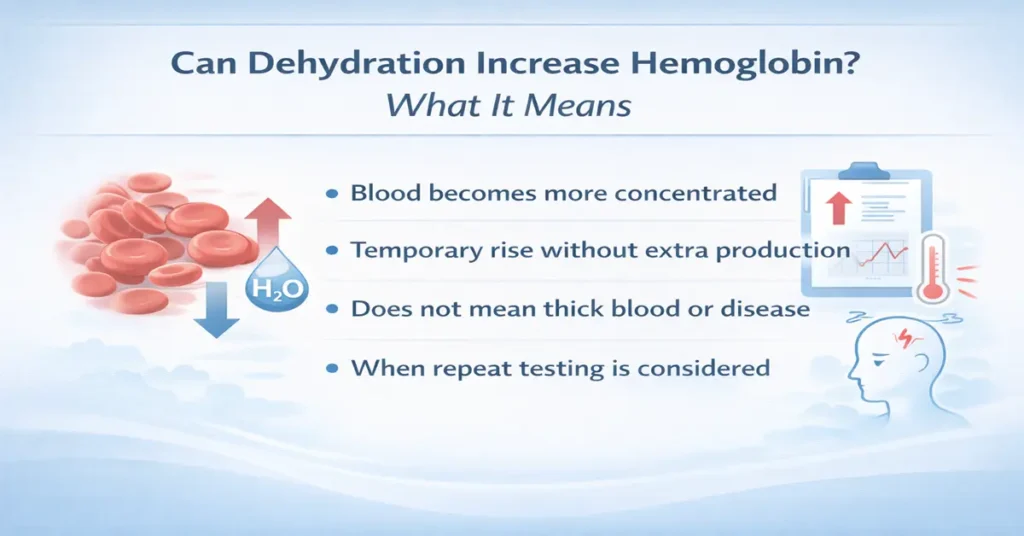
Can Dehydration Increase Hemoglobin? What Lab Reports Really Show
This is a very common question patients ask after seeing their blood report:
“I was told I was dehydrated. Can dehydration really increase hemoglobin?”
“Does this mean my hemoglobin is actually high?”
“Should I be worried, or is it just because I drank less water?”
From more than 10 years of real hospital, diagnostic lab, and OPD experience, I can confidently say:
yes, dehydration can make hemoglobin appear higher on a blood test — and in most routine cases, it is not dangerous.
This article focuses only on this specific confusion. It does not explain what hemoglobin is in general, does not list causes of high hemoglobin, and does not overlap with treatment or reduction articles. The goal is simple: to help you understand how dehydration affects hemoglobin readings and how doctors interpret it in practice.
Why This Confusion Happens So Often
Most people assume that if hemoglobin is high, the body must have produced extra red blood cells. So when dehydration is mentioned, it sounds too simple to explain a “high” number.
In real lab practice, however, hemoglobin values are influenced not only by red blood cell production, but also by how concentrated the blood is at the time of testing.
Dehydration changes blood concentration, not red blood cell production.
How Dehydration Affects Hemoglobin in Simple Terms
When the body loses fluid and does not replace it adequately:
- Plasma (the liquid part of blood) decreases
- Red blood cells stay the same
- Blood becomes more concentrated
Because hemoglobin is measured as a concentration, the value appears higher even though the actual amount of hemoglobin in the body has not increased.
From lab experience, this is one of the most common reasons for a sudden or unexpected rise in hemoglobin.
Real OPD and Lab Examples Seen Every Day
Fasting blood tests
Patients who come for blood tests after long fasting with little or no water often show higher hemoglobin. When they repeat the test after proper hydration, the value usually comes down.
Hot weather and sweating
In warm climates, people lose fluids through sweat without realizing it. Mild dehydration is enough to affect hemoglobin concentration.
Illness with poor intake
During fever, vomiting, or diarrhea, fluid loss is common. Hemoglobin may appear higher during this phase and normalize later.
Elderly patients
Older adults often drink less water. Mild dehydration-related hemoglobin elevation is very common in this group.
These are routine findings in daily lab work and usually do not indicate disease.
Does Dehydration Truly Increase Hemoglobin Production?
Clinically, the answer is no.
Dehydration does not stimulate the bone marrow to produce more hemoglobin or red blood cells. It only changes the ratio of cells to fluid in the blood.
Once hydration improves, blood volume returns to normal and hemoglobin readings usually correct themselves.
How Much Can Hemoglobin Increase Due to Dehydration?
From practical lab observation:
- Mild dehydration can raise hemoglobin by about 0.5 to 1 g/dL
- Moderate dehydration may cause slightly more noticeable changes
Doctors usually look at the context rather than the number alone. A small rise explained by dehydration is considered clinically acceptable.
How Doctors Interpret High Hemoglobin When Dehydration Is Suspected
In OPD and ward practice, doctors usually ask:
- Was the patient fasting or poorly hydrated?
- Was there recent illness, fever, vomiting, or diarrhea?
- Are other blood parameters stable?
- Does the patient have symptoms?
If dehydration is likely and other values are normal, doctors often consider the hemoglobin reading temporary and non-concerning.
When Dehydration-Related High Hemoglobin Is Usually Harmless
From routine diagnostic experience, it is usually harmless when:
- Hemoglobin elevation is mild
- The patient feels generally well
- Other CBC values are normal
- There is a clear reason for dehydration
- The value normalizes on repeat testing
In these cases, reassurance and hydration are enough.
When Doctors Pay Closer Attention
Doctors may look more carefully if:
- Hemoglobin remains high despite good hydration
- The value keeps increasing on repeat tests
- There are symptoms such as headache, dizziness, or visual discomfort
- Other blood parameters also show abnormalities
Even then, dehydration being ruled out is just the first step, not a diagnosis.
Should Hemoglobin Always Be Rechecked After Dehydration?
Not always, but often.
From lab experience:
- If dehydration was obvious, doctors may advise repeat testing after proper hydration
- If the patient has no symptoms, repeat testing is not urgent
- Repeat testing helps confirm whether the change was dilution-related
Many patients see their hemoglobin return to baseline once hydration improves.
Common Misunderstandings About Dehydration and Hemoglobin
“High hemoglobin means thick blood forever”
Not true. Dehydration-related concentration is temporary.
“I must reduce hemoglobin immediately”
Not needed if dehydration is the cause.
“This means a serious blood disorder”
In most routine cases, it does not.
Understanding these points prevents unnecessary anxiety.
How This Is Explained to Patients in OPD
In daily OPD practice, the explanation is usually simple:
“Your hemoglobin looks higher because your body fluids were low at the time of testing. Let’s hydrate well and see if it settles.”
This calm explanation reassures most patients.
Test Preparation
To avoid dehydration-related changes in hemoglobin:
- Drink adequate water before blood sampling (unless restricted by your doctor)
- Avoid long fasting without fluids
- Inform the lab about recent fever, vomiting, or diarrhea
- Try to test in a rested state
- Follow test instructions properly
Good preparation improves report accuracy.
When to Consult a Doctor
Consult a doctor if:
- Hemoglobin remains high after proper hydration
- You experience symptoms like headache or dizziness
- There is repeated unexplained elevation
- Other blood parameters are abnormal
- A doctor advises further evaluation
Otherwise, hydration and observation are usually sufficient.
Important Word Explanations
Hemoglobin
The oxygen-carrying protein in red blood cells.
Dehydration
A state where the body has less fluid than needed.
Plasma
The liquid portion of blood.
Concentration
The amount of a substance relative to fluid volume.
CBC (Complete Blood Count)
A test that measures different blood components.
People Also Ask
Can dehydration falsely raise hemoglobin levels?
Yes. It can make hemoglobin appear higher without actual increase.
Will hemoglobin go back to normal after drinking water?
In many cases, yes.
Is dehydration-related high hemoglobin dangerous?
Usually no, if mild and temporary.
Should I repeat my test after hydration?
Often advised if dehydration was present.
~END~
Related Posts
None found