
Overview
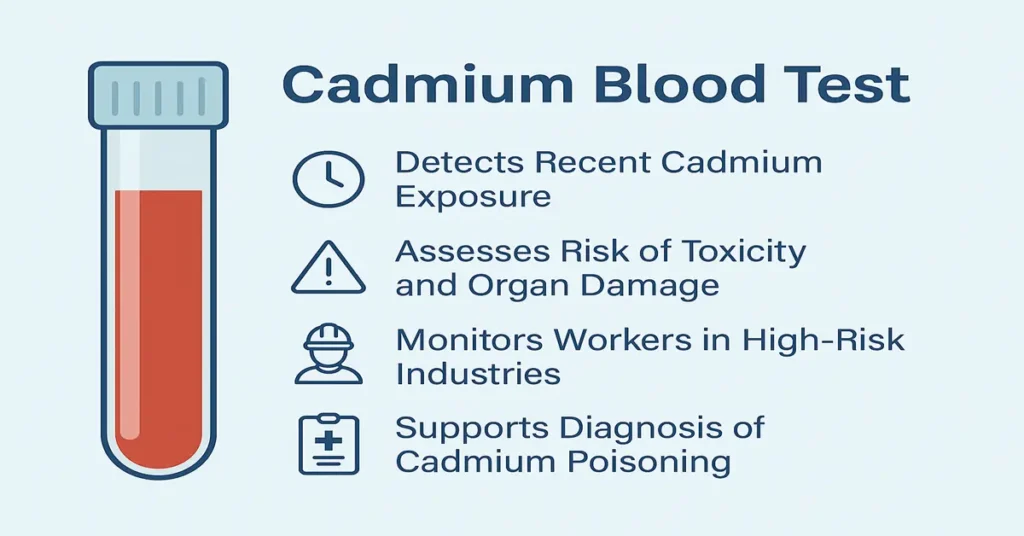
The Cadmium Blood Test measures the amount of cadmium, a toxic heavy metal, present in the bloodstream. Cadmium is not produced by the human body. Exposure happens from the environment—most commonly through cigarette smoke, contaminated food or water, polluted air, or certain occupational settings such as battery manufacturing, metal work, plastics, paints, and welding.
This test is used to identify recent exposure and to assess whether cadmium may be contributing to unexplained health findings. From a laboratory perspective, blood cadmium reflects what has entered the body relatively recently, which makes the test particularly useful for workplace monitoring and for evaluating suspected exposure.
Where It Is Found or Produced in the Body
Cadmium has no physiological role in the human body. Once it enters through inhalation or ingestion, it circulates briefly in the blood and then gradually accumulates in tissues.
Over time, cadmium is stored mainly in the kidneys and liver, where it can remain for many years. The body clears cadmium very slowly, which is why repeated or long-term exposure can lead to accumulation even when daily exposure levels seem small.
Main Functions and Importance of the Test
Because cadmium itself has no beneficial function, the value of this test lies in exposure assessment and risk evaluation rather than routine screening.
Clinically, the Cadmium Blood Test helps to:
- Identify recent cadmium exposure.
- Support evaluation of symptoms that may raise concern for heavy metal toxicity.
- Monitor individuals working in industries where cadmium exposure is a recognized risk.
- Complement urine cadmium testing, which reflects longer-term body burden.
From a doctor’s viewpoint, blood and urine results together often give a clearer picture than either test alone.
Causes of Low or Undetectable Levels
Low or undetectable cadmium levels are expected in healthy individuals and are considered normal.
They usually reflect:
- No meaningful environmental or occupational exposure.
- Effective workplace safety measures.
- Absence of major exposure sources such as smoking or industrial contact.
Symptoms of Low Levels
There are no symptoms associated with low cadmium levels. In fact, this finding simply indicates that cadmium is not present in amounts that raise concern.
Causes of High Cadmium Levels
Elevated blood cadmium levels suggest recent or ongoing exposure. Common sources include environmental, occupational, and lifestyle-related factors.
Smoking is one of the most frequent contributors, as tobacco smoke contains cadmium that is readily absorbed through the lungs. Occupational exposure may occur in industries involving metals, pigments, batteries, or welding fumes. Cadmium can also enter the body through food grown in contaminated soil or through polluted water sources.
Living near industrial areas or waste sites can increase background exposure through air or dust particles.
Symptoms of High Levels (Cadmium Toxicity)
Symptoms depend on the duration and intensity of exposure rather than the blood level alone.
With short-term exposure, people may experience general digestive or respiratory discomfort. With long-term accumulation, effects are more often related to kidney, bone, or lung function.
Importantly, laboratory findings may show elevated cadmium levels before clear symptoms appear. This is why testing is often used as an early warning tool in exposed individuals rather than only after symptoms develop.
Reference Ranges
Reference values can vary slightly between laboratories. Commonly used interpretive ranges include:
- Below 5 µg/L: No significant recent exposure
- 5–10 µg/L: Possible environmental or mild occupational exposure
- Above 10 µg/L: Significant exposure requiring clinical correlation
Smokers may show modestly higher values even without industrial exposure, which is taken into account during interpretation.
Sample Type and Test Method
The test is performed on a venous blood sample collected under standard conditions.
In many cases, a urine cadmium test is requested alongside the blood test, as urine levels better reflect long-term accumulation in the kidneys.
Laboratories typically use highly sensitive techniques such as inductively coupled plasma mass spectrometry (ICP-MS) or atomic absorption spectroscopy (AAS) to measure trace amounts accurately.
Test Preparation
No fasting is required for this test.
Patients should inform their doctor about occupational exposures, smoking history, and any supplements or medications being taken, as these details help with accurate interpretation. For workplace monitoring, laboratories may provide specific instructions that should be followed closely.
When to Consult a Doctor
You should discuss testing or results with a doctor if you:
- Work in environments with known metal exposure.
- Have ongoing symptoms that are unexplained by routine tests.
- Live near industrial or heavily polluted areas.
- Are undergoing occupational health monitoring.
If cadmium levels are elevated, doctors typically correlate the results with symptoms, exposure history, and other laboratory findings before deciding on further evaluation or follow-up.
Important Word Explanations
- Cadmium: A toxic heavy metal with no biological role in the human body.
- µg/L (Microgram per Liter): A unit used to measure very small concentrations in blood.
- Toxicity: Harmful effects caused by exposure to a substance.
- ICP-MS / AAS: Advanced laboratory techniques used to detect trace metals with high precision.
- Heavy Metal Exposure: Contact with metals that can accumulate in the body and affect organ function over time.
~END~
Related Posts
None found
Dear allabouttests.com Admin!
Hi, How can i help you.