
Overview
The C1 Esterase Inhibitor (C1-INH) Test is a blood test used to assess both the amount and functional activity of a protein called C1 esterase inhibitor. This protein plays a central role in keeping several immune and inflammatory pathways under control. When it works properly, it prevents excessive swelling, inflammation, and abnormal immune activation.
Clinically, this test is most often used when doctors suspect hereditary angioedema (HAE)—a rare condition marked by recurrent, unpredictable episodes of swelling. These episodes can involve the skin, abdomen, or, more seriously, the airways. Because the symptoms can resemble allergies or other causes of swelling, laboratory confirmation is essential.
What is the C1 Esterase Inhibitor Protein?
C1 esterase inhibitor is a plasma protein found in the liquid portion of the blood. It is produced mainly by the liver and circulates continuously in the bloodstream.
Its role is regulatory rather than defensive. Instead of attacking infections directly, it acts as a control mechanism for several powerful systems in the body, including the complement system, the kallikrein–kinin pathway, and parts of the clotting system. When C1-INH is present in adequate amounts and functions normally, these systems remain balanced. When it is deficient or dysfunctional, swelling and inflammation can occur without warning.
Where It Is Synthesized or Produced in the Body
The liver is the primary site of C1 esterase inhibitor production. After synthesis, the protein is released into the circulation, where it interacts with multiple enzymes involved in immune and inflammatory responses.
In particular, it regulates key proteins such as C1r and C1s in the complement system and enzymes like kallikrein and factor XIIa in the contact system. By limiting their activity, C1-INH helps prevent unnecessary inflammation and excessive fluid leakage into tissues.
Main Functions and Importance
C1 esterase inhibitor serves as a critical “brake” on several biological systems.
It prevents excessive activation of the complement system, protecting tissues from damage caused by uncontrolled immune reactions. It also limits the formation of bradykinin, a chemical mediator that increases blood vessel permeability and leads to swelling. In addition, it contributes to balance within clotting and fibrinolytic pathways.
From a clinical standpoint, adequate C1-INH activity is what prevents the sudden swelling attacks seen in hereditary angioedema. Measuring this protein helps explain symptoms that otherwise appear puzzling or resistant to standard allergy treatments.
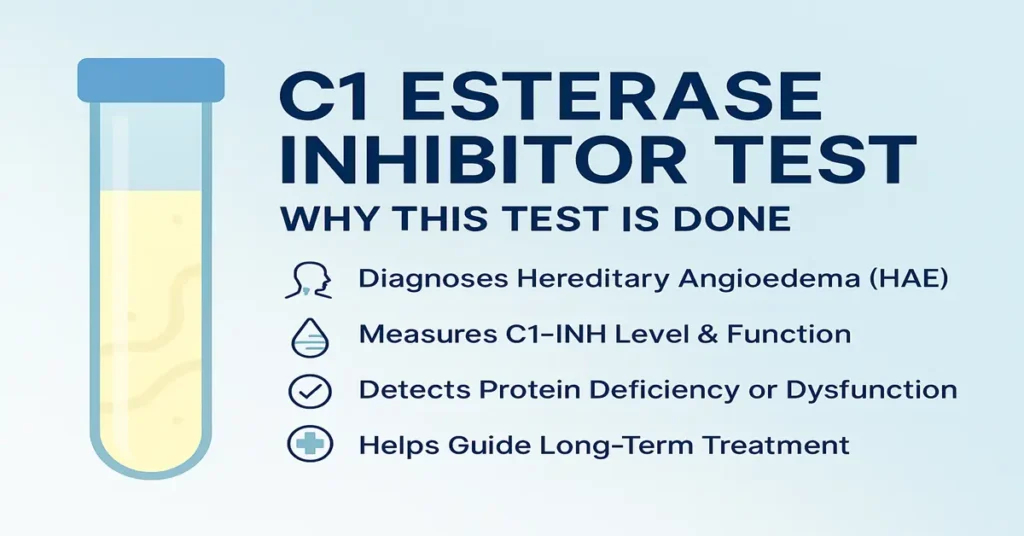
Why the C1 Esterase Inhibitor Test is Done
Doctors typically order this test when a patient has repeated episodes of swelling without hives or itching, especially if the episodes do not respond to antihistamines or steroids.
The test helps confirm hereditary angioedema, distinguish between different types of the condition, and separate hereditary causes from acquired forms that develop later in life. It also provides insight into whether symptoms are due to a true deficiency of the protein or a problem with how the protein functions.
Causes of Low C1 Esterase Inhibitor Levels
Reduced levels or activity of C1-INH most commonly occur in hereditary angioedema.
In Type I HAE, the body produces insufficient amounts of the protein, leading to low circulating levels. In Type II HAE, the quantity may appear normal, but the protein does not function properly. In both cases, the regulatory control over inflammation is impaired.
Low C1-INH can also be seen in acquired angioedema, which usually develops later in life and may be associated with autoimmune conditions, certain cancers, or increased consumption of the protein. Severe liver disease can also reduce production, as the liver is the site of synthesis.
Symptoms of Low C1 Esterase Inhibitor Levels
When C1-INH is deficient or dysfunctional, patients may experience recurrent swelling episodes. These commonly affect the hands, feet, face, lips, or genitals. Swelling of the gastrointestinal tract can cause severe abdominal pain, nausea, or vomiting. Swelling involving the throat or airway is particularly serious because it can interfere with breathing.
A key clinical clue is that the swelling is usually non-itchy, develops gradually over several hours, and lasts for days. It also does not improve with typical allergy medications, which often prompts further investigation.
Causes of High C1 Esterase Inhibitor Levels
Elevated C1-INH levels are uncommon and are generally not a cause for concern. When they do occur, they are usually seen in the setting of inflammation, infection, or immune activation.
In most cases, high levels do not indicate a specific disease and do not require treatment on their own.
Symptoms of High Levels
There are typically no symptoms directly attributable to increased C1-INH levels. Such findings are usually interpreted in the context of other clinical or laboratory evidence of inflammation.
Reference Ranges
Reference values can vary slightly by laboratory and method. Commonly used ranges include:
- C1 Esterase Inhibitor level: approximately 21–39 mg/dL
- Functional activity: greater than 50% of normal
Low quantity or reduced activity suggests hereditary or acquired angioedema. Normal quantity with low functional activity is characteristic of hereditary angioedema type II.
Sample Type and Test Method
The test requires a blood sample, collected from a vein under routine conditions. Laboratories use specialized assays to measure both the concentration of C1-INH and how well it functions.
Quantitative measurement is often performed using immunologic techniques, while functional assays assess the protein’s regulatory activity. Both measurements together provide a clearer clinical picture than either alone.
Test Preparation
No fasting or special preparation is needed. Patients should inform their doctor about current medications or recent illnesses, as these factors may influence results.
When hereditary angioedema is suspected, testing of close family members may also be considered, since the condition is inherited.
When to Consult a Doctor
Medical advice should be sought if there are repeated episodes of unexplained swelling, particularly involving the face, throat, or abdomen. Severe abdominal pain without a clear cause or any breathing difficulty related to swelling warrants urgent evaluation.
A family history of hereditary angioedema is another important reason to discuss testing. If results show reduced levels or activity, further evaluation—such as complement testing or genetic studies—may be recommended to confirm the diagnosis and guide long-term care.
Important Word Explanations
- C1 Esterase Inhibitor (C1-INH): A regulatory protein that controls immune and inflammatory pathways.
- Complement System: A group of proteins that support immune defense but require tight regulation.
- Hereditary Angioedema (HAE): A genetic condition causing recurrent, non-allergic swelling episodes.
- Bradykinin: A chemical mediator that increases blood vessel permeability and leads to swelling.
- Functional Activity: A measure of how effectively a protein performs its biological role.
~END~
Related Posts
None found