
What is C-Reactive Protein (CRP)?
C-Reactive Protein (CRP) is a protein made by the liver that rises in the blood whenever there is inflammation somewhere in the body. It does not point to a specific disease on its own, but it serves as a very sensitive signal that the immune system has been activated due to infection, tissue injury, or an inflammatory process.
In routine clinical practice, doctors use the CRP test to detect inflammation, assess how severe it is, and monitor how the body is responding over time. It is also widely used as a supportive marker in evaluating cardiovascular risk.
Where is CRP Produced in the Body?
CRP is produced in the liver. Its release is triggered by chemical messengers called cytokines, especially interleukin-6 (IL-6), which are released during inflammation or infection.
When body tissues are injured or when bacteria or viruses enter the system, IL-6 signals the liver to increase CRP production. As inflammation increases, CRP levels rise accordingly. This direct relationship makes CRP a reliable laboratory indicator of inflammatory activity.
Main Functions and Importance of CRP
CRP plays a supportive role in the body’s immune response and has significant clinical value.
It helps the immune system recognize damaged cells and certain microbes, allowing them to be cleared more efficiently. Clinically, CRP is especially useful as an early marker, often rising before more obvious signs of illness appear.
Doctors frequently rely on CRP levels to monitor disease activity and response to treatment in infections, autoimmune conditions, and inflammatory disorders. In addition, mildly elevated CRP levels—measured using high-sensitivity testing—can reflect ongoing low-grade inflammation linked to cardiovascular disease risk.
Rather than providing a diagnosis, CRP offers context, helping clinicians decide whether further evaluation is needed.
Causes of Low or Negative CRP Levels
Low or undetectable CRP levels generally indicate that there is no active inflammation in the body at the time of testing. This is commonly seen in healthy individuals.
Low values are also observed once an infection or inflammatory condition has resolved, or when inflammation is well controlled. In clinical settings, a low CRP usually reassures doctors that significant inflammatory activity is unlikely.
Symptoms of Low or Negative CRP Levels
Low CRP levels themselves do not cause symptoms. They simply reflect the absence of active inflammation. People with normal CRP values are often asymptomatic or recovering well from a recent illness.
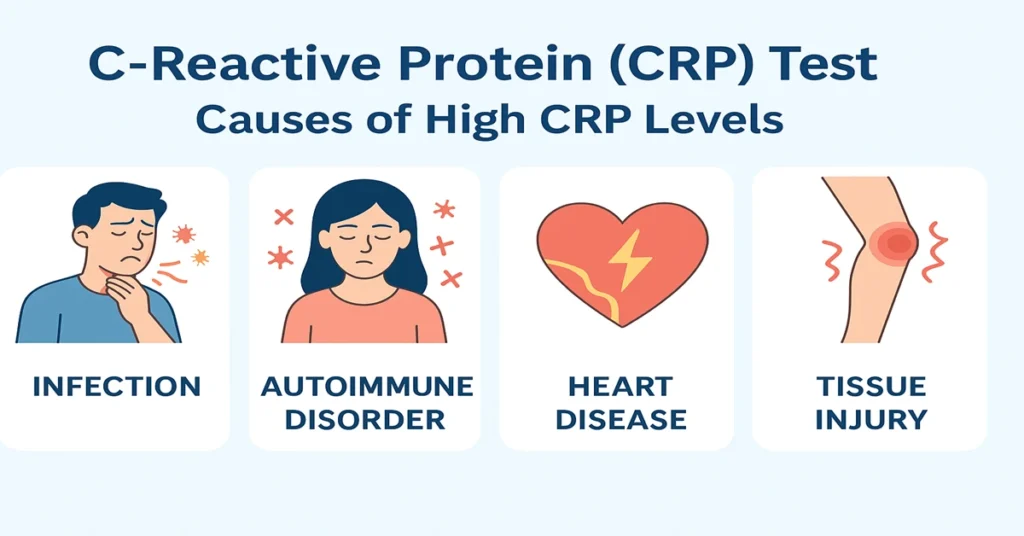
Causes of High or Positive CRP Levels
An elevated CRP level indicates that the body is responding to inflammation or tissue injury. This response may be acute or chronic.
Higher values are commonly associated with infections, autoimmune conditions, tissue damage, or inflammatory diseases. Persistent elevation may also be seen in chronic inflammatory states or cardiovascular conditions where low-grade inflammation is ongoing.
CRP does not distinguish between these causes, which is why results are always interpreted alongside symptoms and other laboratory findings.
Symptoms of High or Positive CRP Levels
CRP itself does not produce symptoms. Any symptoms present are due to the underlying condition causing inflammation.
Patients may experience fever, fatigue, pain, swelling, or stiffness depending on the source of inflammation. In heart-related conditions, symptoms such as chest discomfort or breathlessness may be present. CRP helps support the clinical picture but does not replace clinical assessment.
CRP Test Reference Ranges
CRP results are reported in milligrams per liter (mg/L). Typical reference ranges are:
- < 1 mg/L: Normal or low cardiovascular risk
- 1–3 mg/L: Mild inflammation or average cardiovascular risk
- > 3 mg/L: Active inflammation or higher cardiovascular risk
- > 100 mg/L: Marked inflammation, often seen in severe infections
Exact cut-offs may vary slightly between laboratories. Very high values usually prompt urgent clinical evaluation.
Types of CRP Tests
Two main forms of CRP testing are used:
The standard CRP test detects moderate to high elevations and is commonly used for infections and inflammatory diseases.
The high-sensitivity CRP (hs-CRP) test measures much lower levels of CRP and is mainly used to assess cardiovascular risk by detecting subtle inflammation in blood vessels.
Sample Type for CRP Test
The CRP test requires a blood sample, usually drawn from a vein in the arm. Serum or plasma is used for analysis.
No special preparation is needed in most cases. However, medications such as statins or anti-inflammatory drugs can influence results, so doctors usually take this into account during interpretation.
Test Preparation
Fasting is generally not required.
Patients should inform their doctor about recent infections, surgeries, or inflammatory conditions, as these can temporarily raise CRP levels. Strenuous exercise just before testing may also cause a short-term increase.
For hs-CRP testing, it is best to perform the test when there is no active infection, to avoid misleading elevations.
When to Consult a Doctor
Medical advice should be sought if CRP levels remain elevated or if symptoms such as persistent fever, joint pain, swelling, or unexplained fatigue are present.
CRP results are most meaningful when reviewed along with clinical findings and other investigations. Doctors may recommend additional tests to identify the underlying cause and guide further evaluation.
Important Word Explanations
- Inflammation: The body’s protective response to injury or infection
- Interleukin-6 (IL-6): A signaling protein that stimulates CRP production in the liver
- Autoimmune Disease: A condition in which the immune system attacks the body’s own tissues
- Atherosclerosis: Narrowing and hardening of arteries due to chronic inflammation and plaque buildup
- High-Sensitivity CRP (hs-CRP): A refined CRP test used to assess cardiovascular risk
~END~
Related Posts
None found