
Overview
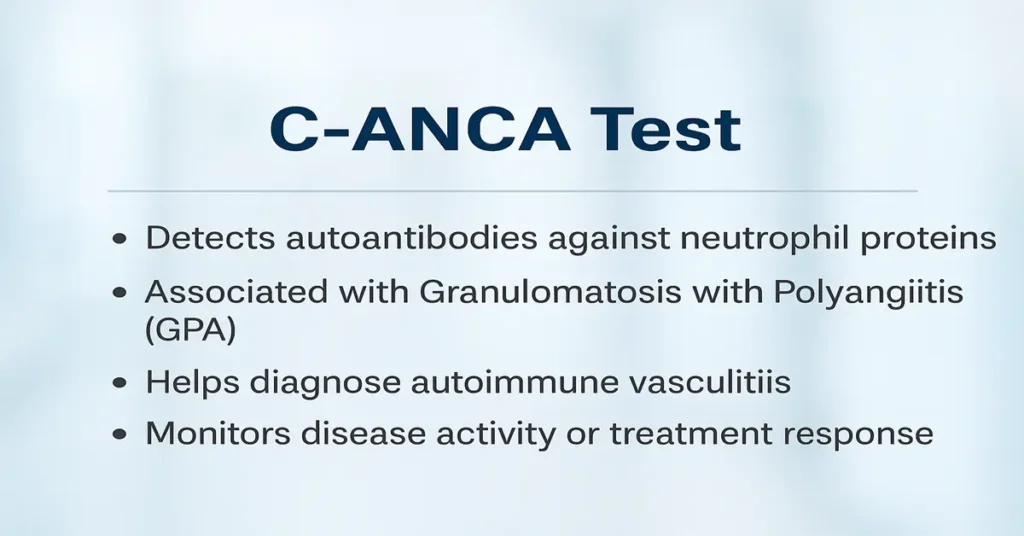
The C-ANCA test is a blood test used to detect certain autoantibodies that target components within white blood cells. C-ANCA stands for Cytoplasmic Anti-Neutrophil Cytoplasmic Antibody. These antibodies are clinically important because they are closely associated with a group of autoimmune conditions known as vasculitis, in which blood vessels become inflamed.
In routine hospital practice, C-ANCA testing is most strongly linked with a specific form of vasculitis called Granulomatosis with Polyangiitis (GPA), previously known as Wegener’s granulomatosis. This condition can involve small and medium-sized blood vessels and may affect organs such as the lungs, kidneys, sinuses, and upper airways. The test helps clinicians identify this pattern early and assess disease activity.
What is C-ANCA?
C-ANCA is a type of autoantibody, meaning it is produced by the immune system against the body’s own proteins. In this case, the antibody is directed against proteinase 3 (PR3), a protein normally found inside neutrophils, which are white blood cells involved in fighting infection.
When C-ANCA binds to PR3, it can trigger abnormal activation of neutrophils. This activation promotes inflammation and damage to blood vessel walls. Over time, this immune-mediated process leads to vasculitis, with symptoms depending on which organs are affected.
Clinically, the C-ANCA test is mainly used to support the diagnosis of autoimmune vasculitis, particularly Granulomatosis with Polyangiitis, and to help distinguish it from other inflammatory or autoimmune conditions.
Where is C-ANCA Produced in the Body?
C-ANCA antibodies are produced by B-cells, a type of white blood cell that forms part of the immune system. Under normal circumstances, these cells help protect the body by producing antibodies against infections.
In autoimmune vasculitis, B-cells become misdirected and begin producing antibodies against PR3, a normal component of neutrophils. Once released into the bloodstream, these antibodies interact with neutrophils and contribute to inflammation of blood vessels. This immune response can involve multiple organs, which explains the wide range of clinical features seen in C-ANCA–associated disease.
Main Functions and Importance of C-ANCA Test
C-ANCA antibodies do not serve any protective or useful function. Their significance lies entirely in what their presence indicates about immune system activity.
From a diagnostic point of view, the C-ANCA test is an important tool in evaluating suspected vasculitis. A positive result supports the diagnosis of Granulomatosis with Polyangiitis and helps clinicians assess whether ongoing inflammation may be immune-mediated. In patients already diagnosed, C-ANCA levels may be followed over time as part of overall disease monitoring, alongside clinical findings and other laboratory markers.
The test also assists doctors in differentiating autoimmune vasculitis from infections or other inflammatory conditions that can present with similar symptoms.
Causes of Low or Negative C-ANCA Levels
A low or negative C-ANCA result means that these antibodies are not detected in the blood. This is a normal finding in healthy individuals and in people without C-ANCA–associated vasculitis.
Negative results may also be seen when the disease is inactive, well controlled, or in early stages before antibodies become detectable. In addition, some forms of vasculitis are associated with different antibodies rather than C-ANCA, so a negative result does not completely exclude all vasculitic conditions.
Symptoms of Low/Negative C-ANCA Levels
Low or negative C-ANCA levels do not cause symptoms. The result simply reflects the absence of detectable C-ANCA antibodies.
If clinical features suggest vasculitis despite a negative test, doctors usually consider other antibody tests, imaging studies, or tissue biopsy, depending on the situation.
Causes of High or Positive C-ANCA Levels
A positive C-ANCA result indicates the presence of antibodies against PR3 and strongly suggests an underlying autoimmune vasculitis. In clinical practice, this finding is most closely associated with Granulomatosis with Polyangiitis.
Less commonly, positive results may be seen in other inflammatory or autoimmune conditions, or transiently in rare situations. Because of this, C-ANCA results are always interpreted in conjunction with symptoms, examination findings, and other laboratory tests.
Symptoms of High C-ANCA Levels
C-ANCA antibodies themselves do not produce symptoms. The symptoms arise from inflammation and damage to blood vessels in affected organs.
Patients may present with ear, nose, and throat symptoms such as persistent sinus issues, lung-related symptoms like cough or breathlessness, kidney involvement reflected by urinary changes, or more general features such as fatigue and joint discomfort. The pattern and severity depend on which organs are involved and how active the disease is at the time of testing.
Reference Ranges
C-ANCA results are typically reported as positive or negative, sometimes with additional confirmation of PR3 specificity. A negative result indicates no detectable C-ANCA, while a positive result supports the possibility of C-ANCA–associated vasculitis.
Interpretation should always be based on clinical correlation and supporting investigations, as antibody results alone are not sufficient for diagnosis.
Sample Type and Test Details
The C-ANCA test is performed on a blood sample, usually collected as serum in a plain or serum separator tube. Fasting is not required, and the sample can be taken at any time of day.
Laboratories commonly use immunofluorescence techniques and/or specific antibody assays to detect antibodies against PR3. Proper sample handling ensures accurate and reliable results.
Test Preparation
No special preparation is generally needed before a C-ANCA test. Patients should inform their doctor about any ongoing medications, especially immunosuppressive drugs or steroids, as these may influence antibody levels.
If symptoms strongly suggest vasculitis but the initial test is negative, additional or repeat testing may be advised based on clinical judgement.
When to Consult a Doctor
Medical evaluation is recommended if there are ongoing or unexplained symptoms such as persistent sinus problems, breathing difficulties, blood in urine, swelling, prolonged fever, or unexplained fatigue.
Early assessment is important when vasculitis is suspected, as timely investigation helps guide further testing and management decisions.
Important Word Explanations
- Autoantibody: An antibody produced by the immune system that mistakenly targets the body’s own tissues.
- Neutrophils: White blood cells that play a key role in fighting infections.
- Cytoplasm: The inner part of a cell where proteins such as PR3 are located.
- Proteinase 3 (PR3): A protein within neutrophils that is targeted by C-ANCA antibodies.
- Vasculitis: Inflammation of blood vessels that can affect various organs.
- Granulomatosis with Polyangiitis (GPA): An autoimmune condition characterized by inflammation of small and medium-sized blood vessels.
~END~
Related Posts
None found