
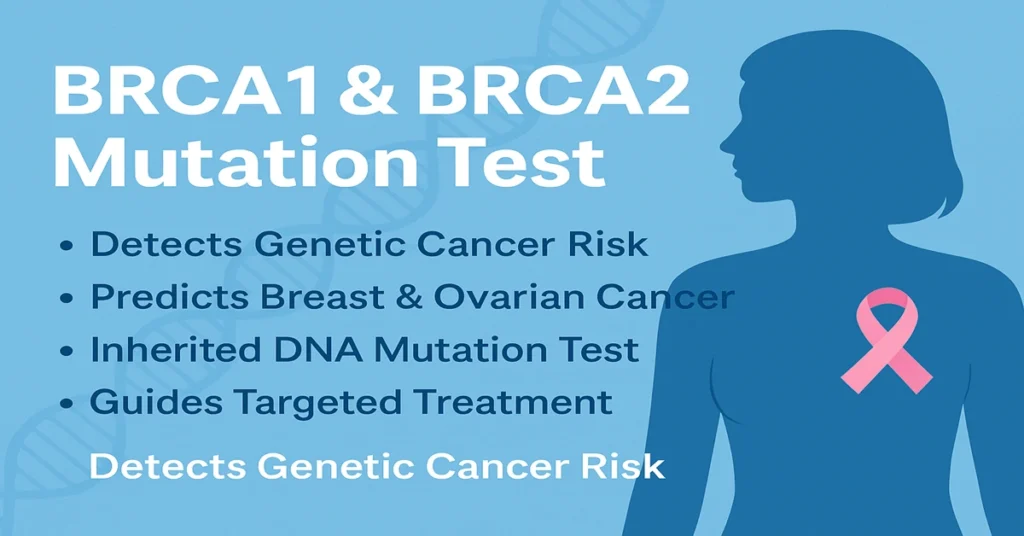
What is BRCA1 & BRCA2 Mutation Test?
The BRCA1 and BRCA2 mutation test is a genetic test used to look for harmful changes (mutations) in the BRCA1 and BRCA2 genes. Under normal circumstances, these genes help repair damaged DNA and keep cell growth under control, acting as a natural defense against cancer development.
When a person inherits a faulty version of either gene, that protective repair mechanism becomes weaker. Over time, this increases the likelihood of certain cancers, most notably breast and ovarian cancer, but also prostate and pancreatic cancers. Importantly, these mutations can be carried by both women and men and can be passed down from either parent.
In clinical practice, this test is most often recommended for individuals with a strong family history of cancer, cancers occurring at a younger-than-usual age, or specific cancer patterns that suggest an inherited risk.
Where BRCA Genes Are Found in the Body
BRCA1 and BRCA2 are part of a person’s genetic makeup and are present in every cell of the body from birth. They are inherited genes, not something the body produces later in life.
From a genetic standpoint, the BRCA1 gene is located on chromosome 17, while the BRCA2 gene sits on chromosome 13. Both function as tumor suppressor genes, meaning their role is to prevent cells from dividing in an uncontrolled way.
When one of these genes carries a mutation, its ability to repair DNA damage is reduced. Over many years, this can allow genetic errors to accumulate inside cells, increasing the chance that cancer may eventually develop.
Main Functions and Importance of BRCA1 & BRCA2 Genes
The primary role of BRCA1 and BRCA2 is DNA repair. Every day, cells experience small amounts of DNA damage, and these genes help fix those breaks accurately, preserving genetic stability.
They also play a key role in suppressing tumor formation by regulating how cells grow and divide. When these protective functions are impaired by a mutation, cancer risk increases—not immediately, but gradually over a lifetime.
From a medical perspective, identifying a BRCA mutation allows doctors to recognize people who have an inherited cancer risk before disease appears. This information supports early surveillance, structured screening plans, and informed long-term decision-making.
In patients who already have cancer, BRCA status can also influence treatment planning, as certain targeted therapies work specifically well in cancers linked to BRCA mutations.
Causes of Low or Negative Results
A negative BRCA test result means that no known harmful mutation was identified in the BRCA1 or BRCA2 genes.
This can occur because the individual truly does not carry a BRCA mutation, or because the cancer risk in the family is related to other genetic factors not covered by this test. It is also important to remember that many cancers develop due to age, hormonal factors, or environmental influences rather than inherited gene changes.
Symptoms or Implications of a Low/Negative Result
A negative result generally suggests that there is no inherited BRCA-related increase in cancer risk. In most cases, the individual’s risk is considered similar to that of the general population.
However, a negative result does not mean cancer can never occur. Routine cancer screening appropriate for age and sex is still important. In families with a very strong cancer history, doctors may still recommend broader genetic testing or closer follow-up, even when BRCA testing is negative.
Causes of High or Positive Results
A positive BRCA test result indicates that a pathogenic (harmful) mutation has been identified in either the BRCA1 or BRCA2 gene.
This mutation interferes with normal DNA repair mechanisms. Over time, cells with unrepaired damage may grow abnormally, increasing the lifetime risk of certain cancers. The degree of risk varies depending on the specific gene involved, family history, and individual factors.
Clinically, a positive result does not mean cancer is present—it means there is an increased susceptibility that requires careful long-term planning and monitoring.
Symptoms or Implications of High/Positive Result
BRCA mutations themselves do not cause symptoms. A person can feel completely healthy while carrying the mutation.
The importance of a positive result lies in its implications. Carriers often develop cancers at a younger age than usual and may see similar cancers affecting close relatives. Knowing this risk early allows for structured screening, timely detection, and informed medical decisions.
A positive result also has implications for family members, who may benefit from genetic counseling and testing to understand their own risk.
Understanding “Variant of Uncertain Significance (VUS)”
Sometimes, testing identifies a change in the BRCA gene that cannot yet be clearly classified as harmful or harmless. This is called a Variant of Uncertain Significance (VUS).
A VUS does not confirm increased cancer risk and should not be treated the same as a positive result. Over time, as more data becomes available, these variants may be reclassified. Doctors usually base medical decisions on personal and family history rather than the VUS alone.
Reference Ranges
BRCA testing does not use numeric reference ranges like routine blood tests. Instead, results are interpreted qualitatively:
- Negative: No known harmful BRCA mutation detected
- Positive: Pathogenic BRCA1 or BRCA2 mutation detected
- VUS: A genetic change detected, but its clinical significance is unclear
Each result type requires a different level of follow-up and discussion.
Sample Type and Testing Method
The test is performed on DNA, which can be obtained from a blood sample or, in some cases, a saliva sample. DNA is extracted and analyzed in a specialized genetic laboratory.
Modern testing most commonly uses next-generation sequencing (NGS), which allows detailed analysis of the BRCA1 and BRCA2 genes, including small mutations as well as larger structural changes.
Once analysis is complete, results are reviewed and explained—ideally with the support of a trained genetic counselor.
Test Preparation
No fasting or special preparation is required for BRCA testing. What matters most is accurate clinical information.
Patients are usually asked about their personal cancer history and detailed family history before testing. Genetic counseling before and after the test is strongly recommended to ensure results are correctly understood and applied.
When to Consult a Doctor or Genetic Counselor
You should consider discussing BRCA testing with a doctor or genetic counselor if you have a strong family history of breast, ovarian, prostate, or pancreatic cancer, or if cancers in the family occurred at a young age.
Consultation is also advised if there is a known BRCA mutation in the family, or if you have been diagnosed with certain types of cancer that are commonly linked to BRCA mutations.
If the test result is positive, genetic counseling is essential to understand long-term risk, screening strategies, and implications for close relatives.
Important Word Explanations
- BRCA1 / BRCA2 Genes: Genes involved in DNA repair and cancer prevention.
- Mutation: A permanent change in a gene that may affect its function.
- Tumor Suppressor Gene: A gene that helps prevent uncontrolled cell growth.
- Genetic Counseling: Professional guidance to understand genetic test results and inherited risks.
- PARP Inhibitors: Targeted cancer treatments effective in some BRCA-related cancers.
- VUS (Variant of Uncertain Significance): A genetic change whose health impact is not yet clearly known.
~END~
Related Posts
None found