
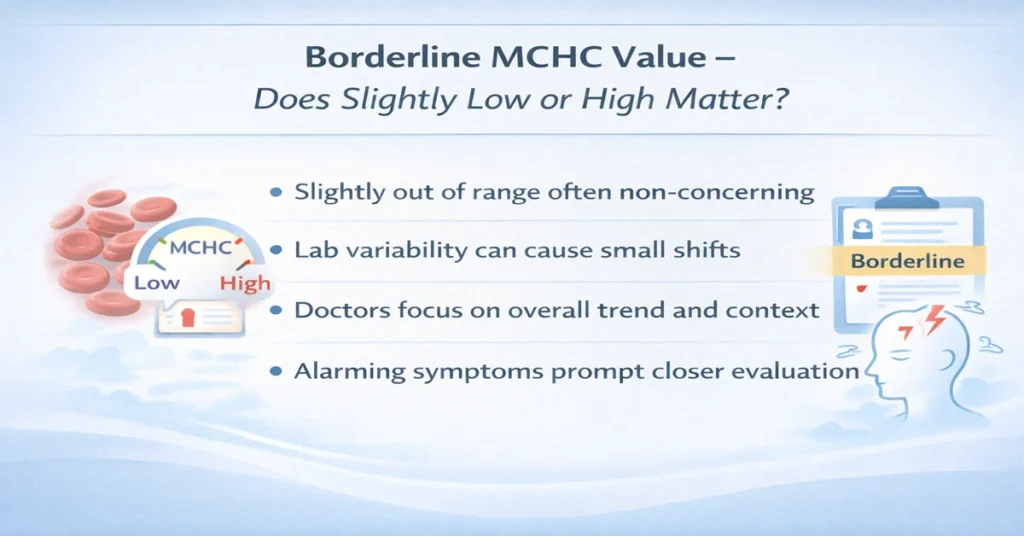
Borderline MCHC Value – Does Slightly Low or High Matter?
This is a question I hear very often in OPD and routine health checkups. A patient looks at the CBC report and says,
“MCHC is just a little low… or slightly high. Doctor, is this a problem?”
From more than 10 years of real hospital and diagnostic lab experience, I want to say this clearly right at the beginning:
A borderline MCHC value is very common, and in most routine cases, it does not indicate a serious problem.
This article is written only to explain this exact confusion—what it means when MCHC is slightly low or slightly high, and how doctors actually interpret it in real practice.
I’ll explain this calmly, the same way I explain it to patients sitting across the lab table.
Why Borderline MCHC Causes Confusion
Most people are familiar with hemoglobin, but MCHC is not a value they usually track. When it falls just outside the reference range, even by a small amount, it creates unnecessary worry.
The main reason for confusion is this:
- People assume any “low” or “high” value means disease
- But MCHC is a sensitive parameter and can shift slightly for many harmless reasons
In daily lab work, borderline MCHC values are seen very frequently, even in healthy individuals.
What a Borderline MCHC Value Means in Simple Words
MCHC tells us how concentrated hemoglobin is inside each red blood cell.
A borderline value means:
- The concentration is just a little lower or higher than average
- Red blood cells are still functioning normally
- Oxygen delivery is usually unaffected
In simple terms:
Your red blood cells are carrying hemoglobin in a slightly different concentration, but the body is still working normally.
Doctors never look at MCHC alone to make decisions.
Why MCHC Can Be Slightly Low or Slightly High
1. Normal Biological Variation (Most Common Reason)
This is the most common and most harmless reason.
From lab experience:
- MCHC can vary slightly from one test to another
- Even when the person is completely healthy
This happens because:
- Red blood cells are constantly being renewed
- Newer and older cells mix in circulation
- The “average concentration” can shift a little
Clinically, doctors accept small changes as normal physiology.
2. Hydration Status on the Day of Testing
This is something patients often overlook.
From OPD observations:
- Mild overhydration → MCHC may look slightly low
- Mild dehydration → MCHC may appear slightly high
These changes are temporary and reversible.
They do not indicate disease.
3. Early or Borderline Nutritional Changes
In some patients:
- Iron-related changes
- Minor nutritional imbalance
May begin affecting red blood cell hemoglobin concentration before hemoglobin itself changes.
At this stage:
- MCHC may shift slightly
- Hemoglobin remains normal
- Patient feels fine
Doctors usually observe rather than treat.
4. Recovery Phase After Illness or Anemia
I often see borderline MCHC values in patients who are:
- Recovering from illness
- Recovering from anemia
- Recently treated for nutritional deficiency
During recovery:
- New red blood cells are produced
- Hemoglobin concentration inside cells stabilizes gradually
A borderline value here is often a sign of adjustment, not a problem.
5. Lab Calculation and Technical Factors
MCHC is a calculated parameter, not directly measured.
Small changes in:
- Hemoglobin
- Hematocrit
- Sample handling
- Instrument calibration
Can slightly affect MCHC.
That’s why doctors focus more on trends than on a single borderline number.
When a Borderline MCHC Value Is Usually Harmless
In routine clinical practice, doctors are usually not concerned when:
- MCHC is only slightly low or high
- Hemoglobin is stable
- The patient has no symptoms
- Other CBC values are within acceptable limits
- This is an incidental finding during routine testing
In these situations, doctors often say:
“This variation is acceptable. No treatment needed.”
And that is usually correct.
When Doctors Pay More Attention
Doctors start paying closer attention if:
- Borderline MCHC keeps drifting further away over time
- Hemoglobin also starts falling or rising abnormally
- MCV and MCH show consistent changes
- The patient has symptoms like fatigue, weakness, or paleness
- There is a known history of anemia or nutritional deficiency
Even then, the approach is gradual and thoughtful, not urgent.
How Doctors Actually Interpret Borderline MCHC
In real hospital practice, doctors don’t ask:
“Is MCHC slightly high or low?”
They ask:
- Is this a one-time finding or a trend?
- Is hemoglobin stable?
- Does the patient have symptoms?
- What do previous reports show?
From experience:
A borderline MCHC value alone almost never changes treatment decisions.
Doctors treat patients, not decimal points.
Does Borderline MCHC Mean a Disease Is Starting?
In most routine cases, no.
Many people show:
- Borderline MCHC for years
- Normal hemoglobin
- No symptoms
- No progression to disease
Doctors only become concerned when:
- The change is progressive
- Other parameters support a pattern
- Symptoms appear
Otherwise, it is considered normal variation.
Is Borderline MCHC the Same as Anemia?
No.
This is a very important point.
Anemia is defined mainly by hemoglobin, not MCHC.
From lab experience:
- Many patients with borderline MCHC never develop anemia
- MCHC changes often come and go without consequence
That’s why doctors rarely label borderline MCHC as anemia.
Is Repeat Testing Always Needed?
No. Repeat testing is not automatic.
From OPD and lab practice:
- Healthy patient + borderline MCHC → repeat during next routine check
- No symptoms → observation only
- Symptoms or worsening trend → repeat sooner if advised
Doctors decide based on clinical sense, not anxiety.
Why Focusing Too Much on Borderline Values Causes Stress
One common mistake patients make is:
- Comparing every report line-by-line
- Expecting exact same values every time
Blood values naturally fluctuate.
In real clinical practice:
- Small, isolated variations are ignored
- Only consistent trends matter
Understanding this prevents unnecessary worry.
What Borderline MCHC Does Not Automatically Mean
Let me be very clear from experience:
- It does not automatically mean anemia
- It does not mean iron deficiency
- It does not mean serious blood disorder
- It does not mean treatment is required
It usually means:
The body is adjusting normally.
Test Preparation
To reduce unnecessary variation in MCHC:
- Stay normally hydrated (not excessive)
- Avoid heavy exercise just before testing
- Avoid alcohol 24 hours before the test
- Inform the lab about recent illness
- Use the same lab for follow-up tests if possible
These steps help ensure consistent results.
When to Consult a Doctor
Consult a doctor if:
- Borderline MCHC keeps moving further away over time
- Hemoglobin starts dropping or rising abnormally
- You feel persistent fatigue, weakness, or dizziness
- Other CBC values also change significantly
- Your doctor recommends follow-up based on history
If you feel well, reassurance is usually enough.
Important Word Explanations
MCHC (Mean Corpuscular Hemoglobin Concentration):
Measures how concentrated hemoglobin is inside red blood cells.
Borderline Value:
A result that is very close to the reference range limit.
CBC (Complete Blood Count):
A blood test that evaluates red cells, white cells, and platelets.
Trend:
A consistent pattern seen over multiple test reports.
Physiological Variation:
Normal changes in the body that are not due to disease.
People Also Ask
Is a borderline MCHC value normal?
Yes. It is very common and often harmless.
Should MCHC always stay exactly the same?
No. Small fluctuations are normal.
Does borderline MCHC mean anemia will develop?
Not necessarily. Many people never develop anemia.
Should I repeat the test immediately?
Only if advised by your doctor or if symptoms appear.
Can hydration affect MCHC?
Yes. Mild dehydration or overhydration can influence results.
~END~